
For individual owners and families managing multiple homes or vacation properties, Mypropertycommandcenter is the strongest AppFolio alternative: it's built specifically for self-managers who want clarity and reminders, not enterprise-grade complexity. AppFolio targets professional property managers with 50+ units, so most of its pricing and feature weight lands in the wrong place for a family juggling three homes and a vacation rental.
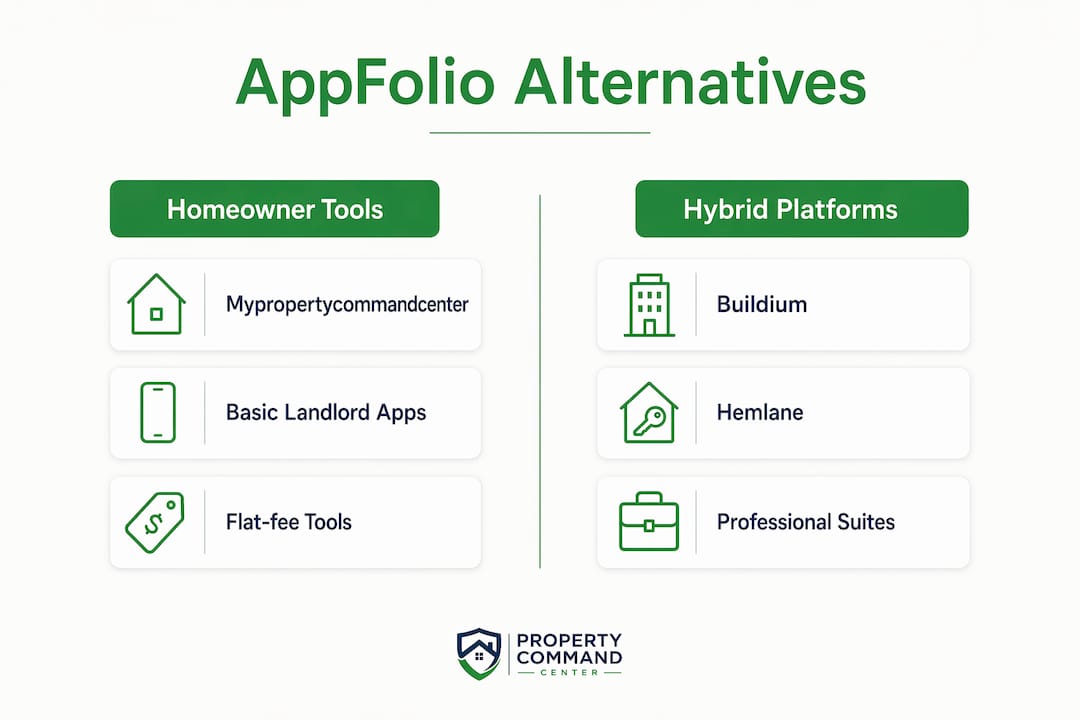
Here's where the best AppFolio competitors land for this audience:
- Mypropertycommandcenter — best for multi-home owners and families who want a clean dashboard, maintenance tracking, and a vendor directory without tenant-management overhead
- Entry-level landlord apps (Avail, TenantCloud) — best for owners who also collect rent and need basic tenant screening and lease tools
- Flat-fee multi-home tools (Rentec Direct, SimplifyEm) — best for small landlords who want predictable monthly costs and simple accounting
- Hybrid management platforms (Buildium, Hemlane) — best for owners who want optional professional management support alongside self-management
All four categories offer free trials or demos. Gartner Peer Insights lists verified user reviews across these categories, and PCI-compliant payment processing is a standard feature to confirm before committing to any platform.
Table of Contents
- How do these AppFolio alternatives compare side by side?
- Profiles of the top alternatives and who they actually fit
- How to choose the right AppFolio alternative for your multi-home needs
- Switching from AppFolio: migration and onboarding checklist
- Why Mypropertycommandcenter is a top pick for owners and families
- What do users say about these platforms?
- How well do these tools integrate with accounting and other software?
- How does customer support compare across these platforms?
- What happens when your portfolio grows?
- How do these platforms handle data security and privacy?
- Key Takeaways
- The software choice most homeowners get wrong
- Mypropertycommandcenter: built for owners, not managers
- Useful sources and further reading
How do these AppFolio alternatives compare side by side?
| Dimension | Mypropertycommandcenter | Entry-level landlord apps | Flat-fee multi-home tools | Hybrid management platforms |
|---|---|---|---|---|
| Best for | Owners & families, multi-home/vacation | Small landlords, rent + screening | Budget-conscious landlords | Owners wanting optional pro support |
| Pricing model | Tiered monthly by property count | Per-unit or flat tier | Flat monthly tier | Per-unit, often higher base |
| Starting price | Low monthly tier; see pricing page | Low per-unit | Low flat rate | Moderate to high |
| Free trial | Yes, 14-day, no credit card | Varies (free tier or trial) | Trial available | Demo or trial |
| Online payments / PCI | PCI-compliant payment flow | Yes, with add-ons | Yes | Yes |
| Maintenance tracking | Yes, with scheduling & reminders | Basic | Basic | Full work-order system |
| Vendor directory | Yes, built-in | Limited | Limited | Yes |
| Tenant screening | Not the focus | Yes | Yes | Yes |
| Accounting / reporting | Task and property reporting | Basic | Full ledger | Full accounting |
| Short-term rental support | Yes | Limited | Limited | Varies |
| Mobile app | Yes | Yes | Yes | Yes |
| Onboarding support | Guided onboarding resources | Self-serve | Self-serve | Onboarding team |
Key tradeoffs to know:
- Mypropertycommandcenter skips tenant-management complexity, which is exactly right if you don't need rent collection built into the same tool
- Entry-level landlord apps are cheap per unit but charge add-on fees for payment processing and screening, so the real monthly cost climbs fast
- Flat-fee tools offer predictable billing but often lack short-term rental or vacation-home features
- Hybrid platforms give you the most features but come with the steepest learning curve and price
Profiles of the top alternatives and who they actually fit
Mypropertycommandcenter
Built for owners and families, not professional managers. The property dashboard consolidates status across all your homes in one view, so you're not hunting through emails or spreadsheets to find out when the HVAC filter was last changed. Core features include maintenance scheduling, a vendor contact directory, a document vault for warranties and insurance, task reminders, and cross-property alerts.

Pricing: Tiered monthly subscription by property count; 14-day free trial, no credit card required. Pro: Purpose-built for the homeowner use case — vacation rentals, multi-home families, short-term rentals all supported. Con: Not the right tool if rent collection and tenant screening are your primary need.
Entry-level landlord apps (Avail, TenantCloud)
These platforms handle the landlord basics: online rent collection, lease templates, maintenance requests, and tenant screening. They work well for owners who rent out one or two properties and want everything in one place. Pricing usually starts low per unit, but payment processing and screening reports are add-ons.
Pro: Covers the full landlord workflow at a low entry price. Con: Feature depth can feel like overkill for vacation-home owners who don't manage tenants month to month.
Flat-fee multi-home tools (Rentec Direct, SimplifyEm)
Flat monthly pricing makes budgeting easy. These tools lean toward accounting and rent tracking, with basic maintenance request features. Good for owners who want a simple ledger and don't need a vendor directory or document vault.
Pro: Predictable cost, solid accounting. Con: Short-term rental and vacation-home features are thin or absent.
Hybrid management platforms (Buildium, Hemlane)
Buildium and Hemlane sit between DIY software and a full property management company. Hemlane, in particular, lets you add local agent support on demand. The tradeoff is complexity and cost.
Pro: Scales well if your portfolio grows toward professional management territory. Con: Steeper learning curve and higher price than most individual owners need.
Pricing note: Alternatives differ by pricing model — per-unit (per door), flat monthly tiers, or base subscriptions with paid add-ons for payments and screening. Always calculate your real monthly cost at your actual property count before committing.
Pro Tip: Run the numbers at your current property count AND at double that. A per-unit plan that looks cheap at three properties can cost more than a flat-tier plan at six.
How to choose the right AppFolio alternative for your multi-home needs
Start with these questions before you sign up for anything:
- How many properties do you manage? Per-unit pricing favors small portfolios; flat tiers pay off at five or more.
- What's your rental mix? Long-term tenants need lease and screening tools. Vacation rentals need calendar and short-stay support.
- Do you collect rent through the software? If yes, confirm PCI-compliant payment processing is included, not an add-on.
- How complex is your maintenance workflow? A vendor directory and scheduled reminders matter more than a full work-order system for most homeowners.
- Do you need accounting? Basic expense tracking vs. a full general ledger are very different things.
- Who else needs access? Family members or a co-owner need simple navigation, not a training manual.
- What's your budget tolerance? Add up the base fee plus payment processing, screening, and any per-property charges.
Questions to ask during a trial or demo: What are support hours and response times? Does the platform help with data migration? Can you export all your data as a CSV? Are there fees for canceling or exporting?
Red flags: No transparent pricing page, no named payment security standard, no data export option, and no onboarding documentation. Gartner and market writeups consistently flag service and support quality as a top decision driver, especially for owners without in-house IT.
Switching from AppFolio: migration and onboarding checklist
A clean migration takes one to four weeks for a small portfolio, depending on how much data you're moving.
- Audit what you have. Export from AppFolio: tenant and contact lists, lease start/end dates, payment history, vendor records, and all documents (warranties, insurance, manuals).
- Map your fields. Match AppFolio's data fields to the new platform's structure before importing anything.
- Pilot with one or two properties. Load a single property first, test every workflow, and confirm alerts and reminders fire correctly.
- Notify tenants and vendors. Tell them about any new payment portal or contact method at least two weeks before go-live.
- Go live on the full portfolio. Once the pilot is clean, migrate the rest.
- Keep AppFolio read-only for 30 days. You'll almost certainly need to look something up. Don't cancel access until you're confident nothing is missing.
Timeline: Simple portfolios (three to five properties, no complex accounting) typically migrate in one to two weeks. Larger or more complex setups can take up to four weeks, especially if you're cleaning up old data along the way.
Pro Tip: Export everything as CSVs before you do anything else. Even if the new platform has an import tool, having raw CSVs means you're never locked out of your own data.
Why Mypropertycommandcenter is a top pick for owners and families
Most property management software was designed for professional managers running 50 to 500 units. Mypropertycommandcenter was built for the opposite end of the market: the family with a primary home, a lake house, and maybe a short-term rental, who just wants to stay organized without hiring a manager.
The features map directly to what homeowners actually need:
- Simple dashboard showing status across all properties at a glance
- Maintenance scheduling and reminders so nothing slips through
- Vendor directory with contacts organized by property and trade
- Document vault for warranties, manuals, and insurance policies
- Task tracking with ownership assigned so family members or vendors know what's theirs
- Cross-property alerts that catch issues before they become expensive
The outcomes are practical: fewer missed maintenance windows, no more digging through email threads to find a contractor's number, and a single place to hand off information when a family member needs to step in. Start with the 14-day free trial to see how it fits your portfolio.
What do users say about these platforms?
Gartner Peer Insights aggregates verified user reviews for AppFolio and its alternatives, covering evaluation criteria like product capabilities, integration and deployment, and service and support. Buyers consistently flag support responsiveness and onboarding experience as the factors that make or break a switch, not feature lists.
Capterra and G2 carry reviews for the entry-level and flat-fee tools. The pattern across platforms is consistent: owners with smaller portfolios rate ease of use and quick setup highest, while owners who tried enterprise-grade platforms report frustration with features they never needed and training time they didn't have.
For Mypropertycommandcenter specifically, the homeowner-first design means the learning curve is short. The onboarding resources are built for self-starters, not IT teams.
How well do these tools integrate with accounting and other software?
Integration depth varies sharply by category. Hybrid platforms like Buildium typically connect with QuickBooks and offer built-in general ledgers. Entry-level landlord apps often sync with QuickBooks Online or export to CSV for manual import. Flat-fee tools usually cover basic accounting internally without external integrations.
CB Insights notes that the AppFolio competitive set includes platforms focused on payroll and accounting synchronization, resident operations automation, and partnership enablement. That range reflects how differently these tools are built.
For homeowners who use a separate accountant or tax software, the most practical question is: can you export a clean transaction report? Most platforms can. The ones that can't are a red flag.
Mypropertycommandcenter focuses on property organization rather than full accounting, which keeps the interface clean. If you need a full general ledger, pair it with QuickBooks or a similar tool.
How does customer support compare across these platforms?
Support quality is where the real differences show up. Enterprise platforms typically offer phone, email, and chat during business hours, with dedicated onboarding teams. Entry-level and flat-fee tools lean on email and help centers, with response times ranging from a few hours to a day or two.
Gartner's research consistently shows that buyers, especially smaller owners without in-house IT, weight service and support as heavily as feature parity when choosing a replacement. A platform with slightly fewer features but fast, knowledgeable support often wins in practice.
Before committing, test support during your trial. Send a question and time the response. Check whether the help documentation covers your specific use case (vacation rentals, multi-home families) or is written entirely for professional managers.
What happens when your portfolio grows?
Most homeowners start with two or three properties and add more over time. The software that works at three properties should still work at eight without requiring a platform migration.
CB Insights and Gartner both show the AppFolio competitive set spans from homeowner dashboards to enterprise suites, which means there's a natural upgrade path if you eventually cross into professional management territory. The practical question is whether your current platform can grow with you or whether you'll hit a ceiling.
Mypropertycommandcenter scales by property count within its tiered model. Entry-level landlord apps scale reasonably well up to 10–20 units. Flat-fee tools often have a unit cap before pricing jumps. Hybrid platforms are built for growth but charge accordingly from the start.
How do these platforms handle data security and privacy?
PCI compliance for payment processing is the baseline standard to confirm. Any platform that handles online rent collection should be able to name its payment security standard explicitly. If it can't, that's a red flag.
Beyond payments, look for data encryption in transit and at rest, clear data ownership language in the terms of service (your data is yours, not theirs), and an explicit data export option so you're never locked in. Privacy policies should state clearly whether your data is shared with third parties.
Mypropertycommandcenter's payment flow is built around PCI-compliant processing. For document storage, the platform keeps your warranties, manuals, and insurance records in a private vault tied to your account.
Key Takeaways
For individual owners and families, the best AppFolio alternative is the one that matches your rental mix and property count without charging you for features built for professional managers.
| Point | Details |
|---|---|
| Match the tool to your use case | Homeowner dashboards, landlord apps, and hybrid platforms solve different problems — pick by rental type, not brand name. |
| Always trial with real data | Load one actual property during the free trial to test alerts, maintenance tracking, and document storage before committing. |
| Verify PCI compliance and data export | Confirm payment security standards and CSV export before signing up — both are red flags if absent. |
| Plan a staged migration | Pilot one or two properties first, keep the old system read-only for 30 days, and migrate the full portfolio only after the pilot is clean. |
| Mypropertycommandcenter fits owners and families | Its tiered monthly plan, 14-day free trial, and homeowner-first dashboard make it the practical starting point for multi-home self-managers. |
The software choice most homeowners get wrong
Most people searching for AppFolio alternatives assume they need to replace it with something equally complex. They don't. AppFolio is a professional management platform. If you're a homeowner or a family managing a handful of properties, you were probably using about 20% of its features and paying for the rest.
The smarter move is to ask what you actually use every week: maintenance reminders, vendor contacts, document storage, and a way to see all your properties at once. That's a homeowner dashboard, not a property management suite. Platforms built for professional managers will always feel like too much, because they are.
Verified review platforms like Gartner Peer Insights are worth checking before you finalize a choice. Real users describe onboarding experiences and support quality in ways that no feature list captures. A platform that looks perfect on paper but takes three weeks to set up and has slow support will cost you more in time than it saves in money.
Mypropertycommandcenter: built for owners, not managers
If the profiles above confirmed that you need a homeowner-first tool rather than a scaled-down professional platform, Mypropertycommandcenter is the direct answer. You get a clean multi-property dashboard, maintenance scheduling, a vendor directory, document storage, and cross-property alerts, all without the tenant-management overhead that inflates cost and complexity on other platforms.
The 14-day free trial requires no credit card. You can load your properties, test the alerts and task reminders, and decide with real data rather than a sales demo.
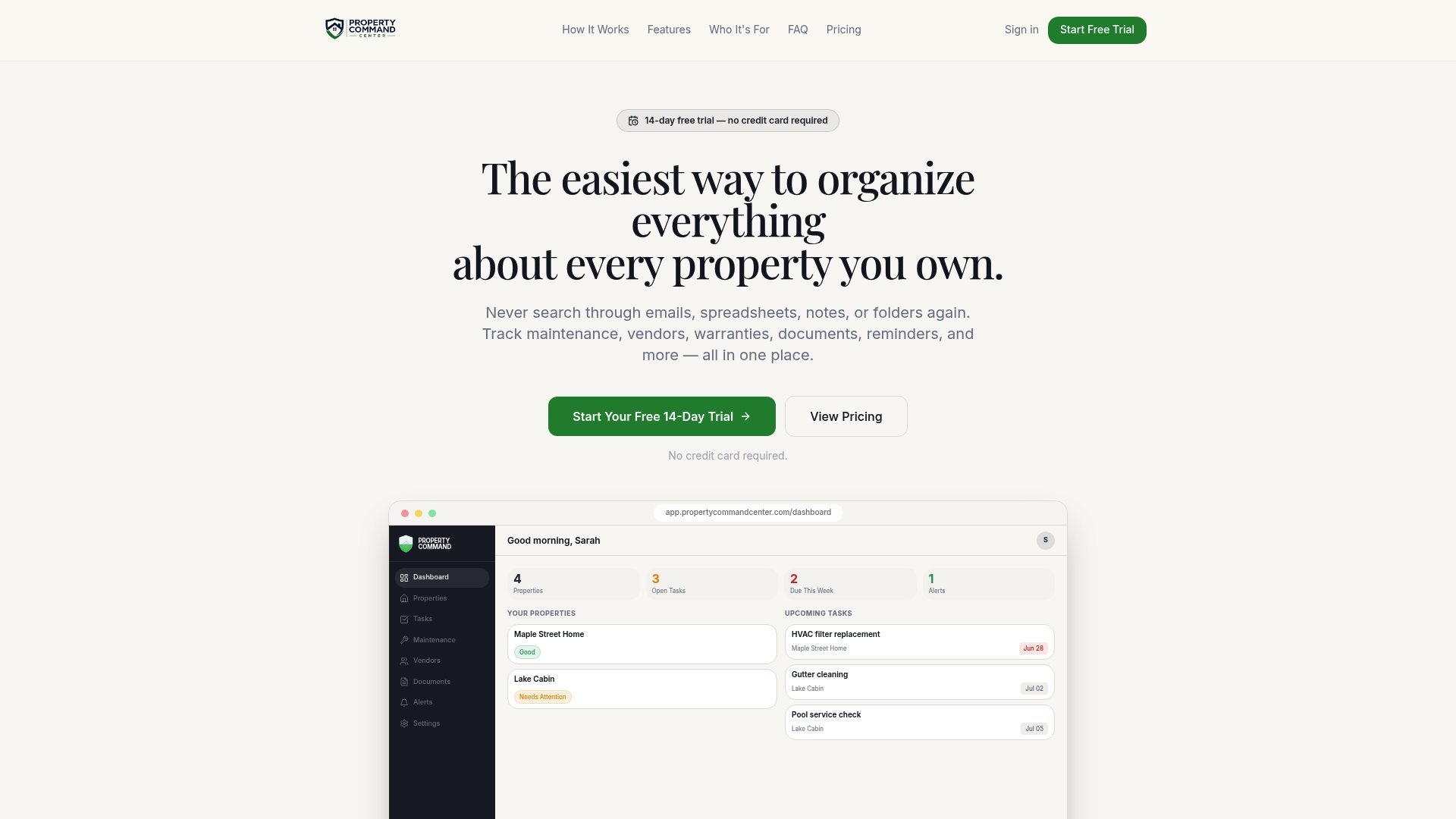
Start with the pricing page to see which tier fits your property count, then walk through the onboarding guide to get your first property set up in under an hour. If you have questions before signing up, the property query page connects you directly with the team.
Useful sources and further reading
- Gartner Peer Insights: AppFolio Alternatives 2026 — verified user reviews and evaluation criteria buyers use when comparing property management software
- CB Insights: AppFolio Alternatives and Competitors — market intelligence on the competitive set, including category breakdowns (accounting-first, resident operations, automation)
- 6sense: AppFolio Market Share and Competitor Insights — market-share context explaining why multiple niche alternatives coexist alongside dominant platforms
- Mypropertycommandcenter Pricing — subscription tiers by property count
- Mypropertycommandcenter Onboarding — step-by-step setup resources for new users
- Mypropertycommandcenter Vendors — vendor directory and coordination features