
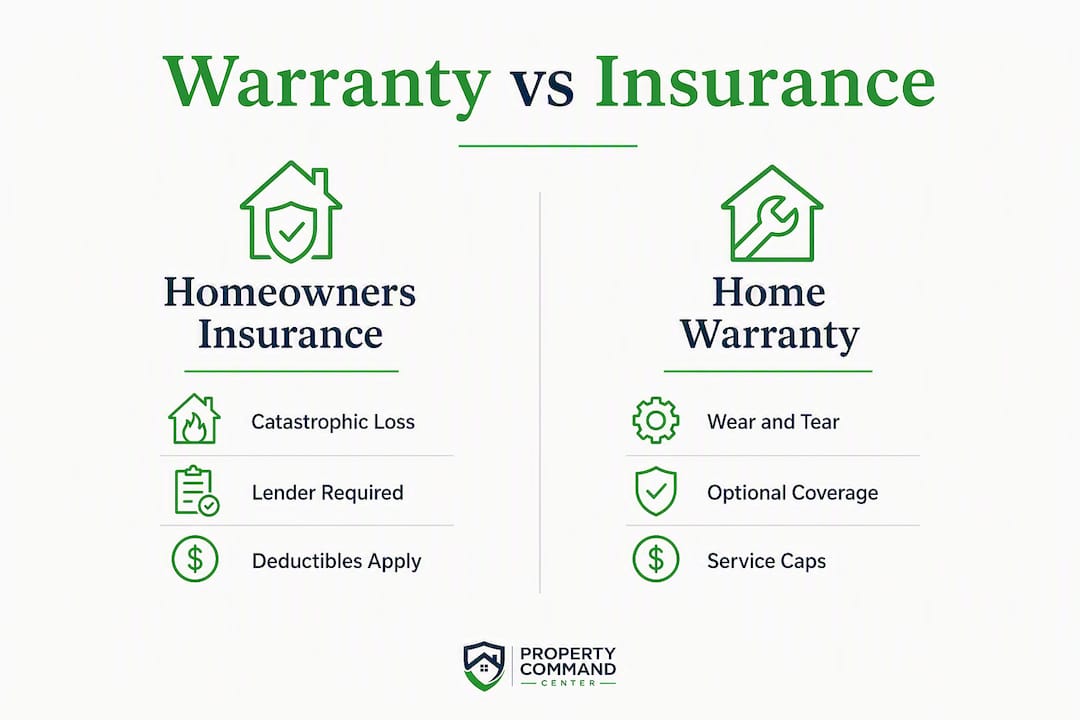
Homeowners insurance is essential — it protects your dwelling, personal property, and liability against sudden, catastrophic events. A home warranty is optional, covering appliance and system repairs from normal wear and tear. For owners juggling multiple properties, the single most consequential contract detail is the HVAC coverage cap, which can vary from $1,500 to $6,500 per unit depending on the provider and plan.
Before you read further, here are the three moves that matter most:
- Verify active homeowners insurance on every property you own — mortgage lenders require it, and no warranty replaces it.
- Pull your warranty contract and find the HVAC cap before your next renewal.
- Upload both documents to a centralized dashboard so you can track them without digging through email.
Table of Contents
- What's the real difference between a home warranty and insurance?
- When do you need insurance, a warranty, or both?
- What does homeowners insurance actually cover?
- What does a home warranty actually cover?
- How do warranty and insurance claims actually work?
- How do you compare policies and warranty contracts across multiple homes?
- Key Takeaways
- The case for treating coverage like a portfolio, not a checklist
- Mypropertycommandcenter keeps your coverage organized across every property
- Useful sources for U.S. homeowners
What's the real difference between a home warranty and insurance?
The table below maps the core dimensions side by side. Read the HVAC cap row carefully — it is where most multi-property owners get surprised.
| Dimension | Homeowners Insurance | Home Warranty |
|---|---|---|
| Purpose | Catastrophic safety net for sudden, accidental loss | Maintenance smoothing for wear-and-tear repairs |
| What's covered | Dwelling, other structures, personal property, liability, additional living expenses | HVAC, plumbing, electrical, water heater, appliances; optional add-ons (pool, septic) |
| Cost structure | Annual premium — deductible per claim | Annual contract fee ($300–$700 per year) plus a service fee ($60–$150 per visit) |
| Out-of-pocket at service | Deductible (often $500) | Service fee charged per visit plus any amount above coverage cap |
| Claims & response | File claim, adjuster dispatched, estimate approved, payout issued | Call provider, technician dispatched from vendor network, repair or replacement authorized |
| Exclusions & caps | Floods, earthquakes, sewer backup, wear and tear | Pre-existing conditions, improper prior repairs, HVAC caps ($1,500–$6,500), per-item limits |
| Best for | Every homeowner — required by lenders | Owners of older homes, aging systems, or tight emergency funds |
Cost figures sourced from Experian's home warranty vs. insurance breakdown.
Concrete examples sharpen the distinction fast. A roof fire? Insurance. A failed water heater from years of sediment buildup? Warranty. A burst pipe from a sudden freeze? Insurance. A dishwasher motor that gave out after eight years of use? Warranty — assuming you have maintenance records.
Pro Tip: The HVAC cap is the single most important number in any warranty contract. A cap of $1,500 on a system that costs $6,000 to replace leaves you holding a $4,500 bill after a "covered" claim. For multi-property owners, multiply that gap across three or four homes and the math gets painful fast. Always confirm the cap before signing.

When do you need insurance, a warranty, or both?
Not every property has the same risk profile. Here is how to think through the decision property by property.
- New homeowner, recently built home. Buy insurance immediately — your lender requires it. Skip the warranty for now; new construction typically includes builder warranties, and appliances carry manufacturer coverage for at least a year.
- Aging home with HVAC systems over 10 years old. Insurance stays non-negotiable. A warranty makes real sense here: older systems fail more often, and a $500 annual contract beats a $6,000 surprise replacement.
- Vacation home with long gaps between visits. Both. Insurance covers storm or fire damage while you are away. A warranty with a responsive vendor network catches slow-developing system failures before they become structural problems.
- Short-term rental property. Check your insurance policy first — standard homeowners policies often exclude commercial activity. You may need a landlord or short-term rental endorsement. A warranty can help with the higher appliance turnover that comes with frequent guests.
- Owner with a healthy emergency fund ($15,000+). Insurance is still mandatory. The warranty becomes optional: you can self-insure routine repairs and skip the service-fee friction.
Mortgage lenders require homeowners insurance as a loan condition — there is no workaround. On the resale side, listing agents sometimes recommend sellers offer a one-year warranty to buyers as a negotiating tool; it signals confidence in the home's systems and can reduce inspection-related price negotiations.
What does homeowners insurance actually cover?
Homeowners insurance is built around five standard coverage categories:
- Dwelling: The structure itself — walls, roof, foundation — against covered perils like fire, wind, and hail.
- Other structures: Detached garages, fences, and sheds.
- Personal property: Furniture, electronics, clothing, and valuables (subject to sub-limits for jewelry and art).
- Liability: Legal and medical costs if someone is injured on your property or you damage someone else's.
- Additional living expenses (ALE): Hotel and meal costs if your home is uninhabitable after a covered loss.
The cost model works like this: you pay an annual premium, and when you file a claim, you pay the deductible before insurance covers the rest. The deductible and the dwelling limit are the two numbers that determine your real out-of-pocket exposure in a disaster.
Standard policies exclude floods, earthquakes, sewer backup, and — critically — wear and tear. Those require separate policies or endorsements. Flood coverage runs through the National Flood Insurance Program or private carriers; earthquake coverage is a separate policy in most states.
Pro Tip: Multi-property owners often underinsure secondary homes. Check that each property's dwelling limit reflects current replacement cost, not purchase price — construction costs have risen sharply. Also confirm your liability limits across all properties; a single lawsuit can reach across your entire portfolio.
What does a home warranty actually cover?
Warranties cover the mechanical failure of systems and appliances from normal use. Typical inclusions:
- HVAC (heating and cooling systems)
- Plumbing and electrical systems
- Water heater
- Kitchen appliances: refrigerator, dishwasher, oven/range
- Washer and dryer
- Optional add-ons: pool equipment, septic system, well pump, roof leak repair
Here is what the math looks like in practice. Say your furnace fails in January. You call your warranty provider, pay a $75 service fee, and a technician is dispatched. The technician determines the heat exchanger needs replacement — total cost $2,800. Your warranty's HVAC cap is $1,500. You owe $75 (service fee) plus $1,300 (the gap above the cap): $1,375 out of pocket on a "covered" repair.
Watch for these contract traps before you sign: Improper prior repair clauses let providers deny claims if a previous technician's work — even years ago — is deemed substandard. Maintenance documentation requirements mean a missed annual HVAC tune-up can void coverage on that system entirely. And per-item caps on appliances (sometimes as low as $500) can make warranty payouts feel symbolic on a high-end refrigerator replacement. Read the exclusions section of any contract before the coverage summary.
How do warranty and insurance claims actually work?
The two processes feel similar on the surface but diverge in ways that matter.
Homeowners insurance claim workflow:
- Document the damage immediately with photos and a written description.
- File the claim online or by phone; note the claim number.
- An adjuster is dispatched (or a virtual assessment is scheduled) to evaluate the damage.
- The adjuster submits an estimate; the insurer approves, disputes, or requests additional documentation.
- You receive a payout minus your deductible, or the insurer pays a contractor directly.
Home warranty claim workflow:
- Call or submit a claim through the provider's portal; describe the failure.
- The provider dispatches a technician from its vendor network (you generally cannot choose your own contractor unless the plan includes a bring-your-own-contractor option).
- The technician diagnoses the problem and submits a repair or replacement recommendation.
- The provider approves or denies coverage based on the contract terms.
- Approved repairs proceed; you pay the service fee and any amount above the cap.
Common denial triggers for both products:
- Evidence of long-term neglect (rust, corrosion, mold from deferred maintenance)
- Missing maintenance records (no receipts for annual HVAC service, no plumbing inspection logs)
- Pre-existing conditions identified at the time of the claim
- Modifications that violate manufacturer specifications
Pro Tip: Store every maintenance receipt, technician note, and dated photo in one place — not a folder on your desktop, but somewhere you can pull it up on your phone at 9 PM when a claim is being disputed. Mypropertycommandcenter's document vault and maintenance log are built exactly for this: upload receipts as you go, and the evidence is there when you need it.
How do you compare policies and warranty contracts across multiple homes?
For multi-property owners, the cheapest plan is rarely the best plan. Inconsistent SLAs and low HVAC caps cost more across a portfolio than a slightly higher annual premium with reliable service.
Policy and contract checklist:
- Confirm dwelling limits reflect current replacement cost for each property
- Verify liability limits are adequate across all properties combined
- Check deductibles and any endorsements (flood, earthquake, sewer backup)
- Identify the HVAC cap and per-item appliance caps in every warranty contract
- Review exclusions and maintenance documentation requirements
- Confirm the vendor network covers your properties' zip codes
- Ask about bring-your-own-contractor options for rural or high-cost markets
- Check complaint volume and regulatory history before signing with any warranty provider
Questions to ask every warranty provider:
- What is the HVAC cap per unit, per year?
- What is the average technician dispatch time in my area?
- Does the plan allow me to use my own licensed contractor?
- What documentation do I need to keep to avoid a denial?
- What is your claim denial rate, and how do I appeal a denial?
Sample annual budget for one property (sourced ranges):
| Item | Low estimate | High estimate |
|---|---|---|
| Homeowners insurance premium | $1,000 | $2,000+ |
| Home warranty annual contract | $300 | $700 |
| Service fees (2–3 visits/year) | $120 | $450 |
| Total estimated annual cost | $1,420 | $3,150+ |
For a three-property portfolio, multiply the warranty and service-fee rows by three — the aggregate cost makes SLA consistency and HVAC caps far more important than saving $50 on the annual contract price.
Key Takeaways
Homeowners insurance is mandatory and covers catastrophic loss; a home warranty is optional and covers wear-and-tear repairs, but the HVAC cap determines whether it actually pays off.
| Point | Details |
|---|---|
| Insurance is non-negotiable | Lenders require it; no warranty substitutes for dwelling, liability, or catastrophic-loss coverage. |
| Warranty value depends on home age | Older systems (10+ years) make a warranty worthwhile; new appliances under manufacturer coverage usually don't. |
| HVAC cap is the key number | Caps range from $1,500 to $6,500 per unit — always verify before signing a warranty contract. |
| Documentation prevents denials | Missing maintenance records are the most common warranty denial trigger; keep dated receipts for every service visit. |
| Mypropertycommandcenter centralizes coverage | The platform's document vault, maintenance scheduler, and renewal alerts keep policies and records organized across all your properties. |
The case for treating coverage like a portfolio, not a checklist
Most homeowners treat insurance and warranties as separate purchases made at different times, filed in different places, and reviewed only when something breaks. That works fine for one home. For two or more, it falls apart.
The real risk for multi-property owners is not choosing the wrong plan — it is losing track of what each property has, when each contract renews, and whether the maintenance records exist to support a claim. A warranty denial on a $4,000 HVAC replacement is not just a financial hit; it is a paperwork failure that could have been prevented.
The conventional wisdom says "buy both and you're covered." That is incomplete. Buying both and managing both — knowing the caps, tracking the service visits, storing the receipts — is what actually reduces out-of-pocket exposure. The coverage is only as good as the documentation behind it.
Mypropertycommandcenter keeps your coverage organized across every property
Owning multiple homes means multiple insurance policies, multiple warranty contracts, multiple renewal dates, and multiple vendor relationships. Tracking all of that in scattered emails and spreadsheets is how claim denials happen — not because the coverage wasn't there, but because the proof wasn't.

Mypropertycommandcenter consolidates everything in one dashboard: a document vault for insurance and warranty contracts, a maintenance scheduler with automated renewal alerts, a vendor directory to store preferred contractors and their SLAs, and task tracking so no annual HVAC service gets skipped. When a claim comes in, your maintenance history is already organized and ready to submit.
No spreadsheets. No hunting through email threads. Start with a 14-day free trial — no credit card required — and set up your first property in minutes.
Useful sources for U.S. homeowners
- FTC Consumer Alert — So What's the Deal with Home Warranties?: Federal guidance on warranty contract traps, denial patterns, and consumer rights.
- Experian — Home Insurance vs. Home Warranty: Practical cost breakdowns and coverage comparisons for everyday homeowners.
- Redfin — Home Warranty vs. Home Insurance: Clear side-by-side feature comparison with lender-requirement context.
- NerdWallet — Best Home Warranties: Independent reviews covering coverage caps, service fees, and claim reliability across major providers.