
Short term rental compliance means satisfying every local, state, federal, HOA/lease, safety, tax, and platform rule that applies to each property you rent — and keeping those requirements current on a rolling basis. Three actions you can take today:
- Confirm your jurisdiction's registration or permit requirement. Search your city or county's official planning or development services page. Record the property-specific registration number the moment it's issued.
- Post that registration number on every public listing. Many U.S. cities now require hosts to display a valid, jurisdiction-specific number on all platforms. Name a local contact who can respond within the timeframe your ordinance specifies.
- Centralize renewal dates, registration documents, and tax filing deadlines in one place. A scattered spreadsheet works until it doesn't. Mypropertycommandcenter is built specifically to consolidate these tasks across multiple properties so nothing slips through.
The IRS, Airbnb, and your city government each have their own compliance clocks. The only way to stay ahead of all three is to treat this like recurring maintenance, not a one-time setup.
Table of Contents
- What short term rental compliance actually covers
- How to find the exact rules for each property
- Compliance checklist and timeline for one property and for multiple
- How platforms and cities enforce rules — and what's at stake
- Taxes every U.S. host needs to understand
- Systems for owners managing multiple short-term rentals
- Ready-to-use templates for listings, HOA inquiries, and applications
- Key Takeaways
- The compliance lesson most owners learn the hard way
- Mypropertycommandcenter keeps your compliance calendar from falling apart
- Authoritative sources and where to find primary guidance
What short term rental compliance actually covers
Every property you rent short-term sits at the intersection of several rule categories. Miss one and the consequences range from a fine to a suspended payout to a delisted account.
- Local STR registration or permit. Most cities require a property-specific certificate before you can list. Permits tie to the specific address; one certificate does not cover multiple units.
- Business license or tax certificate. Seattle, for example, requires an STR operator license and a business license tax certificate as a prerequisite. Many cities follow similar two-step logic.
- Occupancy and night caps. Washington, D.C.'s Short-Term Rental Regulation Act limits vacation rentals to no more than 90 nights per calendar year unless an exemption is granted.
- Zoning and land-use. Registration does not override zoning. If your parcel's zoning prohibits STRs, permit applications are often rejected automatically.
- HOA and lease restrictions. Even a valid municipal permit doesn't override a private covenant. Confirm HOA rules and lease terms in writing before listing.
- Safety and building code requirements. Smoke alarms, carbon monoxide detectors, and maximum occupancy limits are standard prerequisites in most jurisdictions.
- Insurance minimums. Arizona state law, for instance, requires liability coverage of at least $500,000 in the aggregate, or equivalent coverage through a platform.
- Platform listing display rules. Registration numbers must appear correctly formatted on every listing. Missing or incorrect numbers are a primary automated trigger for takedowns.
- Tax obligations. Occupancy taxes, sales taxes, and income reporting each carry separate requirements and deadlines.
How to find the exact rules for each property
Rules vary block by block in some cities, so go straight to the official source.
- Identify your municipal boundaries. Determine whether your property falls under city or county jurisdiction — they sometimes overlap, and the wrong agency's page wastes time.
- Search the official planning or development services site. Use these search strings directly: "short-term rental registration [city name]", "vacation rental certificate [county name]", "short-term rental ordinance [city name]", "rental registration portal [city name]".
- Look for these specifics on the official page: whether registration is per-property or per-owner, how the registration number must be displayed on listings, local contact and response-time requirements, primary-residence conditions, night caps, inspection prerequisites, fee schedules, and renewal cadence.
- Confirm parcel zoning before applying. Your county assessor's GIS portal shows the zoning designation for any parcel. If STRs are not a permitted use, the registration process is moot.
- Check state-level preemption rules. Some states limit what cities can regulate. Arizona, for example, prohibits cities from banning STRs outright but allows permit and contact requirements.
Pro Tip: Save the city registration page and the platform tax help page as bookmarks inside your compliance binder. When an ordinance updates, you'll know exactly where to check.

Compliance checklist and timeline for one property and for multiple
Step-by-step checklist
- Confirm parcel zoning allows STR use (assessor/GIS portal).
- Confirm HOA or lease permission in writing.
- Apply for local STR registration or permit; pay required fees.
- Schedule and pass any required safety inspection; upload the certificate.
- Create a local-contact plan with a named person who can respond within the required window.
- Add the registration number to every public listing in the exact format the municipality requires.
- Register for state and local occupancy or lodging tax accounts where the platform does not remit on your behalf.
- Document proof of insurance and any required business license.
- Set renewal reminders at least 60 days before each expiry date.
Typical timeline and cost buckets
| Item | Typical duration | Typical cost range |
|---|---|---|
| STR permit/registration application | 1–4 weeks processing | — |
| Safety inspection scheduling | 1–3 weeks lead time | — |
| Business license (where required) | 1–2 weeks | — |
| Occupancy tax account registration | 1–5 business days | Usually free |
| Listing update with registration number | Same day | No cost |
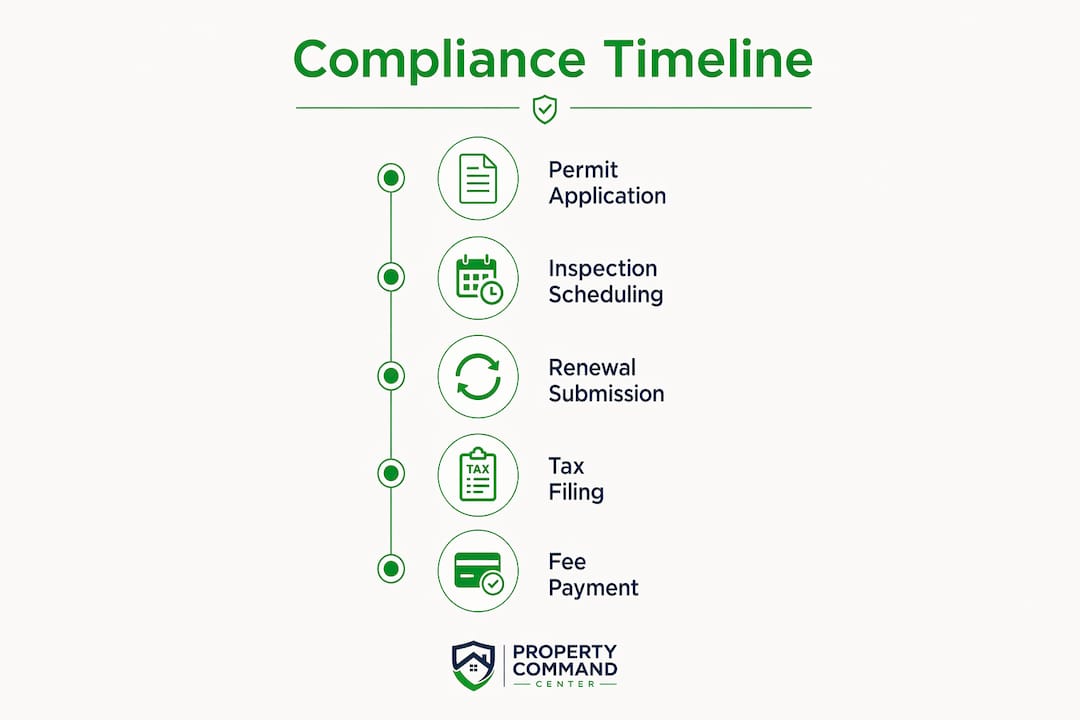
Fines are commonly assessed per day and can quickly exceed the initial cost of compliance. D.C.'s ordinance, for example, sets civil penalties at $500 for a first violation, $2,000 for a second, and $6,000 for a third.
Renewal calendar template (fields per property)
- Property address and unit number
- Registration number and issuing agency
- Issue date and expiry/renewal window
- Inspection due date
- Tax filing deadlines (monthly, quarterly, or annual)
- Insurance renewal date
- Local contact name and phone number
How platforms and cities enforce rules — and what's at stake
Cities and platforms are no longer relying on complaint-driven enforcement. Automated data scraping and platform-municipality data-sharing are now standard tools. A missing or incorrectly formatted registration number on a listing is the top automated trigger for immediate takedown.
What triggers enforcement action:
- Missing registration number on a listing
- Registration number present but in the wrong format
- Scraped listing data cross-matched against unregistered parcels
- Neighbor or guest complaints routed to the city
- Expired permits caught during a platform audit cycle
Consequences owners face:
- Immediate listing removal by the platform
- Per-day municipal fines (often $100–$1,000 per day depending on jurisdiction)
- Suspended payouts or tax withholding by platforms when tax credentials are missing
- Account-level penalties when one property's lapse affects the entire host account
Pro Tip: For owners with multiple properties, stagger renewal dates across a 30–90 day rolling window. A single day when several registrations expire simultaneously creates account-wide jeopardy if any renewal is delayed.
Taxes every U.S. host needs to understand
Tax compliance for short-term rentals runs on three parallel tracks: income reporting, occupancy/lodging tax, and platform-level tax identity.
Platform tax identity (W-9/W-8): Platforms may require a completed W-9 (for U.S. persons) or the appropriate W-8 form (for non-U.S. persons). Failure to provide valid tax information can result in payout suspension, calendar blocking, or backup withholding on earnings.
Income reporting: Platforms issue Form 1099-K or 1042-S depending on your tax status. This reflects gross booking revenue, not your net income after expenses. Treating gross platform payouts as taxable income without deducting allowable expenses is a common and costly mistake.
Occupancy and lodging taxes: These vary by jurisdiction. In some markets, Airbnb collects and remits occupancy tax on your behalf. In others, you must register with the state or local tax authority and remit it yourself. Confirm which applies to each property individually.
Tax setup action list:
- Submit a valid W-9 or W-8 to every platform you use.
- Confirm whether the platform remits local occupancy tax in each property's jurisdiction.
- Register for state or local lodging tax accounts where required.
- Keep occupancy tax collected in a separate line item in your bookkeeping — it is not your revenue.
- Consult the IRS guidance on rental income and the 14-day rule for properties used personally.
Systems for owners managing multiple short-term rentals
The biggest risk across a portfolio is decentralized tracking. A lapsed registration on one property can trigger platform-level penalties that affect every listing on your account.
Best-practice checklist:
- Maintain a digital compliance binder per property: registration certificate, business tax certificate, inspection reports, and insurance proof.
- Assign a named local contact per property and store their information in a central vendor directory.
- Use a single compliance calendar for all properties, not one spreadsheet per home.
- Run a quarterly compliance review: check expiry dates, confirm registration numbers are still displayed correctly, and verify tax accounts are current.
Onboarding a new property into your system:
- Run the parcel/zoning check and document the result.
- Confirm HOA or lease clearance in writing; file the response.
- Submit the STR registration application and log the expected issue date.
- Schedule the safety inspection and upload the certificate when complete.
- Update the listing with the registration number in the correct format.
- Add all renewal and filing dates to the central calendar.
A digital property management workflow reduces the chance of human error at each of these steps. Mypropertycommandcenter maps directly to this workflow: the dashboard tracks per-property status, the vendor directory stores local contacts, and the document vault holds certificates and inspection reports.
Pro Tip: Keep a master vendor contact list that includes your local contacts, licensed inspectors, and a tax professional familiar with short-term rental rules. When a guest incident or city notice arrives, you need those numbers in one place, not buried in email.
Ready-to-use templates for listings, HOA inquiries, and applications
Compliant listing notice (copy and adapt)
HOA or landlord inquiry email
STR permit application checklist
- Government-issued ID and proof of property ownership
- Completed application form (city/county portal)
- Proof of liability insurance meeting the jurisdiction's minimum
- Proof of local contact (name, phone, address within required radius)
- Safety inspection certificate or scheduled inspection confirmation
- Business license or tax certificate (where required as a prerequisite)
- Application fee payment confirmation
- Neighbor notification attestation (where required)
Many ordinances require a separate certificate for each rental unit, so run this checklist for every address individually.
Key Takeaways
Short term rental compliance requires active, property-by-property management of permits, taxes, safety standards, and platform rules — a lapse on any one item can trigger fines, delisting, or account-wide platform penalties.
| Point | Details |
|---|---|
| Register each property separately | Permits tie to a specific address; one certificate does not cover multiple units or properties. |
| Display the registration number correctly | Missing or incorrectly formatted numbers are the top automated trigger for platform delisting. |
| Separate occupancy tax from revenue | Occupancy tax collected from guests is not your income; track it separately to avoid misreported filings. |
| Stagger renewal dates across properties | Rolling 30–90 day renewal windows prevent a single expiry event from creating account-wide jeopardy. |
| Mypropertycommandcenter centralizes compliance | The dashboard consolidates renewal reminders, document vault, vendor directory, and per-property status across all your homes. |
The compliance lesson most owners learn the hard way
The conventional wisdom says get your permit, check the box, move on. That framing is exactly what gets owners into trouble.
Compliance is a continuous operational requirement. Cities are moving toward active enforcement: automated scraping, platform-municipality data sharing, and rolling audit cycles mean your registration number is being checked whether you think about it or not. The owners who get caught are almost never the ones who ignored the rules from the start. They're the ones who registered correctly, then let a renewal slip during a busy season.
The multi-property version of this problem is worse. One expired certificate on a secondary property can freeze payouts or trigger account-level review across every listing you own. That's not a theoretical risk — it's the predictable result of tracking five or six renewal dates in a spreadsheet you update manually.
The fix isn't complicated. Schedule 15–30 minutes today to add every registration expiry date, inspection due date, and tax filing deadline to a single calendar. If you're managing more than two properties, a dedicated dashboard pays for itself the first time it catches a renewal you would have missed.
Mypropertycommandcenter keeps your compliance calendar from falling apart
Managing short-term rental compliance across multiple properties means tracking permit renewals, inspection certificates, tax deadlines, vendor contacts, and listing updates — all at once, for every address. Mypropertycommandcenter is built for exactly that situation.
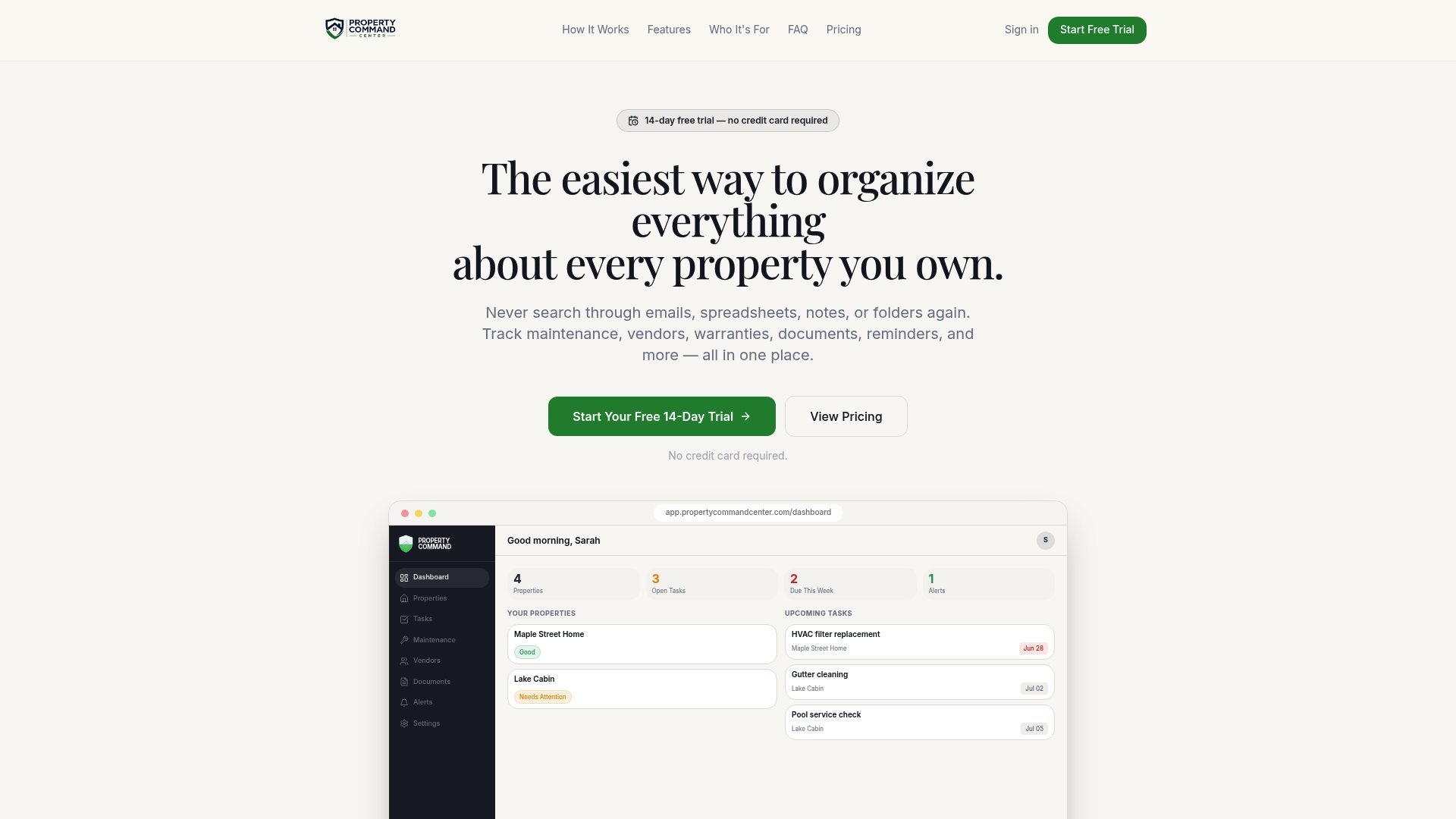
The dashboard gives you a consolidated view of every property's status, with automated renewal alerts that fire before a deadline, not after. The document vault stores your registration certificates, inspection reports, and insurance proof in one place. The vendor directory keeps your local contacts, inspectors, and tax professionals a click away. For owners managing two, five, or ten homes, that's the difference between a quarterly compliance review that takes 20 minutes and one that takes a weekend.
No complex software to learn. No credit card required to start. Add your first property today and see how much simpler the compliance side of ownership gets when everything lives in one place. View pricing and plans to find the tier that fits your portfolio.
This article is general information, not legal or tax advice. Confirm current rules with your local government, state tax authority, or a qualified professional for your specific situation.
Authoritative sources and where to find primary guidance
Use these resources when completing registrations, confirming tax obligations, or verifying platform requirements:
- Your city or county planning/development services page. Search "[city name] short-term rental registration" to find the official portal. This is the only authoritative source for your specific permit requirements, fees, and renewal cadence.
- Your county assessor's GIS portal. Confirms parcel zoning before you invest time in a permit application.
- Your state department of revenue. Confirms whether state-level lodging or sales tax registration is required and whether the platform remits it on your behalf.
- IRS rental income guidance (irs.gov). Covers income reporting, the 14-day personal-use rule, and deductible expenses for rental properties.
- Airbnb's responsible hosting and tax help pages. Explains platform-specific W-9/W-8 requirements, payout withholding rules, and which jurisdictions Airbnb remits occupancy tax for.
- Your state's short-term rental insurance requirements. For liability minimums and coverage guidance, a renters and property insurance guide for property managers is a useful starting point before consulting your insurer.
- Local ordinance text (Municode or your city's code library). Save the direct URL to your city's STR ordinance in your compliance binder so you can check it when rules update.