
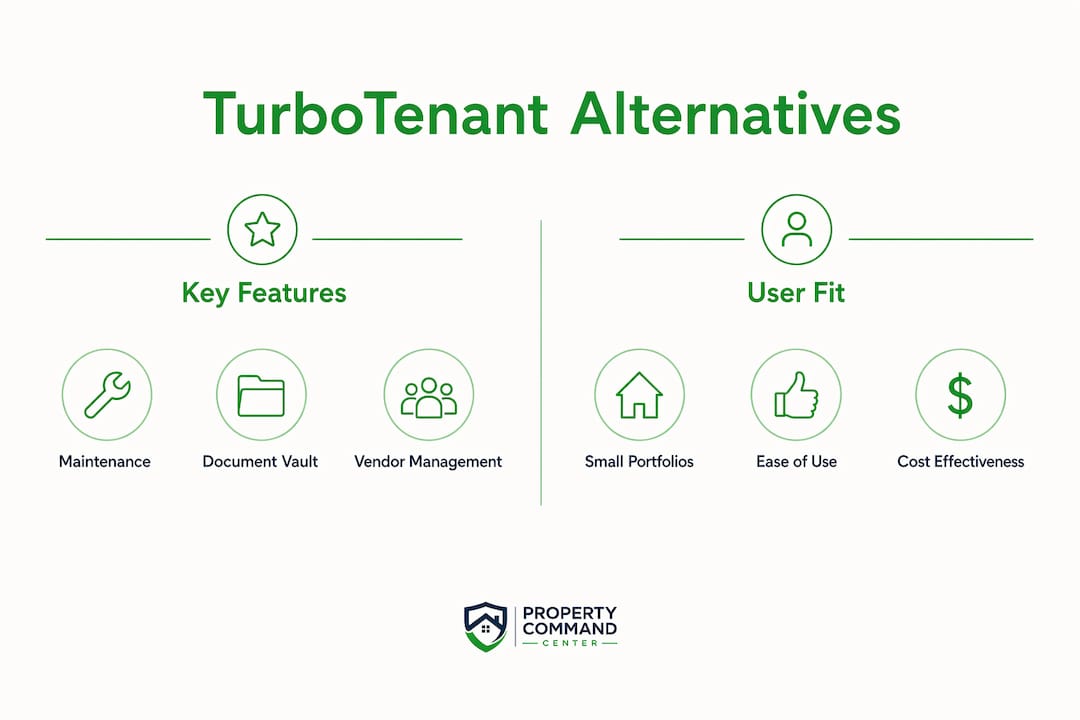
For small-portfolio owners who want maintenance tracking, a document vault, and vendor management without tenant screening, Mypropertycommandcenter is the clearest fit. It was built specifically for individual owners and families managing multiple homes, vacation rentals, and short-term properties. If you're evaluating the broader field, the useful categories break down like this: maintenance-first SaaS (Mypropertycommandcenter), DIY listing platforms with basic bookkeeping (Avail, TenantCloud), lightweight task and vendor apps (SimplifyEm, Hemlane), and accounting-focused tools (Rentec). The Fair Credit Reporting Act governs tenant screening in the US, but if screening isn't your priority, you can skip that entire feature tier and focus on what actually runs your day.
Table of Contents
- How do TurboTenant alternatives compare for small portfolios?
- How we evaluated these options
- How do you choose the right rental software for your situation?
- What features actually matter for maintenance, vendors, and documents?
- What does property management software really cost?
- How to migrate from TurboTenant to a maintenance-first platform
- Why a document vault is worth getting right
- How does vendor directory management save you time?
- What does onboarding from TurboTenant actually look like?
- What free trials and support options should you expect?
- What do small-portfolio owners say about these tools?
- How well do these tools integrate with accounting software?
- Key Takeaways
- The feature-count trap most landlords fall into
- Mypropertycommandcenter: built for owners who want clarity, not complexity
- Useful sources and further reading
How do TurboTenant alternatives compare for small portfolios?
| Dimension | Mypropertycommandcenter | Maintenance-first SaaS | DIY listing & bookkeeping apps | Lightweight task + vendor apps | Accounting-focused tools |
|---|---|---|---|---|---|
| Best for | small portfolios, families, vacation/STR owners | Multi-unit owners prioritizing repair workflows | Landlords who also list and collect rent | Owners needing basic task lists + vendor contacts | Owners whose primary pain is bookkeeping |
| Maintenance & task tracking | Full ticket lifecycle, recurring schedules, smart alerts | Strong; varies by platform | Basic or add-on | Moderate | Minimal |
| Document vault | Warranties, leases, insurance, photos in one place | Varies | Limited | Limited | Minimal |
| Vendor management | Dedicated vendor directory with contact history | Varies | Minimal | Basic contact list | None |
| Ease of use / mobile | Clean dashboard, mobile-ready, no steep learning curve | Moderate | Moderate to steep | Simple | Moderate |
| Rent collection | Not the core focus | Optional | Yes, core feature | Optional | Yes, core feature |
| Tenant screening | Not included (by design) | Sometimes included | Often included | Rarely included | Not included |
| Pricing shape | Tiered monthly subscription; transparent pricing | Subscription; varies | Free tier + paid tiers | Low-cost or free | Subscription |
| Onboarding effort | Low; 14-day free trial, no credit card | Moderate | Low to moderate | Low | Moderate |
| Support | Direct support; guided onboarding | Varies | Community + email | Limited | Email/chat |

Verdicts: Mypropertycommandcenter suits owners who want one organized dashboard for maintenance, documents, and vendors. DIY listing apps work if rent collection is also a priority. Lightweight task apps fit owners who just need a contact list and basic reminders. Accounting-focused tools are the right pick only when bookkeeping is the primary pain.
How we evaluated these options
The evaluation focused on operational fit for owners managing small portfolios who prioritize maintenance workflows and documentation over listing syndication or tenant screening. As industry guidance notes, growing portfolios should shift from evaluating popularity or free features to evaluating operational fit first.
Criteria included: total cost of ownership (subscription plus activation, add-ons, and migration labor), onboarding time, mobile UX, native maintenance task workflows, document vault depth, vendor directory management, and cloud backup practices. Off-the-shelf SaaS tools deploy faster for standard landlord workflows than custom-built stacks, which matters when you're managing real properties, not running an IT project.
Callout: Vendor self-comparisons are directionally useful but should always be validated with real workflow demos before you commit to a platform.
How do you choose the right rental software for your situation?
Start here: map three core workflows before you open a single demo. What does a maintenance request look like from report to resolution? How do you store a warranty or insurance document? How do you find a plumber's number at 10 PM? If a tool can't handle those three things cleanly, the feature list doesn't matter.
During any trial or demo, run these specific tests:
- Create a maintenance ticket on mobile and attach a photo.
- Schedule a recurring task (HVAC filter, gutter cleaning) and confirm the reminder fires.
- Upload a lease, a warranty, and an insurance certificate to a single property record.
- Export an accounting summary or expense log.
- Add a vendor with a rate note and assign them to an open ticket.
To estimate first-year total cost of ownership for a small portfolio: take the monthly subscription, multiply by 12, add any activation or setup fee, add the cost of some hours of your own time for data migration (at whatever you value your time), and add any premium module fees. Hidden costs like per-transaction fees and advanced-reporting add-ons can push the real number well above the advertised price.
Pro Tip: Run a 14-day parallel test with one real property and actual tickets before you deactivate your old system. You'll catch data gaps and workflow mismatches before they become problems.
What features actually matter for maintenance, vendors, and documents?
Choosing rental software comes down to three functional pillars for small-portfolio owners: tight maintenance workflows, a vendor directory with contact history, and a searchable document vault. Feature count is a distraction. A platform with 40 features you don't use is harder to operate than one with 10 that fit your day.
The features worth scrutinizing:
- Ticket lifecycle management: Can you log a request, assign a vendor, track status, and close with a note? Partial workflows create gaps.
- Recurring task scheduling: HVAC, pest control, and seasonal inspections need to fire automatically, not rely on your memory.
- Vendor assignment and rate tracking: Knowing which contractor you used last time, at what rate, saves real time.
- Document tagging and file types: Leases, warranties, manuals, photos, and insurance certificates all need a home. Confirm the vault supports the file types you actually use.
- Mobile photo uploads: Maintenance documentation happens on-site. If the mobile experience is clunky, it won't get used.
- Simple bookkeeping exports: You don't need a full accounting suite, but a clean expense export to QuickBooks or a CSV matters at tax time.
- Smart maintenance alerts: Proactive reminders beat reactive scrambling every time.
Owners who deliberately skip screening workflows (governed in the US by the FCRA) avoid a significant layer of compliance complexity. That's a feature, not a gap.
What does property management software really cost?
The published subscription price is rarely the full number. Here's what to account for:
| Cost category | Typical structure | Watch for |
|---|---|---|
| Base subscription | Monthly or annual per-property tier | Annual lock-in discounts that hide flexibility costs |
| Activation / setup fee | One-time, varies | Sometimes waived on annual plans |
| Premium modules | Add-on pricing (advanced reporting, AI features) | Bundled vs. à la carte pricing |
| Transaction fees | Per-payment percentage (rent collection) | Adds up fast on multiple units |
| Migration labor | Your time or a paid service | Almost always underestimated |
| Support tier | Included vs. paid | Response time SLAs matter |
For a five-property owner on a mid-tier plan, first-year TCO including migration labor typically ranges between $390 and $510 before any add-ons. Multi-year contracts can lower the monthly rate but eliminate flexibility. Prefer month-to-month cloud SaaS with transparent billing, especially for your first year on a new platform.
How to migrate from TurboTenant to a maintenance-first platform
Data migration is the most underestimated step in any platform switch. A manual audit before import prevents garbage-in/garbage-out problems that take weeks to untangle.
- Inventory all properties and owners. List every address, owner name, and associated contact.
- Export leases, contacts, and maintenance history from TurboTenant in the highest-fidelity format available (CSV or PDF).
- Run a manual audit. Remove duplicates, correct addresses, and standardize vendor names.
- Standardize file names before upload (e.g., "123Main_Lease_2025.pdf" not "scan001.pdf").
- Import into the new document vault and verify each property record is complete.
- Set up your vendor directory with names, phone numbers, specialties, and rate notes.
- Configure recurring maintenance tasks (HVAC, inspections, seasonal items).
- Run a 14-day parallel test with at least one live property before deactivating TurboTenant.
Common pitfall: Owners consistently underestimate cleanup time. It's wise to budget at least two hours per five properties for the audit step alone. Skipping it means importing messy data that will slow you down for months.
Why a document vault is worth getting right
A document vault isn't just storage. It's the difference between finding a warranty in 30 seconds and spending 45 minutes searching email threads during a contractor call. For multi-property owners, the vault needs to be organized by property, support multiple file types, and be accessible on mobile.
Mypropertycommandcenter's property-level organization keeps leases, warranties, manuals, insurance certificates, and photos attached directly to each address. That structure matters when you're managing a vacation rental in one state and a long-term rental in another.
How does vendor directory management save you time?
Most owners keep vendor contacts in their phone, a spreadsheet, or a text thread. That works until it doesn't — and it usually fails at the worst moment. A dedicated vendor directory with contact history, specialty tags, and rate notes means you're not starting from scratch every time a repair comes up.
Owners who want to understand the full scope of tenant management workflows—and why some deliberately skip screening—can review tenant management best practices to see exactly what the screen-free approach trades off.
What does onboarding from TurboTenant actually look like?
The migration checklist above covers the data side. The onboarding side is about configuring your new platform to match your real workflows before you go live. For Mypropertycommandcenter, the onboarding process is designed for owners who aren't IT professionals — the dashboard is set up to be navigable on day one, not after a training course.
The biggest onboarding mistake is importing data before configuring the platform's structure. Set up property records, vendor categories, and task templates first. Then import. Reversing that order means re-tagging everything.
What free trials and support options should you expect?
Mypropertycommandcenter offers a free trial period with no credit card required. That's enough time to run the parallel test described above and validate your core workflows before committing.
When evaluating any platform's support, ask two specific questions: What is the typical response time for a support ticket? Is there a live chat option during business hours? For small-portfolio owners without an IT team, slow support during a data migration or a maintenance emergency is a real operational risk.
What do small-portfolio owners say about these tools?
The pattern across reviews for this category is consistent: owners with fewer than 25 units consistently rate ease of use and mobile access above feature depth. Platforms that require significant setup or training see lower adoption rates among independent landlords. The tools that get used are the ones that feel intuitive on day one.
Owners who deliberately skip screening workflows report that removing that complexity from their software reduces both cost and cognitive load — the platform does less, but what it does is faster and cleaner.
How well do these tools integrate with accounting software?
For most small-portfolio owners, "integration" means one thing: getting expense and income data into QuickBooks, Wave, or a spreadsheet without manual re-entry. Full two-way API integrations are rarely necessary at this scale.
Look for CSV export at minimum, and a clean expense categorization structure that maps to standard Schedule E categories for US tax filing. Calendar sync for maintenance tasks (Google Calendar, iCal) is a practical secondary integration that prevents scheduling conflicts with vendors.
Key Takeaways
For small-portfolio owners, operational fit beats feature count every time — Mypropertycommandcenter is the recommended pick for maintenance, documents, and vendor management without screening complexity.
| Point | Details |
|---|---|
| Prioritize operational fit | Map maintenance, vendor, and document workflows before evaluating any platform. |
| Test before committing | Run a 14-day parallel test with one real property to catch gaps before full migration. |
| Budget for migration | First-year TCO includes subscription, setup, and migration labor — not just the monthly fee. |
| Mobile UX matters | Platforms that feel clunky on mobile get abandoned; ease of use drives actual adoption. |
| Mypropertycommandcenter | Built for 1–25-unit owners: maintenance schedules, vendor directory, document vault, and smart alerts in one dashboard. |
The feature-count trap most landlords fall into
The conventional wisdom in property management software comparisons is that more features equal more value. For small-portfolio owners, that logic is backwards. Every feature you don't use is a menu item that slows you down, a setting that needs configuring, and a potential source of confusion when something breaks.
The tools that win for independent landlords aren't the ones with the longest feature lists. They're the ones where the three things you do every week — log a maintenance issue, find a vendor's number, pull up a document — take under 60 seconds each. That's the real benchmark.
Screening-heavy platforms built for professional property managers carry that complexity into every corner of the interface. If you're managing a family vacation home and two long-term rentals, you don't need FCRA-compliant screening workflows. You need a clean dashboard that tells you what needs attention today. Choosing a platform that matches your actual operation, rather than the operation of a 200-unit management company, is the single most important decision in this process.
Mypropertycommandcenter: built for owners who want clarity, not complexity
If the tools above feel like they were designed for professional property managers and you're just trying to keep three homes organized, that's because most of them were. Mypropertycommandcenter takes a different approach: one dashboard, your properties, your vendors, your documents, and your maintenance schedule — nothing you don't need.
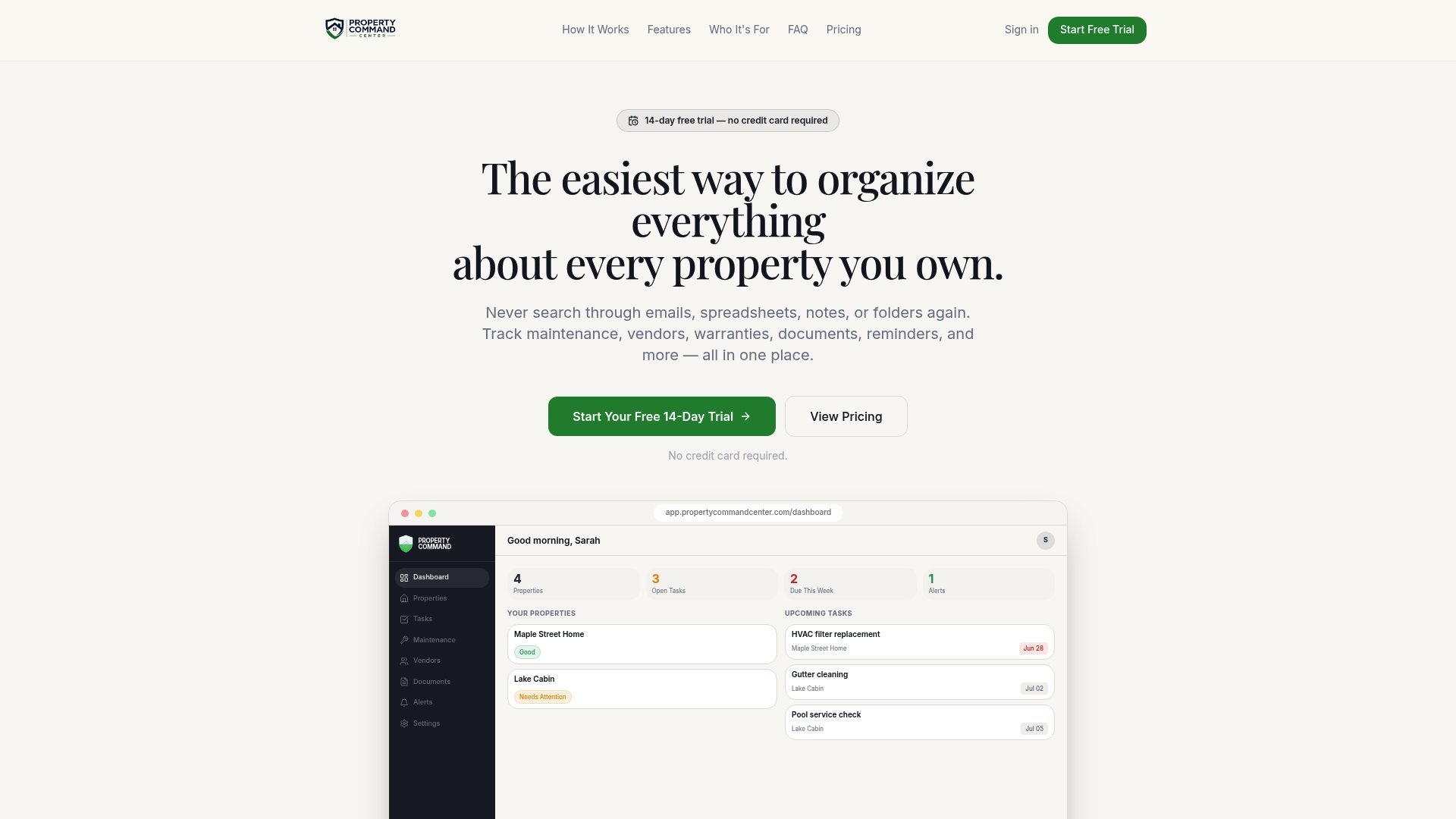
The platform covers the core needs directly: task and repair tracking with recurring schedules, a vendor directory with contact history, a document vault for warranties and insurance, smart alerts across all your properties, and simple bookkeeping exports. No tenant screening module to navigate around. No listing syndication you'll never use. Pricing is tiered by number of properties with transparent monthly billing — see the full breakdown on the pricing page.
The free trial requires no credit card. Start your 14-day trial with one property, run the parallel test, and see whether it fits your workflows before you commit to anything.
Useful sources and further reading
- Property Management Software: A 2026 Guide to Choosing the Right System — Optimal Unlimited's buyer guide; strong on operational fit criteria and the shift away from feature-count evaluation.
- How to Choose Property Management Software: Complete Guide 2026 — StudioAgent's TCO framework; useful for understanding hidden costs and cloud-hosting considerations.
- Property Management Software Buyer's Guide (2026) — ARC/Alrafay Global's comparison of off-the-shelf vs. custom-built approaches; relevant for owners deciding between quick-start SaaS and more complex stacks.
- Top TurboTenant Alternatives of 2026 — RentSpree's editorial comparison; useful background on what screening-focused guides emphasize and where the gaps appear for maintenance-first owners.
- How to Choose the Best Rental Software — integraRental's practical guide on integrations, maintenance ticketing, and recurring task configuration.
- 7 Essential Tenant Management Best Practices for Landlords — Rental Income Insurance partner resource; useful context for owners assessing whether they need screening tools or can rely on process-based workflows.
- Tenant Screening Checklist for Landlords 2026 — Rental Income Insurance; shows the manual work screening adds, which clarifies why some owners deliberately choose screen-free platforms.