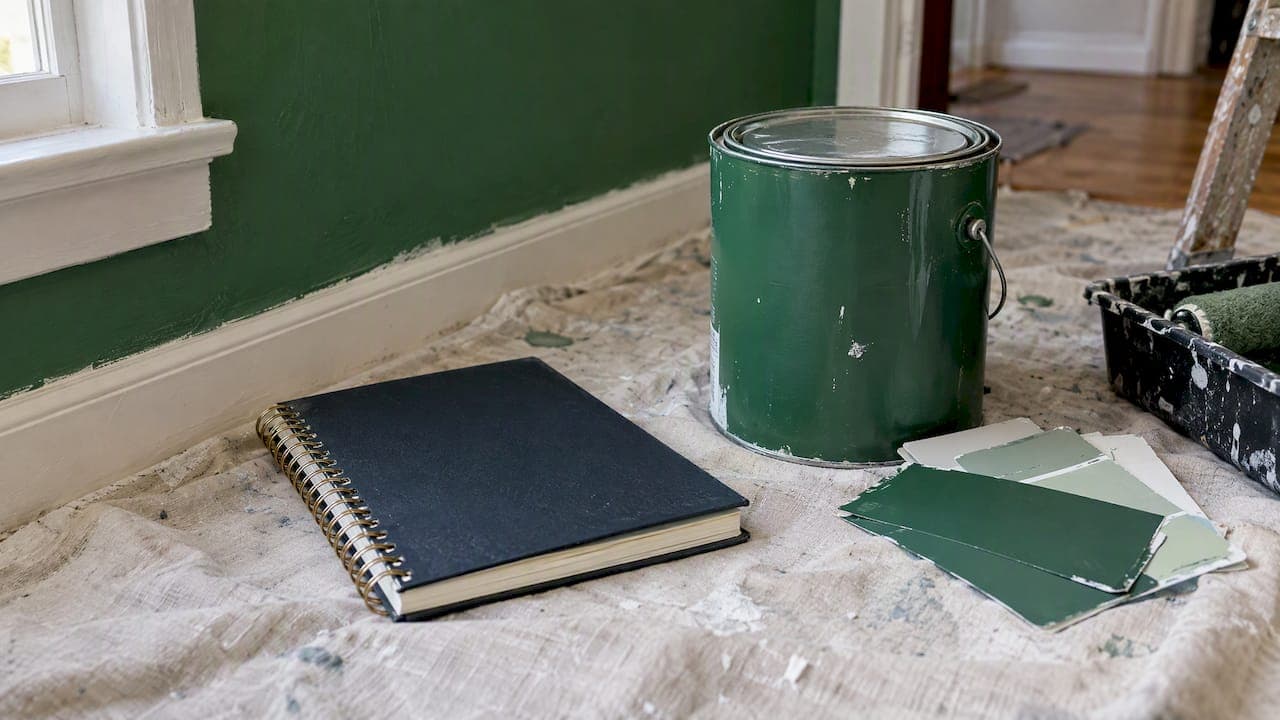
A good home paint colors log records, for every painted surface, the brand, exact color code, product line, sheen, date, quantity and store, plus a photo of the can label. Keep it by property first, then room, then surface, and store it somewhere searchable that you can reach from your phone. Do that once at the end of a paint job and you will never again stand in a hardware aisle guessing between two shades of cream.
This guide covers the fields that matter, a simple template, what to do if you own a log home or several houses, and how the same habit extends to a shutoff map and a smart lock code log.
TL;DR
- Log each painted surface separately (walls, ceiling, trim, door, cabinets), not just a room name and a color.
- Record manufacturer, exact code, product line, sheen, date, quantity, coats and store. A color name alone is not enough to match later.
- Photograph the tinted-can label, but treat the photo as a backup to the written record, not a replacement.
- Own more than one home? Organize by property first so a contractor or house sitter can find the right entry in seconds.
- Use the same system for shutoff locations and smart lock codes: one place, always current.
Table of Contents
- Why a room name and a color are not enough
- The fields every entry should have
- A worked example
- If you own a log home or cabin
- Choosing colors you will want to log for years
- Where to keep the log
- Perspective: why paint belongs with everything else you own
- Beyond paint: a shutoff map and a lock code log
- Putting it all in one place
- A 30-minute starter plan
- FAQ
- Sources
Why a room name and a color are not enough
Most people who try to keep track of paint write something like "Living room: Steamed Milk." Six years later that tells you very little. Painting professionals point out that the formula number alone does not guarantee a reliable match later. The manufacturer, product line, sheen, surface and date also matter, because formulations and appearance can vary across products and over time.
The second common failure is lumping a whole room together. One room can easily hold a wall color, a ceiling white, a trim white, a door color, an accent wall and a fireplace finish. Everyday Old House recommends treating each painted surface as its own entry and noting the quantity and number of coats, which also makes the next purchase faster.
Here is the practical consequence. A touch-up of a scuffed hallway wall needs the eggshell wall paint, not the semi-gloss trim paint that happens to be the same color name. If your log does not say which is which, you are back to guessing.
The fields every entry should have
The documentation guide from Home Painting Advice lists what a useful record contains. Here is that list turned into a working template.
| Field | What to write | Why it matters |
|---|---|---|
| Property | Main house, lake cabin, rental unit | Keeps multiple homes separate |
| Room | Primary bedroom | Quick lookup |
| Surface | Walls, ceiling, trim, door, cabinets, exterior siding | Each surface often uses a different paint |
| Manufacturer | Benjamin Moore, Sherwin-Williams, etc. | Codes are not interchangeable between brands |
| Color name and exact code | Name plus the full number | Names get duplicated and renamed |
| Product line | Interior latex, exterior stain, cabinet enamel | Same color performs differently across lines |
| Sheen | Flat, matte, eggshell, satin, semi-gloss | Wrong sheen makes a touch-up show |
| Date painted | Month and year | Formulas change over time |
| Quantity and coats | 2 gallons, 2 coats | Speeds up the next purchase |
| Store | Location and who mixed it | Stores can often look up past tints |
| Photo | Tinted-can label, plus the finished wall | Visual cross-check |
| Painter | You, or the contractor | Someone to call with questions |
A few notes on getting these fields right.
Copy the label, do not retype from memory
The label on the lid of a tinted can carries the formula and the product details. Photograph it before you pour a drop, while it is still clean. Then type the key fields into your log the same day.
Use the photo as a backup, not the record
Paint-tracking guidance from Everyday Old House treats a sample or can-label photo as a useful visual cross-check, but says it should supplement the written brand and code. A swatch ages and looks different under different lighting. A written product record is what lets a store reproduce your purchase.
Save leftover details, not just leftover paint
If you keep a small labeled jar of the leftover paint, write the same room, surface and date on the jar. Jars separate from their cans quickly, and an unlabeled jar of beige is worse than none.

A worked example
Say you repainted the family room of your main house in June. Entries might look like this:
- Main house, family room, walls: Benjamin Moore, interior matte, color code from the can, eggshell or matte as printed on the label, June of this year, 2 gallons, 2 coats, local store, label photo attached.
- Main house, family room, ceiling: a flat ceiling white, 1 gallon, 1 coat.
- Main house, family room, trim and door: a semi-gloss white, 1 quart.
- Main house, family room, fireplace surround: the specific product used, plus the primer.
Four lines, ten minutes, and you have solved the problem for the next decade. When a contractor patches drywall after a leak, you can send them the exact entry instead of a guess.
If you own a log home or cabin
The top results for this topic skew heavily toward log cabin colors, so a word for those owners. In a log home, paint should be chosen in relation to the existing wood, stone, views and daylight rather than from a trend list alone. Benjamin Moore's cabin palette leans on nature-linked colors: forest green such as Jack Pine 692, cedar brown, lakeside blue, crisp white and toasted neutrals. For darker exteriors it points to colors like Evening Dove 2128-30 and Silhouette AF-655, balanced with lighter trim and ceiling colors.
Two log-home notes belong in your log specifically:
- Note the wood next to the paint. Wood undertones can shift how a color reads, so test beside the actual logs. Record which test patch won and where it was placed.
- Separate stain from paint. Logs are often stained or sealed rather than painted. Log the product, the number of coats and the date, because those finishes have maintenance cycles that paint on drywall does not.
What about the "3-color rule"?
The rule says to use a dominant color, a secondary color and an accent. It is a design guideline, not a building requirement, and the sources we reviewed do not present it as a formal standard. In a log home, the wood itself is often the dominant material, so your painted walls may be the secondary color and a door, cabinetry or textiles the accent. Adapt it rather than forcing three painted colors.
Choosing colors you will want to log for years
If you are logging because you are about to repaint, a quick look at where color is heading may help. As of 2026, American Painting Contractor reports warm neutrals and earth tones replacing cool gray as the leading direction. Coverage of Sherwin-Williams' view on exterior color describes neutrals moving warmer, with more blues and greens and browns that resemble natural wood.
There is no single color replacing gray. The documented direction is a palette: warm whites and creams, sand, greige and taupe, olive and sage, clay, mineral blue, forest green, caramel and brown, with deeper reds, burgundies and charcoal as accents. Gray remains a fair choice where a cool modern or industrial look is intentional.
For an owner, the lower-risk move is a warm greige or khaki rather than an aggressively saturated whole-house palette. Whichever you pick, the log is what lets you repeat it in the next room, or in the next house, with confidence.
Where to keep the log
The format matters less than three habits.
- Searchable. You should be able to type "hallway" or a color code and find the entry. A paper binder fails this test in a second home.
- Backed up. Information that lives on one device or in scattered notes is hard to retrieve when a contractor needs it. Keep a digital copy plus an export or printout.
- Organized by property first. For several residences or rentals, sort by property, then room, then surface.
Common options are a spreadsheet, a notes app, a dedicated app, or a home management dashboard. A spreadsheet works fine for one house. It starts to creak at three, when the cabin's trim white and the rental's trim white are quietly two different products.
Perspective: why paint belongs with everything else you own
We built Property Command Center for owners who juggle more than one property, and the pattern we see is the same every time. The paint color is rarely the problem. The problem is that the paint color lives in one email, the warranty in a drawer, the plumber's number in someone's phone and the HVAC filter size on a sticky note at the other house.
A paint log is a small version of a bigger habit: write down the facts about each property once, in one place, so that the person who needs them can find them. That person is sometimes you at 9 p.m. in a store, sometimes your spouse, a house sitter, or a contractor you have never met.
Our view is that this should not take training or complex software. Paint codes, vendor contacts, manuals, insurance papers and maintenance reminders are essential records. Tenant and rent features are a different job, and we leave them out on purpose so the tool stays simple for owners.
— Francisco
Beyond paint: a shutoff map and a lock code log
Readers who search for a paint log often want the same thing for two other records: where the shutoffs are and who has which door code. Both follow the same rules as paint. Record specifics, keep one current version, and make it findable.
Home shutoff map
A shutoff map answers one question in an emergency: where do I turn this off, and how? A free printable shutoff map from Ardent Workshop suggests sketching the plan, numbering each valve where it actually sits, and noting which way it turns and what tool it takes. That last detail is the one people skip, and it is the one that matters at 2 a.m. with water on the floor.
For each property, log:
- Main water shutoff, plus fixture shutoffs under sinks and toilets
- Electrical panel and any subpanels, with what each breaker controls
- Gas shutoff and the tool it needs, if you have gas service
- Irrigation and outdoor spigot shutoffs, which matter at a vacation home you close for winter
- A photo of each location, so a house sitter can find it without calling you
At a seasonal home, add the closing and opening sequence, since the shutoff order is part of the record.
Smart lock code log
Smart locks keep their own history. For example, Nuki's activity log shows which user locked or unlocked the door and when. That tells you what happened. It does not tell you who each code belongs to, why it exists or when it should end. Your own log should cover that.
For each lock, record:
- Who holds each code or app invitation, and their role (cleaner, guest, contractor, family)
- The date it was issued and the date it should expire
- Which property and door it opens
- The date you last reviewed the list
Do not store the actual code in a place that could be shared widely. Record the person and the dates, and keep the code itself in a protected spot. Short-term rental hosts should review the list after every cleaner or contractor change.
Putting it all in one place
A paint log, shutoff map and code log are three of many records a multi-property owner has to keep current. If you would rather not maintain them across notes, spreadsheets and email threads, Property Command Center gathers property status, maintenance schedules and reminders, a vendor directory, and a document vault for warranties, manuals and insurance in one dashboard. Our vendor directory is where the painter who did your trim can live next to the entry for the paint they used.
There is a 14-day free trial with no credit card required. After that, plans are priced by the number of properties: Starter is $19 per month and Pro is $49 per month. We built it for individual owners and families, vacation home owners, and short-term rental hosts, not for property managers or tenant and rent management.
A 30-minute starter plan
You do not need to catalog the whole house this weekend. Start small.
- Pick one property and one room. Choose the room you painted most recently.
- Find the evidence. Look for leftover cans, receipts, the store's email confirmation or the painter's invoice.
- Write each surface as its own line using the template above. Where a field is unknown, write "unknown" so you know to fill it in.
- Photograph what exists. A can label if you have the can, otherwise the wall in daylight.
- Set a rule for the future. Every time you paint, the log gets updated before the brushes are cleaned.
- Add the shutoff map and lock list for that property while you are at it.
Where you cannot recover the original information, a store can often help you match a color from a sample, and the entry then records the new product precisely. From that day forward the log is correct.
FAQ
What should a home paint colors log include?
For each painted surface, record the property, room, surface, manufacturer, exact color code, product line, sheen, date, quantity, coats and store, plus a photo of the tinted-can label. The sheen and product line are the fields most people omit, and they decide whether a touch-up blends in.
Is a photo of the paint can enough?
A label photo is a very useful backup, but it should not be your only record. Photos get lost, and a swatch or wall photo can look different under different lighting. Write down the brand and code as well, so a store can reproduce the purchase.
How do I keep paint records for more than one house?
Organize by property first, then by room and surface. Keep a searchable digital copy and a backup export, so the information does not depend on one device or one person's memory. This also helps when a contractor or house sitter needs a specific entry quickly.
What color is replacing gray in 2026?
No single color is. According to trade coverage of 2026 paint trends, warm neutrals and earth tones such as wheat, sand, clay, taupe, olive and brown are taking over from cool gray. Gray still suits a deliberately cool, modern look.
Sources
- Never Forget a Paint Color Again: The Paint Documentation Guide, Home Painting Advice
- 6 Free Ways to Keep Track of House Paint Colors, Everyday Old House
- Cozy Cabin-Style Paint Colors, Benjamin Moore
- Paint Trends 2026, American Painting Contractor
- Beyond Gray: Sherwin-Williams on the Future of Exterior Color, McElroy Metal
- Free Home Shutoff and Breaker Location Map, Ardent Workshop
- Activity log: Who locked your door and when?, Nuki Support