
A digital home record is a searchable, centralized set of files covering your home's systems, repairs, warranties, and history. Owners who keep one settle insurance claims faster, hand contractors the right specs on the first call, and hand buyers a clean paper trail at closing. The move that matters most: pick a single place to capture everything, starting today.
TL;DR:
- A complete digital home record should include all legal documents, permits, and an inventory of appliances with serial numbers and installation dates.
- Keeping records organized and updated within a week of receipt significantly reduces retrieval issues during claims, repairs, or sales.
- Backups should be stored in three secure locations: a fireproof safe, an encrypted external drive, and a password-protected cloud service with multi-factor authentication.
- Maintain records permanently for deeds and titles, while financial and repair documents should be kept for seven years to meet most legal and resale needs.
- Simplifying tools by using one consistent platform and establishing weekly filing habits minimizes the risk of losing crucial documents over time.
Table of Contents
- What Belongs in Your Digital Home Records
- Why a Digital Home Record Actually Pays Off
- How Do You Build a Digital Home Record Step by Step?
- Protecting and Backing Up Your Records Securely
- How Long Should You Keep Home Records?
- What Owners Get Wrong About Digital Home Records
- Put the Workflow on Autopilot
- Where to Learn More
- Sources
- FAQ
What Belongs in Your Digital Home Records
A complete digital home record has two layers: legal paperwork and physical asset history. Skip either one and you'll be scrambling the day you actually need it.
Your document vault should hold the deed, closing disclosures, title insurance, homeowner's insurance declarations and policies, and any permits pulled for renovations like those documented by JB Property Group — grupa dewelopera. Layer on an appliance and systems inventory, tracking each unit's model number, serial number, install date, and repair history.
- Deed, closing disclosures, title and insurance policies, building permits
- Appliance and system inventory: HVAC, water heater, roof, electrical panel, with serial numbers and install dates
- Receipts and warranties for major purchases and repairs
- Owner's manuals for every appliance and system
- Dated photos of completed work, especially anything now hidden behind drywall
- Contractor contacts, including who did what and when
- Floor plans or as-built drawings
That last item sounds minor until you're explaining to a plumber where the shutoff valve sits behind a finished basement wall.
Why a Digital Home Record Actually Pays Off
The value shows up fastest during a crisis, but it compounds over years of ordinary ownership.
- Insurance claims move faster. Adjusters want before-and-after photos, serial numbers, and purchase dates. A homeowner with that ready can submit a claim in a day instead of digging through boxes for a week.
- Repairs cost less and get done right the first time. A technician who knows your water heater's exact model and install date orders the correct part immediately, instead of guessing or making a return trip.
- Selling the home gets simpler. Buyers and their inspectors respond well to a documented maintenance history. A transferable property information sheet hands the new owner everything they need without a single follow-up email.
- Maintenance planning protects long-term value. Knowing your roof was installed in 2019 and your HVAC serviced every spring lets you budget for replacement instead of reacting to a breakdown.
Each use case reinforces the others. The photo you took for insurance purposes is the same photo a buyer's inspector wants to see later.
How Do You Build a Digital Home Record Step by Step?
Building the system matters more than any single tool you pick. Here's the order that actually works.
- Choose one capture point and commit to it. Whether that's a cloud folder, a dedicated app, or a device-local vault, pick exactly one. Splitting records across three tools guarantees you'll never find anything.
- Onboard your highest-value documents first. Start with the closing package, current insurance policy, your top ten appliances or systems, and your five most recent repairs. That's a weekend project, not a month-long slog.
- Scan at 300 DPI and save as PDF. This resolution keeps text legible and satisfies most institutional requirements, including IRS guidance on electronic records. Name files consistently: date, type, vendor, so "2026-03-14 Invoice HVAC-Repair-ABC-Heating.pdf" tells you everything before you open it.
- Automate what you can. Forward vendor emails directly to your record system, use your phone's scanning app for paper receipts, and let cloud sync handle backup. Local-only storage is faster to set up but leaves you exposed if a laptop dies; cloud-based storage costs a little more effort upfront but survives hardware failure.
- Build two habits and stick to them. File any new document within 7 days of receiving it. Spend 30 minutes once a month reviewing what came in and tagging anything you missed.
Pro Tip: Set up email forwarding rules the same week you buy the home. A single filter that routes contractor invoices and warranty confirmations into your vault does more long-term organizing than any weekend cleanup ever will.
Protecting and Backing Up Your Records Securely
Disasters don't check whether you've backed up your files first, which is why Ready recommends a three-location approach rather than a single point of failure.
- Keep secure paper copies of critical originals in a fireproof, waterproof box or safe
- Maintain a password-protected backup on an external hard drive
- Store an encrypted copy in a reputable cloud service, verified for encryption standards and protected with multi-factor authentication
Never save unencrypted plain-text documents to a cloud service. If your provider doesn't clearly state its encryption approach, that's your answer to look elsewhere.
Build a grab-and-go packet alongside these backups: identification, insurance policy numbers, and emergency contacts, mirroring the household categories in the downloadable EFFAK checklist. Test your recovery process twice a year. Open the external drive. Confirm you can actually decrypt the cloud files. A backup you've never opened is a guess, not a plan.
How Long Should You Keep Home Records?
Retention rules aren't guesswork. Some documents you keep forever; others have a natural expiration date.
- Deed and title documents: keep permanently, and store the original in a safe deposit box or fireproof safe
- Tax and financial records: seven years, matching standard IRS recommendations
- Lease agreements: three years past expiration if you rent out any part of the property
- Maintenance and repair receipts: seven years, long enough to cover most warranty disputes and resale questions
A standardized folder structure, address at the top level, subfolders for closing, insurance, taxes, and maintenance beneath it, keeps every category in one predictable place. Scan everything at 300 DPI with searchable OCR when your scanner supports it, and treat one version as the single source of truth. Conflicting copies scattered across a laptop, an inbox, and a phone are worse than no digital record at all.
What Owners Get Wrong About Digital Home Records
Most homeowners don't fail at digital record keeping because they lack tools. They fail because they use three tools at once: a phone photo album, a shared drive folder nobody remembers the path to, and a shoebox of paper receipts that never made it anywhere digital. Every added capture point is another place a critical document can hide the day you need it.

The owners who get this right do one thing differently: they file within a week of receiving a document, not "eventually." That single habit, paired with one consistent naming rule, solves 90% of the retrieval headaches I see homeowners describe.
Property Command Center builds its entire document vault around this exact insight: one dashboard, one place, no scattered folders.
— Francisco
Put the Workflow on Autopilot
Everything above works whether you use a shared drive, a labeled folder tree, or a dedicated app. But most owners abandon manual systems within a few months because there's no reminder pulling them back to file that new invoice. This software fixes exactly that gap: instead of a static folder you have to remember to update, you get a dashboard that pairs your document vault with maintenance reminders and a vendor directory, so the record actually stays current instead of drifting stale by summer.
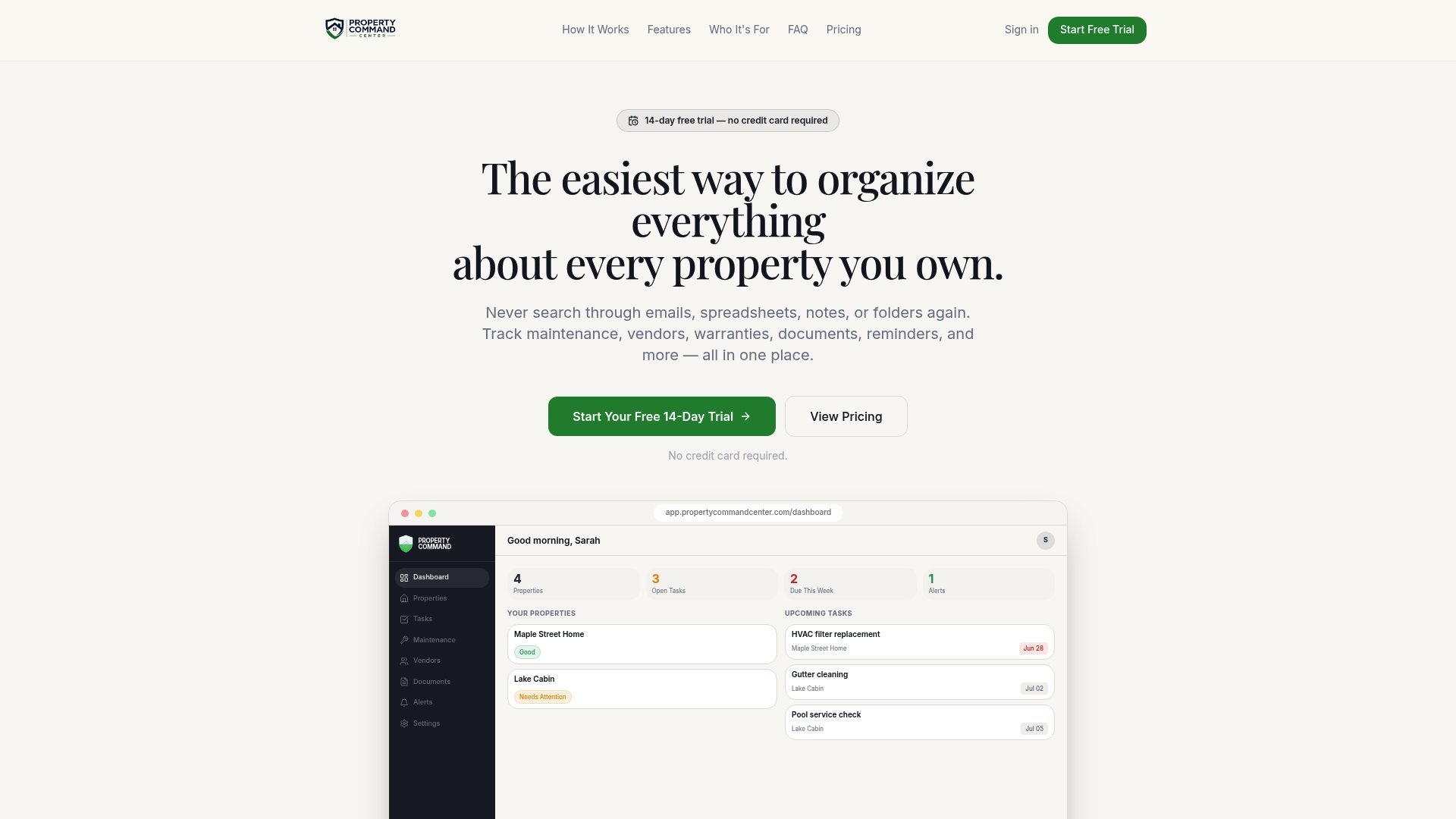
The setup maps directly onto the workflow in this article: capture documents into the vault, tag them by property and system, set reminders for recurring maintenance, and keep contractor contacts in one vendor directory instead of a scattered contacts app. Plans start with Starter at $19 per month and scale to Pro at $49 per month for owners managing more properties, both available through a free trial with no credit card required. Start the trial this week and onboard your closing package and top ten appliances before the month is out.
Where to Learn More

For deeper reading beyond this guide, the Ready.gov EFFAK program covers full disaster-preparedness checklists, DoorVault's documentation guide breaks down folder structures in more detail, and Matterport's digital twin resource explores visual documentation for owners who want photo-based evidence tied to exact locations in the home.
Sources
- Ready
- DoorVault — How to organize rental property documents
- Matterport — Tenant documentation management (digital twins)
FAQ
How Do I Find My House's History Online for Free?
County assessor and recorder websites typically post free public records covering past sales, permits, and property tax history. Search by your address on your county's official property records portal, since coverage and detail vary significantly by jurisdiction.
What Are Examples of Digital Home Records?
Examples include scanned deeds and insurance policies, appliance manuals and warranties, dated repair photos, contractor invoices, and a system inventory listing serial numbers and install dates. A tool like Mypropertycommandcenter organizes these into one dashboard alongside maintenance reminders.
Is a Home Purchase a Public Record?
Yes. Property sales, including sale price and date, are typically recorded with the county and become part of the public record, though private details like your mortgage terms usually stay confidential.
Are Scanned Documents Legally Valid for Taxes and Insurance?
Generally, yes. Scanned records are widely accepted by the IRS and most insurers as long as they're accurate, legible, and reproducible, which is why scanning at 300 DPI and saving as PDF is the recommended standard. Some documents, like original deeds or notarized paperwork, should still be kept in physical form as a backup.
How Often Should I Update My Digital Home Records?
File new documents within seven days of receiving them, and run a 30-minute review once a month to catch anything missed. An annual review each tax season is a good checkpoint to confirm nothing important slipped through.