
For most self-managing landlords, the best move away from Avail is toward either a flat-rate unlimited platform (if rent collection and leasing are your core needs) or an owner-focused command-center SaaS (if you manage multiple properties and need consolidated dashboards, task tracking, and a vendor directory). Avail's freemium model works well for 1–2 units, but the per-unit premium pricing adds up fast as your portfolio grows.
Three categories cover most landlord situations:
- Flat-rate unlimited platforms (e.g., RentRedi, DoorLoop): Fixed monthly pricing regardless of unit count. Best for landlords with 3+ units who want predictable costs and solid rent collection.
- Full accounting and owner-portal platforms (e.g., Buildium, AppFolio, Yardi Breeze): Deeper accounting, owner reporting, and maintenance workflows. Best for landlords scaling past 10 units or managing for other owners.
- Owner-focused command-center SaaS (e.g., Mypropertycommandcenter): Consolidated dashboard for property status, tasks, vendors, documents, and alerts. Best for individual owners and families managing multiple homes or vacation rentals who want clarity without enterprise complexity.
Table of Contents
- What are the best Avail alternatives at a glance?
- Why self-managing landlords seek alternatives to Avail
- Profiles of the main alternative categories
- How to choose the right alternative for your portfolio
- When is it time to move off Avail?
- How we evaluated these alternatives
- What's the best alternative for your specific situation?
- Per-tool profiles: what makes each option different
- What do user reviews actually say about these platforms?
- How does customer support compare across categories?
- What security and data privacy measures should you expect?
- What integrations do these platforms support?
- Key Takeaways
- The part of this decision most landlords get wrong
- Why Mypropertycommandcenter is worth trying before you commit to a full switch
- Authoritative sources to consult before you decide
What are the best Avail alternatives at a glance?
The table below compares the four main alternative categories across the dimensions that matter most when switching. Category-level pricing shapes vary widely; always verify current per-unit and transaction fees directly with each vendor before deciding.
| Category | Best for | Pricing model | Core features | Rent collection | Maintenance | Accounting | Onboarding support | Ease of use | Support |
|---|---|---|---|---|---|---|---|---|---|
| Freemium DIY tools | 1–4 units, budget-first | Free base + per-unit premium | Listings, lease signing, basic screening | ACH (often free or low fee); card fees vary | Basic request logging | Simple ledger | Minimal; manual re-entry | High | Email/chat; limited hours |
| Flat-rate unlimited platforms | 3–50 units, growth-focused | Flat monthly (usually starting around $5/month) | Listings, e-sign, screening, autopay | ACH + card; autopay standard | Work orders, vendor messaging | Mid-level ledger to full accounting | Guided import; tenant invite tools | Medium-high | Chat, email, some phone |
| Full accounting/owner-portal platforms | 10–200+ units, scaling landlords | Per-unit or tiered pricing depending on features and vendor | Full feature set, owner portals, reporting | ACH + card; autopay; owner disbursements | Full work-order workflows, vendor tracking | Full GAAP-level accounting | Dedicated onboarding; data migration | Medium (steeper learning curve) | Phone, email, account manager |
| Owner command-center SaaS | 1–20+ properties, multi-home owners | Flat subscription; free trial | Dashboard, tasks, vendors, docs, alerts | Not a primary rent-collection tool | Task and repair tracking, vendor directory | Document vault; not full accounting | Low friction; no credit card for trial | Very high | US-based; email and in-app |
Note: This table covers category-level patterns. Per-vendor onboarding nuances, ACH timing, and exact fee structures require direct verification with each provider.
Category consolidation in the property management software market means enterprise acquisitions have pushed pricing and bundled features in unpredictable directions. Small owners often get better value from flat-rate or command-center options than from scaled-down enterprise tiers.
Why self-managing landlords seek alternatives to Avail
Avail's free tier covers the basics well: listings syndication, lease templates, online rent collection, and tenant screening. The friction starts when your portfolio grows or your operational needs outpace what a freemium model is designed to handle.
The most common triggers landlords describe:
- Owner portal absence — If you manage properties for family members or co-owners, Avail has no owner-facing reporting layer.
The operational switching cost is real. Re-uploading lease documents, re-inviting tenants to a new payment portal, and recreating maintenance histories take time. That's exactly why onboarding support and data import tools deserve as much weight in your decision as pricing.
Pro Tip: Before you start comparing platforms, list every document type you'd need to migrate: leases, addenda, inspection reports, vendor contacts, and payment history exports. That list tells you which platforms' onboarding tools will actually save you time.
Profiles of the main alternative categories
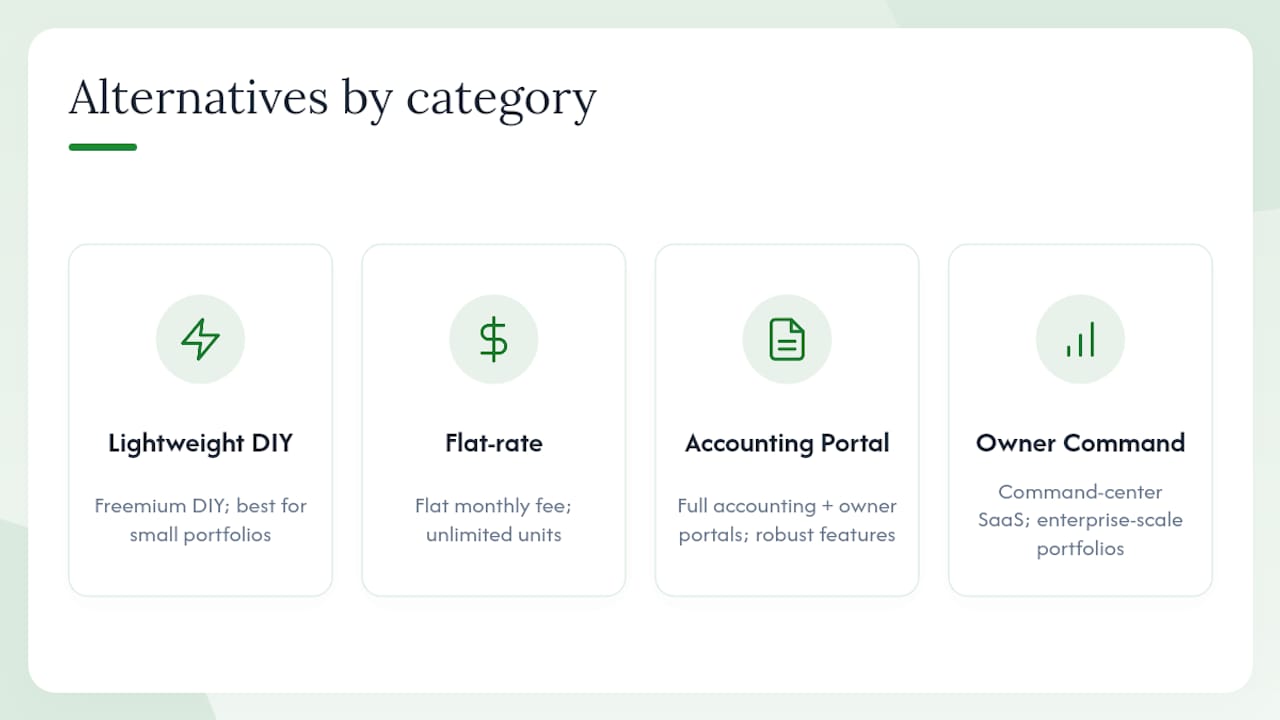
Understanding the category shapes helps you shortlist faster than reading individual vendor pages. Review aggregators show more than ten viable alternatives, but they cluster into four practical categories.
Lightweight freemium DIY tools
What it is: Free base tier with optional paid upgrades, similar in structure to Avail itself. Platforms in this category compete on zero upfront cost and simple tenant-facing flows.
Best for: 1–4 units, first-time landlords, or owners who only need listings, a lease template, and basic online rent collection.
Pricing shape: Free to start; premium features unlocked per-unit or per-month. Transaction fees on rent payments vary.
Pros:
- No monthly commitment to start
- Tenant-facing UX is typically clean and familiar
- Screening integrations (credit, background) available at low cost
Cons:
- Per-unit costs compound quickly past 3–4 units
- Accounting is ledger-only; no full reporting
- Onboarding support is minimal; migration is largely manual
Onboarding note: Expect to re-enter lease data and tenant contacts manually. No bulk import tools in most cases.
Ideal portfolio: small portfolios with a few units
Flat-rate unlimited platforms
What it is: A fixed monthly subscription covering unlimited units. RentRedi starts at $5/month on annual billing; DoorLoop and similar platforms sit higher but include more accounting depth. StackScored's category analysis ranks these as top picks for small landlords moving off per-unit pricing.
Best for: Landlords with 3–50 units who want predictable costs and a clear upgrade path.
Pricing shape: Flat monthly or annual fee, often $5–$100+/month depending on tier. ACH fees and card processing fees vary by platform and plan.
Pros:
- Cost becomes more predictable as you add units
- Rent collection, e-signing, and screening in one place
- Autopay and tenant reminders reduce manual follow-up
Cons:
- Some platforms charge extra for screening or premium support
- Accounting depth varies; not all offer full double-entry bookkeeping
- Customer support quality differs significantly between vendors
Onboarding note: Most offer guided tenant invite flows and some lease import capability. Ask specifically about CSV import for existing tenant ledgers.
Ideal portfolio: landlords with multiple units
Full accounting and owner-portal platforms
What it is: Enterprise-adjacent platforms like Buildium, AppFolio, and Yardi Breeze that include full GAAP-level accounting, owner portals, and maintenance work-order systems. These are the tools property managers use, not just self-managing owners.
Best for: Landlords managing 10+ units, owners who manage on behalf of others, or anyone who needs owner disbursement reports and bank reconciliation.
Pricing shape: Per-unit or tiered, typically starting at $50–$300+/month. Setup fees are common.
Pros:
- Full accounting with bank sync and owner reporting
- Maintenance work-order workflows with vendor tracking
- Owner portals for co-owners or investors
Cons:
- Steeper learning curve; overkill for 1–10 unit owners
- Higher cost, especially at lower unit counts
- Onboarding takes longer; some require dedicated setup calls
Onboarding note: Most offer dedicated onboarding support and data migration assistance, but expect 2–4 weeks to go fully live.
Ideal portfolio: landlords managing larger portfolios or others' properties
Owner command-center SaaS
What it is: A consolidated dashboard built for individual property owners and families managing multiple homes, vacation rentals, or a mixed portfolio. Mypropertycommandcenter fits here. The focus is on property status visibility, task and repair tracking, a vendor contact directory, a document vault, and smart alerts — not rent collection or tenant-facing leasing flows.

Best for: Owners managing 1–20+ properties who want to eliminate information sprawl across emails, spreadsheets, and sticky notes.
Pricing shape: Flat subscription with tiered plans by property count. Free trial available; no credit card required.
Pros:
- Single dashboard for all properties, tasks, vendors, and documents
- Very low onboarding friction; no tenant migration required
- Works alongside other tools (you can still use a separate rent collection app)
Cons:
- Not a full rent-collection or leasing platform
- Not designed for property managers handling other owners' portfolios
- Accounting depth is document-vault level, not full bookkeeping
Onboarding note: No tenant re-invitation required. Add your properties, upload key documents, and set up task reminders in a single session.
Ideal portfolio: owners managing multiple properties including vacation homes
How to choose the right alternative for your portfolio
Start with your unit count and your biggest operational pain point. Those two inputs eliminate most of the field immediately.
Decision checklist:
- Count your units and run the cost math. If you have 5+ units, a flat-rate plan almost always beats per-unit pricing. For 1–2 units, a freemium tool may still be cheapest.
- Identify your primary pain point: rent collection friction, accounting gaps, maintenance chaos, or information sprawl across multiple properties.
- Decide whether you need tenant-facing features (online payments, lease signing, screening) or owner-facing features (task tracking, vendor directory, document vault, alerts).
- Check onboarding support before you commit. Ask vendors: Can I import existing leases as PDFs? Can I bulk-invite tenants? How long does migration take?
- Verify transaction fees. A "free" platform that charges 2.9% on every card payment can cost more than a $50/month subscription for a landlord collecting $5,000/month in rent.
Questions to ask every vendor:
- What file formats do you accept for lease and ledger imports?
- How do tenants get notified to switch payment portals, and who sends that communication?
- What are the ACH processing fees, and who absorbs card fees by default?
- Is there a dedicated onboarding contact, or is it self-serve?
- What does your adverse-action workflow look like for tenant screening? (Relevant under the Fair Credit Reporting Act, which requires landlords to send adverse-action notices when declining an applicant based on a consumer report.)
Red flags to watch for:
- Pricing pages that don't list ACH or card fees clearly
- No data export option (you should always be able to get your data out)
- Tenant screening that doesn't reference HUD fair housing obligations or FCRA compliance
- No onboarding documentation or migration support for self-serve plans
Pro Tip: Run one month of parallel rent reconciliation before fully switching platforms. Collect rent in the new system while keeping your old records active. Any discrepancy surfaces before it becomes a problem.
When is it time to move off Avail?
Some landlords stay on a platform longer than they should because switching feels disruptive. These signals mean the disruption of staying is already costing you more than the disruption of moving.
Move immediately if:
- You're manually reconciling rent payments every month because the platform's ledger doesn't match your bank
- A maintenance issue fell through the cracks because your vendor contacts and work notes live in three different apps
- You've missed a lease renewal because reminders don't exist or don't reach you reliably
Plan a move within 1–3 months if:
- Your portfolio is growing past the point where per-unit pricing makes financial sense
- You're spending more than 5–10 hours per month on operational tasks that a better platform would automate or consolidate
- You've added a vacation rental or second home and your current tool has no way to track it alongside your long-term rentals
Stage your migration if:
- You have active tenants mid-lease (notify them 30 days before switching payment portals)
- You have more than 10 units (run a pilot with 2–3 units first)
- You rely on accounting exports for tax filing (confirm the new platform's export format works with your accountant's software before going fully live)
Before you flip the switch: export all leases, tenant ledgers, and vendor contacts from Avail in whatever format it supports. Store them in a document vault or cloud folder you control. That backup is your safety net regardless of which platform you move to. The upgrade path matters as much as the starting price.
| Signal | Recommended timeline |
|---|---|
| Manual reconciliation every month | Move immediately |
| Per-unit cost exceeding flat-rate alternatives | Plan move within 1–3 months |
| Portfolio growth past 5+ units | Plan move within 1–3 months |
| Active tenants mid-lease | Stage migration; 30-day notice window |
| 10+ units with complex accounting needs | Staged rollout over 4–8 weeks |
How we evaluated these alternatives
The recommendations above follow a consistent framework applied across all categories.
- Tenant-facing UX — A platform your tenants find confusing generates support calls that land on you. We evaluated payment portal clarity, notification flows, and screening experience.
- Compliance integration. Tenant screening features were evaluated against HUD fair housing guidance and FCRA obligations. Platforms that build adverse-action notice workflows into their screening flow reduce landlord compliance risk.
Pricing data was drawn from vendor pages, category review aggregates, and third-party comparisons. Fees change; verify current rates before deciding.
What's the best alternative for your specific situation?
Single-unit owner on a tight budget: A freemium DIY tool covers your needs at minimal cost. The per-unit premium only becomes a problem when you add properties.
Owner with 3–10 units focused on rent collection: A flat-rate unlimited platform gives you predictable costs and solid tenant-facing payment flows. Run the unit-count math against your current Avail bill first.
Landlord scaling past 10 units or managing for co-owners: A full accounting and owner-portal platform is worth the higher price. The accounting depth and owner reporting justify the cost at this scale.
Multi-home owner, vacation rental host, or family managing several properties: Mypropertycommandcenter is the clearest fit. The consolidated dashboard, vendor directory, task tracking, and document vault address the information-sprawl problem that neither freemium tools nor enterprise platforms solve well for individual owners.
Owner who needs both rent collection and consolidated property oversight: Consider running a flat-rate rent collection tool alongside Mypropertycommandcenter. The two categories solve different problems and don't overlap in a way that creates redundancy.
If you're not sure which scenario fits, delay switching until you've run the cost math and mapped your top three operational pain points. Switching to the wrong platform costs more time than staying put for another month.
Per-tool profiles: what makes each option different
The ten platforms most frequently cited as Avail alternatives each have a distinct positioning. Here's what separates them in practice.
Property Command Center consolidates property status, tasks, vendors, documents, and alerts in a single owner-facing dashboard. It's built for individual owners and families, not property managers. No rent collection or leasing flows, which keeps the UX clean and the onboarding fast. Free trial, no credit card required.
Hemlane adds a managed-services layer on top of self-management tools. You can handle everything yourself or hand off maintenance coordination to Hemlane's local agent network. That hybrid model suits landlords who want software control but occasional professional backup.
DoorLoop targets landlords and property managers who want a full-featured platform at a flat rate. Strong accounting, maintenance work orders, and a polished tenant portal. Pricing sits above entry-level tools, but the feature depth justifies it for portfolios of 10+ units.
Buildium is one of the more established names in property management software, with full accounting, owner portals, and maintenance workflows. It's priced and designed for professional property managers, which means self-managing landlords often pay for features they don't use.
Landlord Studio emphasizes accounting and tax reporting for landlords. If Schedule E prep and bank reconciliation are your primary pain points, it's worth a look. Less strong on tenant-facing UX and maintenance workflows.
Baselane leads with banking and financial management. It offers a landlord-specific bank account, rent collection, and expense tracking in one place. A good fit for landlords who want to consolidate their property finances rather than their operational workflows.
TenantCloud covers the full landlord workflow at a low price point. Listings, leasing, screening, rent collection, and basic maintenance requests. The free tier is limited; the paid tiers are competitive for small portfolios.
AppFolio is an enterprise-grade platform with pricing to match. Strong accounting, owner reporting, and AI-assisted maintenance routing. Designed for professional property managers handling 50+ units. Self-managing landlords with smaller portfolios will find it expensive and feature-heavy. For a deeper look at whether it fits your situation, the AppFolio alternatives guide covers the tradeoffs.
Yardi Breeze is Yardi's small-to-mid-market offering. Full accounting, maintenance, and tenant management in a cleaner interface than Yardi's enterprise suite. Still priced above most self-managing landlord budgets at lower unit counts.
RentRedi competes on price. Starting at $5/month on annual billing, it offers rent collection, tenant screening, and basic maintenance requests at the lowest flat rate in the category. Feature depth is lighter than DoorLoop or Buildium, but for a landlord who just needs reliable rent collection, it gets the job done.
What do user reviews actually say about these platforms?
Review patterns on Capterra and G2 reveal consistent themes across categories that don't always show up in feature lists.
Flat-rate platforms like RentRedi earn strong marks for value and simplicity but draw complaints about customer support response times and limited accounting depth. DoorLoop scores well on ease of use and onboarding support, with users noting the guided setup reduces the migration headache significantly.
Full accounting platforms like Buildium and AppFolio get high marks from professional property managers but lower scores from self-managing landlords who find the interface complex and the pricing hard to justify at smaller portfolio sizes. Yardi Breeze sits in a similar position.
Baselane's banking-first approach gets positive feedback from landlords who want to separate property finances from personal accounts. The main criticism is that it's less useful if you already have a solid banking setup and just need operational tools.
Mypropertycommandcenter draws consistent praise for its clean dashboard and low onboarding friction. Owners managing vacation rentals and multiple homes specifically note that the vendor directory and task tracking fill a gap that neither freemium tools nor enterprise platforms address for their use case.
One pattern worth noting: landlords who switched from Avail to a flat-rate platform often report that the migration itself was smoother than expected, but that they underestimated how long it takes tenants to adopt a new payment portal. Build a 30-day tenant communication window into your timeline.
How does customer support compare across categories?
Support quality varies more than pricing does, and it matters most during migration.
Freemium and entry-level tools typically offer email and chat support during business hours. Response times of 24–48 hours are common. Phone support is rare. If you hit a migration problem on a Friday afternoon, you're waiting until Monday.
Flat-rate platforms like DoorLoop and RentRedi offer chat and email support, with DoorLoop providing more responsive onboarding assistance. Neither offers a dedicated account manager at standard pricing tiers.
Full accounting platforms like Buildium and AppFolio include dedicated onboarding support and, at higher tiers, account managers. That support is part of what you're paying for at their price points.
Mypropertycommandcenter offers US-based support via email and in-app channels. For owners who want help planning their migration before committing, the property query page lets you ask specific onboarding questions directly.
The practical takeaway: if you're migrating more than 5 properties or have complex document histories, prioritize platforms that offer a real onboarding contact, not just a knowledge base.
What security and data privacy measures should you expect?
Any platform handling lease documents, tenant personal information, and payment data needs to meet a baseline security standard. Here's what to verify before you sign up.
Data encryption: Confirm that data is encrypted in transit (TLS 1.2 or higher) and at rest. This is table stakes; any reputable platform should confirm it without hesitation.
Payment security: Rent collection platforms should be PCI-DSS compliant for card processing. Ask specifically about ACH security and how bank account data is stored.
Tenant data handling: Platforms that run credit and background checks are subject to FCRA requirements, including secure handling of consumer reports and proper adverse-action procedures. Verify that the platform's screening workflow includes these steps, not just the screening result.
Document storage: For platforms like Mypropertycommandcenter that serve as a document vault, confirm that documents are stored in encrypted cloud storage with access controls. You should be able to set permissions on who can view sensitive files.
Data portability: You should always be able to export your data. Before committing to any platform, confirm the export formats available and whether there are fees for data export.
Privacy policy clarity: Read the section on data sharing with third parties. Some platforms share tenant data with affiliated services or marketing partners. That's worth knowing before you upload lease agreements and tenant contact information.
What integrations do these platforms support?
Integration depth separates platforms that fit into your existing workflow from ones that require you to rebuild it.
Accounting software: QuickBooks Online integration is the most commonly requested. Buildium, DoorLoop, and AppFolio offer native QuickBooks sync. Landlord Studio has strong accounting export capabilities. Platforms without native QuickBooks integration typically offer CSV exports that require manual import.
Bank feeds: Baselane's banking-first model means bank feeds are native. Other platforms vary; confirm whether bank sync is included in your tier or requires an upgrade.
Listing syndication: Most rent collection platforms syndicate to Zillow, Trulia, and Apartments.com. Avail syndicates to Realtor.com given its ownership structure. Verify which networks your chosen platform reaches if vacancy marketing matters to your workflow.
Maintenance and vendor tools: Platforms like DoorLoop and Buildium integrate with maintenance request systems and some vendor networks. Mypropertycommandcenter's vendor directory is built in rather than integrated, which keeps the workflow inside a single dashboard.
Zapier and API access: For landlords with custom workflows, Zapier connectivity lets you connect your property management platform to tools like Google Sheets, Slack, or your CRM. DoorLoop and some enterprise platforms offer API access at higher tiers.
Financial planning: For owners who want to connect property-level financials to broader mortgage and refinance decisions, Friendly Financial Group offers resources on loan categories and property financing that complement what most property management platforms provide on the accounting side.
The integration question that most landlords forget to ask: does the platform export data in a format your accountant can actually use? A CSV that requires two hours of reformatting before your CPA can open it is not a useful integration.
Key Takeaways
The right Avail alternative depends on your unit count, primary pain point, and whether you need tenant-facing tools, owner-facing tools, or both.
| Point | Details |
|---|---|
| Run the unit-count cost math first | Flat-rate plans typically beat per-unit pricing once you have multiple units; category comparisons show the break-even is often 2–10 units depending on the vendor. |
| Onboarding support is a primary selection criterion | Migration friction is the top reason landlords delay switching; prioritize platforms with guided import and tenant invite tools. |
| Tenant screening requires FCRA compliance | Any platform running consumer reports must support adverse-action notices; verify this before using screening features. |
| Match the tool to your actual pain point | Rent collection gaps call for flat-rate platforms; information sprawl across multiple properties calls for a command-center approach. |
| Mypropertycommandcenter fits multi-home owners | The consolidated dashboard, task tracking, vendor directory, and document vault address the operational chaos that neither freemium nor enterprise tools solve for individual owners. |
The part of this decision most landlords get wrong
Most landlords approach a platform switch as a pricing decision. They run the per-unit math, find a cheaper option, and move. Then they spend three months dealing with the operational fallout: tenants confused about where to pay rent, maintenance requests lost in email, lease documents scattered across two systems.
The platforms that actually reduce your workload long-term are the ones that match your operating model, not just your budget. A self-managing owner with four vacation homes and two long-term rentals has almost nothing in common with a professional property manager running 200 units, even if both are "landlords." Enterprise platforms built for the latter will frustrate the former every time.
The command-center approach addresses something the rent-collection-first tools miss entirely: the cognitive load of managing multiple properties across different types. When your vendor contacts, task reminders, document vault, and property status all live in one place, you stop spending mental energy remembering where things are. That's not a feature. It's the difference between managing your properties and being managed by them.
One practical note on staged migration: the landlords who report the smoothest transitions are the ones who ran a parallel month before going fully live. They kept their old system active for one rent cycle while setting up the new one, caught any discrepancies, and only then shut down the old platform. It adds a month to the timeline and saves weeks of cleanup.
Why Mypropertycommandcenter is worth trying before you commit to a full switch
If your biggest frustration with Avail is information sprawl across multiple properties, not rent collection mechanics, Mypropertycommandcenter solves a different problem than most alternatives on this list.
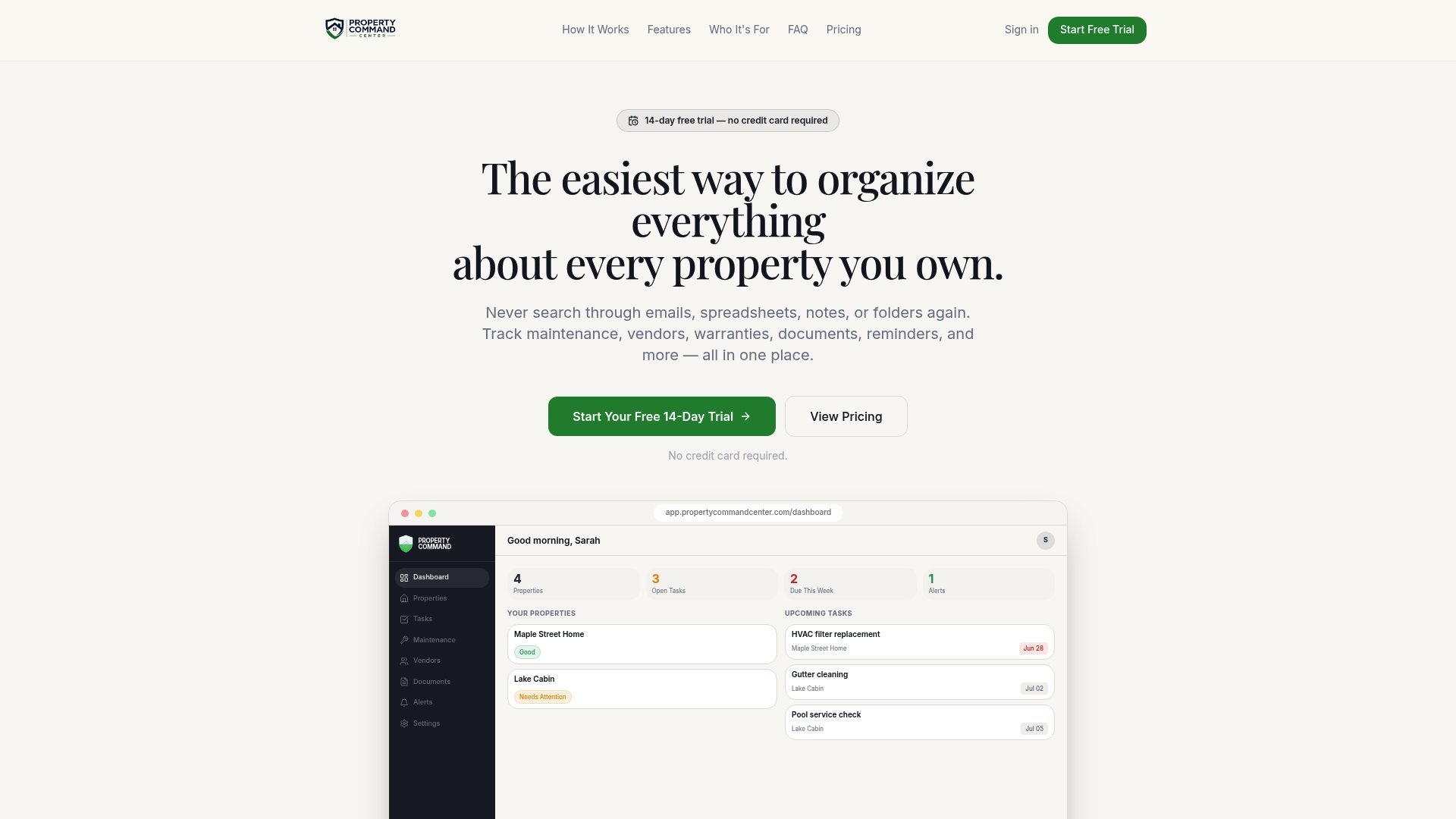
The platform gives you a single dashboard for property status, task and repair tracking, a vendor contact directory, a document vault for warranties and insurance, and smart alerts across all your homes. It's built for individual owners and families managing multiple properties, including vacation rentals and short-term rentals, not for property managers or enterprise portfolios. Onboarding takes one session. No tenant migration required. No credit card needed for the 14-day free trial.
If you want to see how it fits your specific portfolio before committing, the onboarding page walks through exactly what setup looks like and what you can import on day one.
Authoritative sources to consult before you decide
These are the primary sources used for pricing, feature comparisons, and compliance guidance in this article. Check vendor pricing pages directly before making a final decision, as fees change.
- Avail Review (2026): Pricing, Features & Honest Verdict - MakerStack
- Avail (Realtor.com) Alternatives in 2026 | StackScored
- Top Avail Alternatives, Competitors
- 10 Best Avail Alternatives & Competitors
- Avail | Landlord Software & Property Management Software for Rental ...
- portal.hud.gov
- HUD user fair housing report
- ftc.gov
This article provides general informational guidance on property management software. It is not legal, financial, or tax advice. Verify current pricing, fees, and compliance requirements with vendors and a qualified professional before making decisions.