Those three steps, done today, prevent the most expensive coastal damage. After any storm, stay off the property until it's safe. Then photograph everything before touching a thing.
Right now, do these three things:
- Rinse all exterior surfaces (siding, windows, railings, hardware) with fresh water
- Walk the roof line and gutters for debris, lifted shingles, or rust
- Set interior dehumidifiers and check HVAC filters
Key Takeaways
| Point | Details |
|---|---|
| Monthly salt rinse | Flush all exterior surfaces with fresh water every month to prevent corrosion and paint degradation. |
| 1.5%–2.5% annual reserve | Coastal homes cost more to maintain than inland ones; set aside this range of home value each year. |
| Seasonal pressure wash | Soft-wash the full exterior twice a year, spring and fall, and inspect the roof at the same time. |
| Document before you repair | After any storm, photograph all damage before cleanup to support insurance claims. |
| Centralize your records | Store vendor contacts, warranties, inspection photos, and invoices in one dashboard to avoid gaps. |
Table of Contents
- What does beach house maintenance actually involve?
- How do you protect a beach house exterior from salt and weather?
- How do you control moisture and prevent mold inside a coastal home?
- Which mechanical systems need the most attention in a coastal home?
- How do you handle pests and landscaping at a beach house?
- What's the right seasonal schedule for coastal home maintenance?
- How much does beach house upkeep actually cost?
- Which jobs can you DIY, and when should you hire a pro?
- Your consolidated 12-month maintenance checklist
- How Mypropertycommandcenter helps you run this plan without the chaos
- What experienced beach house owners wish they'd known sooner
- Sources
What does beach house maintenance actually involve?
Coastal property maintenance is a different discipline than standard homeownership. Salt air corrodes metal fasteners in months, not years. Sand acts as a fine abrasive against paint and window seals. Humidity sits persistently high, feeding mold inside walls and under floors. UV intensity at the waterfront bleaches and cracks finishes faster than any inland neighborhood. The result: a beach house that goes without a structured maintenance plan can rack up repair bills that dwarf what a comparable inland home would cost.
The good news is that most of the damage is preventable. The tasks aren't complicated. What trips owners up is frequency and follow-through, especially for properties that sit vacant between visits.
How do you protect a beach house exterior from salt and weather?
Salt, UV, and sand hit the exterior hardest, and routine rinsing and scheduled maintenance are the most cost-effective defense you have.
Washing and rinsing
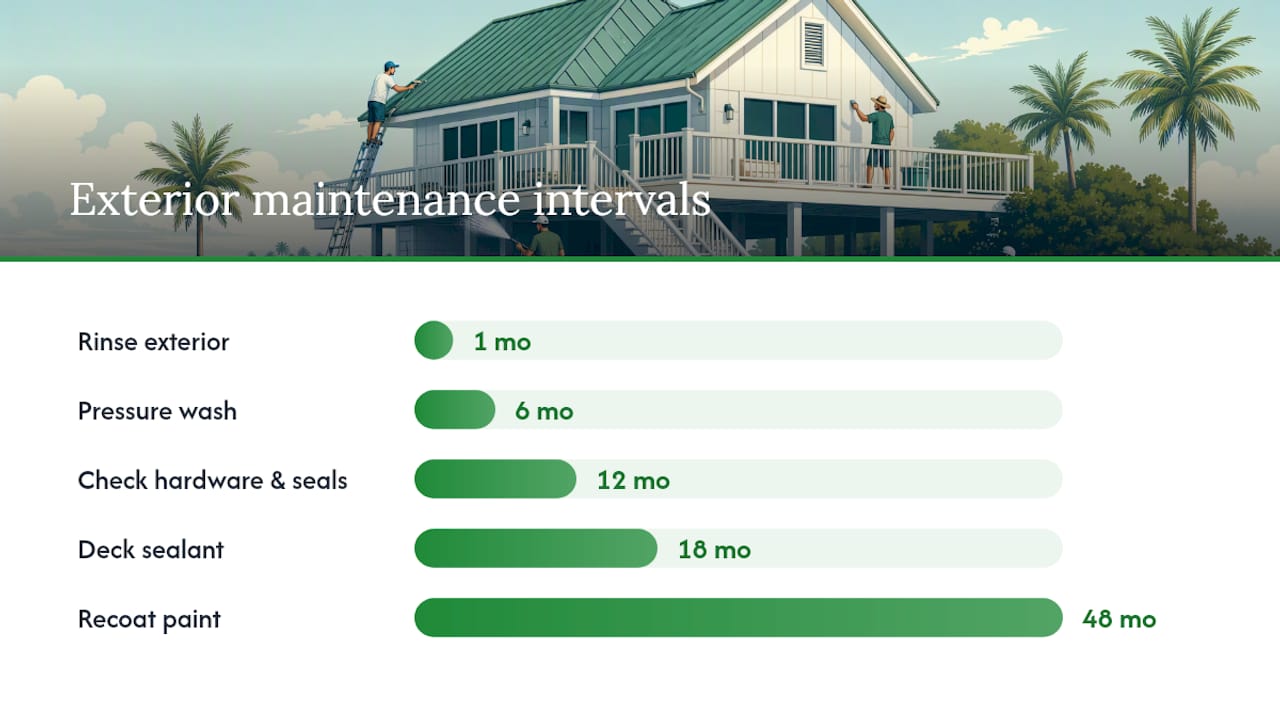
- Rinse all siding, windows, railings, and hardware with fresh water monthly. A garden hose works fine; you're flushing salt crystals before they etch surfaces.
- Pressure wash the full exterior twice a year, spring and fall. Use a soft-wash setting on wood and painted surfaces to avoid stripping finishes.
- Clean gutters at the same time. Coastal gutters clog with organic debris faster than inland ones, and standing water accelerates rust on metal gutters and fascia.
Paint, varnish, and wood Exterior paint on a coastal home typically needs recoating every 3–5 years rather than the 7–10 years you'd expect inland. For wood decking and trim, a penetrating oil-based sealant or marine-grade varnish applied every 1–2 years outperforms film-forming finishes, which peel and trap moisture underneath.
Metal hardware and fasteners Standard zinc-plated screws and hinges fail fast in salt air. Replace any corroding hardware with marine-grade 316 stainless steel or hot-dipped galvanized alternatives. Check gate hinges, deck screws, railing brackets, and exterior light fixtures every spring. A few dollars per fastener now beats a rotted deck board later.
Roof and gutters Inspect the roof twice a year and after every significant storm. Look for lifted or missing shingles, cracked flashing around chimneys and vents, and rust on any metal components. Coastal roofs face higher wind uplift, so pay attention to the edges and ridge cap. Hire a licensed roofer for anything beyond clearing debris or replacing a single shingle.
Windows and doors Check weatherstripping and caulk seals every spring. Salt-laden air works into micro-gaps around frames and degrades seals faster than you'd expect. Re-caulk with a marine-grade or paintable silicone product. Rinse window tracks monthly; salt crystals in tracks grind against seals and accelerate failure.
Pro Tip: Fiberglass doors and composite trim boards cost more upfront than wood, but they don't rot, don't need annual painting, and hold up to salt air for decades. On a beach house, that upfront premium pays for itself within 5–7 years in avoided refinishing costs.
How do you control moisture and prevent mold inside a coastal home?
Without ventilation and dehumidification, closed coastal homes are prone to mold and mildew growth on nearly every interior surface, especially when the property sits vacant.
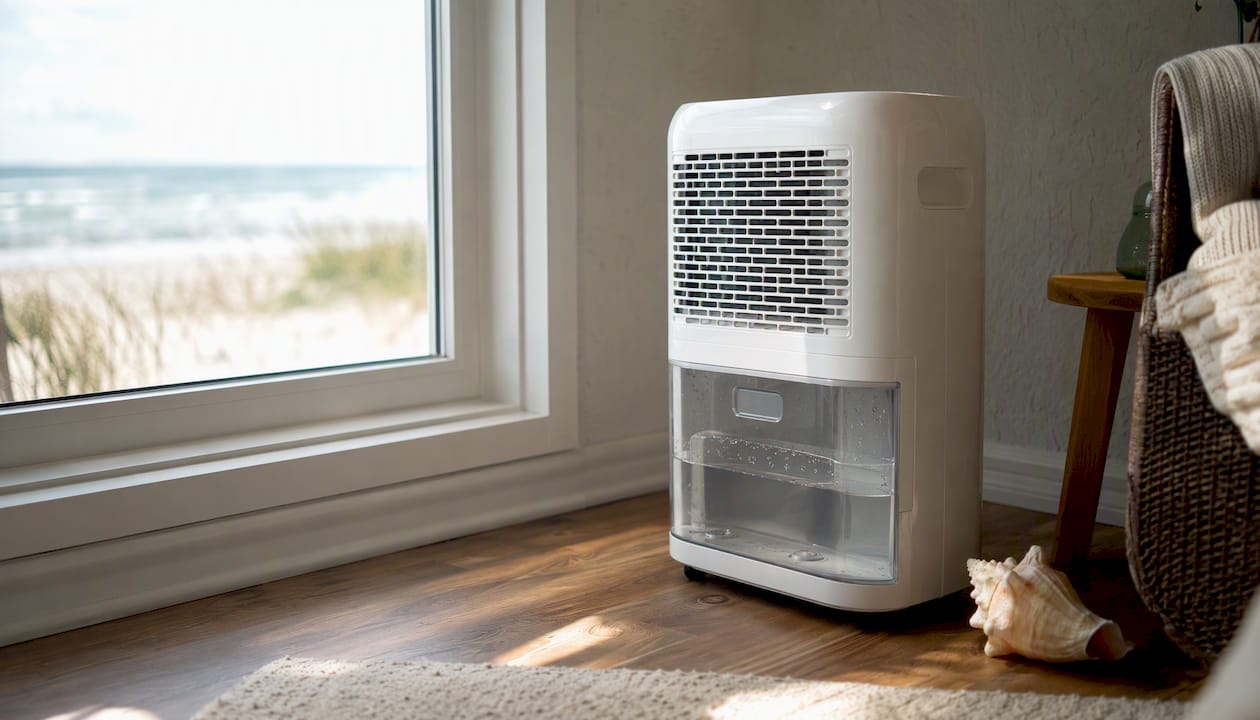
Run a dehumidifier year-round in humid climates, or at minimum during the shoulder seasons when the home is unoccupied. A whole-home dehumidifier tied to the HVAC system is the most reliable option. Portable units work for single rooms but need frequent emptying. Replace HVAC filters every 1–3 months depending on occupancy; a clogged filter reduces airflow and lets humidity build.
Bathroom and kitchen exhaust fans should vent directly outside, not into the attic. Check that duct connections are intact every year. If a guest reports a musty smell, treat it as a mold signal, not just an odor problem. Any water intrusion, whether from a roof leak, plumbing failure, or storm surge, needs to be dried within 48 hours to prevent mold colonization.
For flooring, luxury vinyl plank (LVP) and porcelain tile handle moisture far better than hardwood or carpet in coastal conditions. If you have area rugs, wash them at least twice a year and replace any that hold persistent odors. Encourage guests to leave shoes at the door; sand is abrasive and carries salt into the home.
Call a licensed mold remediation contractor if you see visible mold covering more than a few square feet, if it's behind walls, or if occupants report respiratory symptoms. DIY mold treatment with bleach works on hard non-porous surfaces but doesn't address mold inside porous materials like drywall.
Which mechanical systems need the most attention in a coastal home?
Mechanical failures in coastal homes tend to be more expensive than inland equivalents because salt air corrodes components faster and replacement parts sometimes require specialized coastal-rated equipment. Schedule these checks annually at minimum.
- HVAC system. Replace filters every 1–3 months. Have a technician clean the evaporator and condenser coils annually; salt deposits on coils reduce efficiency and shorten compressor life. Inspect condensate drain lines for blockages, which cause water backup and ceiling damage.
- Water heater. Coastal humidity accelerates corrosion on the tank exterior and anode rod. Inspect the anode rod annually and replace it every 3–5 years. Water heater maintenance in coastal homes also means checking the pressure relief valve and looking for rust staining at connections.
- Plumbing. Inspect all exposed pipes under sinks and in crawl spaces for corrosion, especially copper-to-galvanized connections. Check supply line hoses on washing machines and dishwashers; rubber hoses degrade faster in humid environments. Replace with braided stainless steel lines.
- Electrical panel. Have a licensed electrician inspect the panel every 3–5 years for corrosion on breakers and bus bars. Coastal homes near the water can experience accelerated oxidation inside panels, which creates fire and failure risks.
- Sump pump (if applicable). Test it quarterly by pouring water into the pit. Replace the backup battery annually. A failed sump pump during a storm surge event causes catastrophic flooding.
Red flags that need immediate professional attention: any active water leak, corrosion visible on electrical connections, unusual sounds from the HVAC compressor, moisture staining on ceilings or walls, or a sulfur smell near the water heater.
Ask every technician for written documentation of what they inspected and what they found. Keep those records in a document vault. They matter for insurance claims and for resale.
How do you handle pests and landscaping at a beach house?
Coastal homes attract termites, rodents, and cockroaches for predictable reasons: wood construction, moisture, and the organic debris that accumulates in crawl spaces and under decks. Subterranean termites are the biggest structural threat in most U.S. coastal markets. Schedule a professional termite inspection annually, and ask the inspector to check crawl space moisture levels at the same time.
For rodents and roaches, the most effective prevention is exclusion: seal gaps around pipes, utility penetrations, and foundation vents with steel wool and caulk. Don't leave food out between visits, and empty trash completely before closing up the property.
Landscaping choices matter more than most owners realize. Plants that trap moisture against the siding, like dense shrubs pressed against the foundation, create ideal conditions for rot and pest entry. Keep all vegetation at least 18 inches from the structure. Choose salt-tolerant native plants for beds near the water; they require less maintenance and don't stress in coastal conditions. Maintain positive grading away from the foundation so rainwater and storm runoff drain away from the house rather than pooling at the base.
For outdoor amenities, store cushions and fabric items in a weatherproof bin or interior closet between uses. Rinse grills and outdoor furniture with fresh water monthly. Hot tubs need weekly chemical checks and a fitted cover; salt air degrades covers faster than inland conditions, so inspect cover straps and hinges every season.
Document pest inspections and any treatments with photos and receipts. Some insurance policies and warranties require proof of regular pest control.
What's the right seasonal schedule for coastal home maintenance?
A written seasonal checklist and documented inspections significantly reduce the risk of costly structural repairs after storms. The schedule below maps the most critical tasks to the right time of year.
| Season / Timing | Key Tasks |
|---|---|
| Monthly (year-round) | Rinse exterior surfaces; check dehumidifier and HVAC filter; inspect for new pest entry points |
| Spring (March–May) | Pressure wash exterior; inspect roof, gutters, and flashings; check caulk and weatherstripping; service HVAC before cooling season; test sump pump |
| Summer (June–August) | Monitor humidity daily; inspect deck and railings for loose fasteners; check storm shutters and hurricane straps; restock emergency kit |
| Fall (September–November) | Second pressure wash; clean gutters; inspect and re-caulk windows and doors; service heating system; store outdoor furniture and cushions |
| Winter (December–February) | Inspect plumbing for freeze risk (northern coastal markets); run dehumidifier; check roof after any major storm; confirm insurance is current |
| Annual | Professional termite inspection; electrical panel check; water heater anode rod inspection; full exterior paint/varnish assessment |
| After any storm | Safety check first; photograph all damage before cleanup; inspect roof, siding, and foundation; document for insurance; call a roofer if shingles are missing |
Post-storm steps, in order:
- Confirm the property is structurally safe before entering.
- Photograph every area of visible damage from multiple angles before moving anything.
- Tarp any roof breaches to prevent further water intrusion.
- Contact your insurance carrier to open a claim within 24–48 hours.
- Hire a licensed contractor for structural repairs; document all invoices.
NOAA's Atlantic hurricane season data confirms that stronger and more active seasons increase the urgency of pre-season preparation. Bookmark the National Hurricane Center (nhc.noaa.gov) and your local county emergency management page. Set up NOAA weather alerts for your property's zip code so you get warnings before a storm makes landfall.
How much does beach house upkeep actually cost?
For a coastal property, many sources recommend reserving higher rates for second homes or rentals, with 1.5%–2.5% being a more realistic floor for a beach house that faces salt air, storm exposure, and higher occupancy turnover.
On a beach house, maintenance costs can be substantially higher than standard expectations, requiring setting aside a significant annual budget before any major repair hits.
Typical task cost ranges (U.S. market, regional variance applies):
- Pressure washing: $200–$600 per session depending on home size
- Exterior repaint: $3,000–$10,000+ depending on square footage and condition
- Roof inspection: $150–$400; repairs range from a few hundred dollars for minor flashing work to several thousand for storm damage
- HVAC service: $100–$300 per tune-up; coil cleaning adds $150–$400
- Termite inspection: $75–$150 annually; treatment costs vary widely by method and infestation size
- Gutter cleaning: $100–$300 per cleaning
If you rent the property, treat a portion of rental revenue as a maintenance reinvestment fund by leveraging real estate SEO services to attract quality tenants and maximize your rental income. After a storm, prioritize spend in this order: stop active water intrusion first, then structural repairs, then cosmetic work.
Which jobs can you DIY, and when should you hire a pro?
Most owners can handle rinsing, filter replacements, caulking small gaps, replacing door hardware, and basic gutter clearing without professional help. The line to hire a pro is clear: anything involving the roof structure, electrical panel, load-bearing elements, plumbing behind walls, or mold remediation beyond a small surface area.
Hire vs. DIY at a glance:
- DIY-safe: Monthly rinsing and exterior wipe-downs; HVAC filter swaps; caulking around windows and doors; replacing weatherstripping; cleaning gutters (single-story); swapping corroded exterior hardware; testing smoke and CO detectors.
- Hire a pro: Roof repairs beyond a single shingle; electrical panel inspection or any wiring work; structural repairs to piers, pilings, or foundation; mold remediation inside walls; major plumbing repairs; hurricane shutter installation or repair.
When vetting a coastal contractor, ask these questions:
- Are you licensed and insured in this state, and can you provide a current certificate of insurance?
- How many coastal or beachfront properties have you worked on in the past two years?
- Can you provide two or three references from coastal clients?
- Will you provide a written scope of work with line-item pricing before starting?
- What warranty do you offer on labor and materials?
- What is your timeline, and how do you handle delays from weather or material availability?
Vague scopes lead to scope creep and disputes. Always get the warranty terms in writing.
Pro Tip: Ask any coastal contractor specifically about the fasteners and materials they plan to use. A contractor who defaults to standard zinc hardware on a beachfront job either doesn't know coastal conditions or is cutting costs at your expense. Marine-grade 316 stainless or hot-dipped galvanized is the minimum standard.
Your consolidated 12-month maintenance checklist
Use this schedule as a starting point. Adjust for your specific climate zone, occupancy pattern, and local hurricane season windows.
| Month | Priority Tasks |
|---|---|
| January | Inspect roof after winter storms; check plumbing for freeze damage (northern markets); run dehumidifier; confirm insurance renewal |
| February | Interior deep clean; inspect crawl space for moisture; check sump pump battery |
| March | First pressure wash of the year; inspect roof, gutters, flashings; check caulk and seals; HVAC pre-season service |
| April | Repaint or varnish wood surfaces as needed; replace corroded hardware; test storm shutters |
| May | Pre-hurricane season inspection; restock emergency kit; photograph all systems and exterior |
| June | Monthly rinse; check deck fasteners; inspect outdoor furniture and covers |
| July | Monitor humidity daily; inspect window seals; check for pest entry points |
| August | Mid-summer rinse; inspect roof after any tropical weather; check gutter attachments |
| September | Second pressure wash; clean gutters; service heating system; store outdoor cushions |
| October | Re-caulk windows and doors; inspect weatherstripping; termite inspection |
| November | Drain and winterize irrigation (northern markets); final exterior inspection before winter |
| December | Confirm dehumidifier is running; check smoke/CO detectors; review maintenance records for the year |
Customizing this schedule: If your property is in South Florida or the Gulf Coast, shift the hurricane prep window to April–May and extend it through November. Mountain cabin maintenance and lake house maintenance follow similar seasonal logic but swap hurricane prep for freeze protection and snow load checks. The core principle holds: inspect before the season that will stress the system most.
How Mypropertycommandcenter helps you run this plan without the chaos
Owning a beach house is rewarding. Tracking 40+ recurring maintenance tasks across vendors, seasons, and systems in a spreadsheet is not. Owners who use a structured dashboard report fewer missed inspections and faster post-storm repairs, because the schedule lives in one place and sends reminders before tasks fall through the cracks.
Here's a practical workflow inside Mypropertycommandcenter:
- Set up your property. Add your beach house through the Properties dashboard, then upload your insurance policy, elevation certificate, and appliance warranties to the document vault.
- Create recurring tasks. Build the monthly rinse, quarterly HVAC filter swap, and semi-annual pressure wash as recurring task reminders so they appear on your calendar automatically.
- Store vendor contacts. Add your roofer, HVAC technician, pest inspector, and electrician to the vendor directory with their license numbers and insurance certificates attached.
- Log inspection photos. After every inspection or storm, upload photos directly to the relevant task or property record. Those photos are your evidence for insurance claims.
- Track maintenance spend. Log invoices against each task so you can see your actual annual maintenance cost versus your reserve budget.
Getting started on the platform takes less time than a single maintenance visit. The 14-day free trial requires no credit card, and the pricing tiers scale by number of properties.

What experienced beach house owners wish they'd known sooner
The owners who handle coastal property upkeep well share a few habits that aren't obvious until something goes wrong.
The first is photographing every system annually, not just after damage. A dated photo of your roof, electrical panel, and crawl space from before a storm is worth far more than any verbal description when you're filing a claim. Insurance adjusters work from evidence. Give them evidence.
The second is treating the first post-storm visit as a documentation exercise, not a cleanup exercise. The instinct is to start fixing things immediately. Resist it. Walk the property with your phone, photograph everything, then call your insurer. Moving or discarding damaged materials before documentation can complicate or reduce your claim.
The third is budgeting for the unexpected, not just the scheduled. It does not cover a roof replacement after a direct hit or a foundation repair after erosion. Owners who keep a separate emergency reserve of $5,000–$10,000 on top of their annual maintenance budget sleep better.
Finally, local coastal guides recommend checking permits and FEMA flood maps and maintaining elevation certificates where applicable. If you haven't pulled your current FEMA flood map and confirmed your flood insurance reflects your actual elevation, do that before hurricane season. Many owners discover they're underinsured only after a claim.
Sources
The following sources back the recommendations in this guide and are worth bookmarking for regional details and post-storm steps.
- Beach Home Maintenance Tips | Vacasa
- A homeowner's guide to owning a beach house in the U.S. | The Zebra
For post-storm steps and emergency planning: bookmark FEMA (fema.gov), the National Hurricane Center (nhc.noaa.gov), and your county's building department website. Local ordinances govern dune work, beachfront construction permits, and debris removal rules, and those rules change after major storm events. Check before you start any exterior repair that touches the dune line or requires a permit.