
This home maintenance checklist covers monthly, seasonal, and annual property tasks organized so you can protect your home's value without scrambling to remember what needs doing. Download or print the checklist below, import it into your calendar or property software, and start with three tasks in the next 72 hours: test every smoke and carbon monoxide detector in the house, check or replace your HVAC filter, and set a recurring monthly reminder on your phone or calendar. The National Fire Protection Association (NFPA) recommends testing smoke and CO detectors monthly, and most HVAC systems need a fresh filter at least every three months per NAHB guidance. For budgeting, plan to set aside a portion of your home's value annually for upkeep. Tools like Mypropertycommandcenter can hold your full schedule, vendor contacts, and documents in one place so nothing falls through the cracks.
[Download the printable PDF checklist] — or save the CSV version to import directly into your calendar or property management software.
Table of Contents
- What does a monthly home maintenance checklist include?
- Seasonal home maintenance tasks by time of year
- Annual and biannual tasks for major home systems
- Safety systems: what to test and how often
- How do you turn a checklist into a schedule you'll actually follow?
- When should you hire a pro, and how do you vet one?
- How to use the downloadable checklist in print or digital format
- Key Takeaways
- Why maintenance is the best investment most homeowners underestimate
- Mypropertycommandcenter keeps your maintenance schedule running automatically
- Useful sources and further reading
What does a monthly home maintenance checklist include?
Monthly tasks take 30–60 minutes total and prevent the small problems that turn into expensive repairs. Run through this list on the first weekend of every month.
- Test smoke and CO detectors (2 min): Press the test button on each unit. Replace batteries twice a year; replace the entire unit every 10 years.
- Check or replace the HVAC filter (5 min): Hold it to the light. If you can't see through it, swap it out. Most homes need a new filter every 1–3 months.
- Inspect under sinks for leaks (5 min): Look for water stains, soft cabinet floors, or dripping supply lines. A slow drip can rot a cabinet floor in months.
- Run water in unused drains (2 min): Pour water down floor drains and guest bath drains to keep P-traps filled and prevent sewer gas from entering.
- Clean the garbage disposal (3 min): Drop in a few ice cubes and a handful of coarse salt, run it, then flush with cold water.
- Vacuum HVAC registers and return vents (5 min): Dust buildup restricts airflow and makes the system work harder.
- Check exterior doors and windows (5 min): Look for gaps in weatherstripping or caulk that has pulled away from the frame.
- Test GFCI outlets (3 min): Press the "Test" button on outlets in kitchens, bathrooms, garages, and outdoor areas. The outlet should go dead; press "Reset" to restore power.
Pro Tip: Tie your monthly checklist to something you already do — like paying your mortgage or utility bill. When the bill notification hits your inbox, run the checklist. The habit stacks onto an existing trigger and you'll rarely skip it.
If a monthly check turns up a running toilet, a soft spot in the floor near a drain, or a detector that won't stop chirping after a battery swap, those are escalation signals. Call a plumber or electrician rather than waiting for the next monthly round.
Seasonal home maintenance tasks by time of year
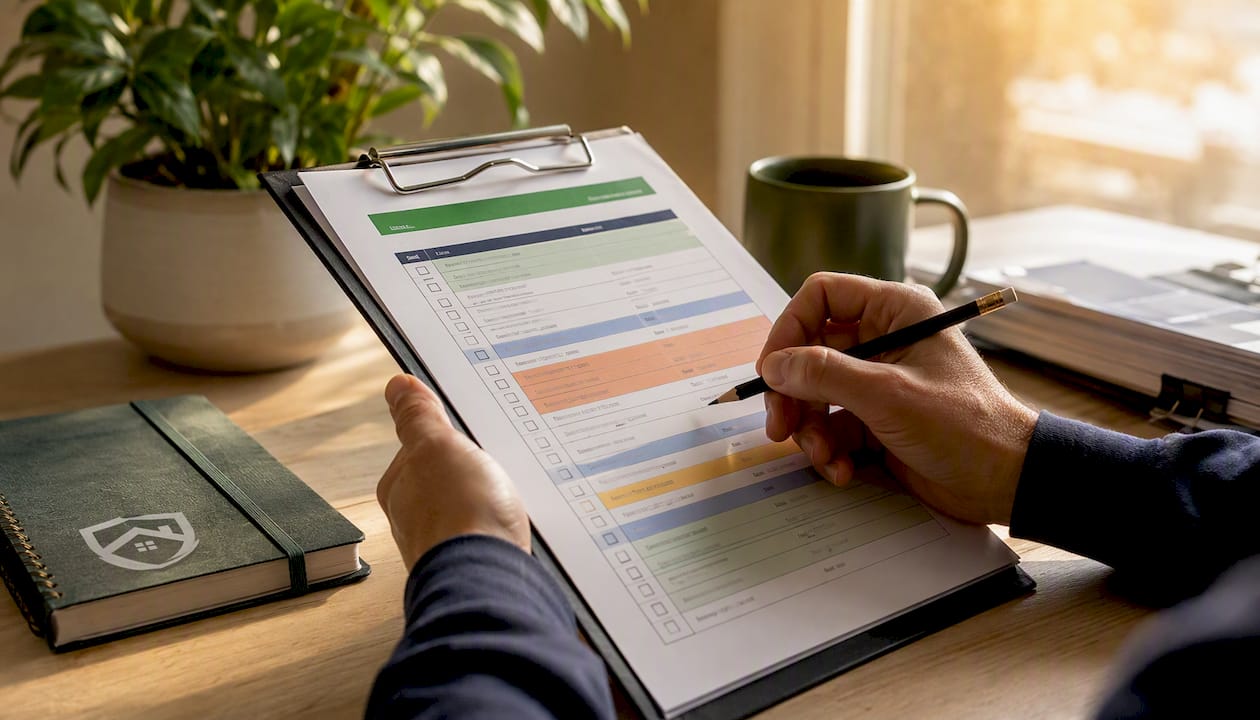
Larger weather-linked tasks are easiest when you tackle them at the right point in the season. The table below maps each season to its highest-priority jobs, and the notes below add context for safety-critical items.

| Season | Priority Tasks | Safety Notes |
|---|---|---|
| Spring | Clean gutters and downspouts; inspect roof for winter damage; schedule HVAC spring tune-up; check attic for moisture or pests; test irrigation system; reseal driveway cracks | Roof inspection after heavy snow or ice — look for missing shingles and damaged flashing |
| Summer | Inspect window screens; service AC unit; clean and seal deck or fence; check for pest activity; test outdoor GFCI outlets; prep pool if applicable | Keep dryer vent clear of lint and debris — a leading cause of home fires year-round |
| Fall | Clean gutters again after leaves drop; schedule furnace tune-up; have chimney inspected and swept; caulk around windows and doors; drain and shut off outdoor faucets; reverse ceiling fans | Chimney inspection before first use each season — creosote buildup is a fire hazard |
| Winter | Insulate exposed pipes in unheated spaces; stock emergency supplies (flashlights, batteries, water); check attic insulation for ice dam risk; monitor heating system performance; clear snow from exhaust vents | Ice dams form when heat escapes through the roof and refreezes at the eaves — poor attic insulation is the root cause |
Better Homes & Gardens and Freddie Mac's homeowner guide both structure seasonal checklists around these same climate-driven priorities, which reflects how most home systems actually fail: at the transition points between seasons.
Spring and fall are your two most important maintenance windows. Spring catches winter damage before it worsens; fall prepares the house for the months when repairs are hardest to schedule and most expensive to ignore.
Set a calendar reminder at the start of each season. If you use property software, recurring seasonal tasks can be pre-loaded so the reminder arrives automatically rather than relying on memory.
Annual and biannual tasks for major home systems
Some jobs don't fit neatly into a monthly or seasonal rhythm. The table below covers the larger, less-frequent tasks, their recommended cadence, and a rough professional cost range to help you budget.
| Task | Cadence | Estimated Pro Cost |
|---|---|---|
| HVAC tune-up (heating + cooling) | Annually (spring for AC, fall for furnace) | — |
| Roof and attic inspection | Annually or after major storms | — |
| Gutter cleaning | Twice a year (spring and fall) | — |
| Dryer vent cleaning | Annually (more often with heavy use) | — |
| Water heater flush | Annually (twice/year in hard-water areas) | DIY or — |
| Termite and pest inspection | Annually | — |
| Chimney sweep and inspection | Annually before heating season | — |
| Electrical panel inspection | Every 3–5 years or after any electrical issue | — |
| Septic system pump-out | Every 3–5 years depending on household size | — |
Sources for exterior annual tasks include Lowe's annual maintenance checklist, which covers roof, gutter, siding, and foundation checks as core yearly priorities.
A few tasks on this list carry outsized risk if skipped:
- Dryer vent cleaning — is one of the most overlooked fire-prevention steps in the home. Lint accumulation is a genuine fire hazard, and NAHB recommends annual cleaning as a baseline.
Pro Tip: Schedule your annual HVAC inspection through an HVAC inspection appointment before the season change. Technicians are easier to book and often cheaper in the shoulder months.
Safety systems: what to test and how often
Safety systems are the one area where "I'll get to it" is not an acceptable answer. The table below gives you the cadence, the time each test takes, and whether a pro is ever needed.
| System | Test/Action | Cadence | Time | Pro Required? |
|---|---|---|---|---|
| Smoke detectors | Press test button; listen for alarm | Monthly | 1 min each | No |
| CO detectors | Press test button | Monthly | 1 min each | No |
| Smoke/CO batteries | Replace batteries | Twice per year | 5 min total | No |
| Smoke/CO units | Replace entire unit | Every 10 years | — | No |
| GFCI outlets | Press Test/Reset on each outlet | Monthly | 5 min | No |
| AFCI breakers | Press test button on breaker | Annually | 10 min | No |
| Fire extinguisher | Check pressure gauge; inspect for damage | Monthly | 1 min | No (annual pro inspection recommended) |
| Sump pump | Pour water into pit; confirm pump activates | Monthly (spring/summer) | 5 min | No |
| Sump pump battery backup | Test backup unit | Twice per year | 10 min | No |
The NFPA recommends testing smoke alarms monthly, replacing batteries at least twice a year, and replacing the full unit every 10 years. A detector that's past its decade mark may pass the button test but still fail to detect smoke in a real fire.
American Family Insurance and Travelers both include these same safety checks in their monthly homeowner checklists, which reflects how seriously insurers treat detector maintenance as a loss-prevention measure.
One note on GFCI outlets: if an outlet trips and won't reset, or if the reset button pops immediately after pressing it, that's a sign of a wiring fault. Call an electrician rather than resetting it repeatedly.
How do you turn a checklist into a schedule you'll actually follow?
A checklist sitting in a drawer does nothing. Here's how to convert it into a working house maintenance schedule.
Build a month-by-month calendar. Assign monthly tasks to the first weekend of each month. Layer seasonal tasks onto the appropriate months: gutter cleaning in April and November, HVAC service in March and September, chimney sweep in October. Annual tasks like termite inspection and electrical review can anchor to a single month you choose and repeat every year.
Budget using the 1%–4% rule. HomeGuide and Rocket Homes both cite this range as the standard homeowner heuristic: set aside 1%–4% of your home's value annually for maintenance and repairs. On a $350,000 home, that's $3,500–$14,000 per year. The higher end applies to older homes or those in harsh climates. Keep this money in a dedicated savings account so it's there when the furnace needs replacing.
Keep records. Log every completed task with the date, what you did or who you hired, the cost, and any photos of the work. Store receipts and warranty documents with the log. This record matters in three situations: filing an insurance claim, selling the house (buyers and agents ask for it), and disputing a contractor's warranty claim.
Freddie Mac's homeowner guide and the AARP Home Upkeep Guide both emphasize that homeowners who use worksheets and simple templates are more likely to complete maintenance consistently.
Choose your format. A printed checklist works fine for a single home. A shared calendar with recurring reminders works better for households where more than one person handles tasks. For owners managing two or more properties, a centralized platform like Mypropertycommandcenter consolidates schedules, vendor contacts, and documents so nothing gets lost between properties. The task scheduling feature lets you set recurring reminders that fire automatically.
When should you hire a pro, and how do you vet one?
Most monthly and seasonal tasks are DIY-friendly. A few are not. Here's a simple rule of thumb: if the job involves the electrical panel, the gas line, the roof structure, or anything requiring a permit, call a licensed professional.
Call a pro when:
- The work requires a permit (electrical, plumbing, structural, HVAC replacement)
- A mistake could void your homeowner's insurance or a manufacturer's warranty
- The safety risk is real (working at roof height, gas line connections, panel work)
- Your time cost exceeds the labor cost by a significant margin
- You've attempted a repair twice and the problem persists
Vendor-vetting checklist before you hire anyone:
- License: Ask for the contractor's license number and verify it with your state licensing board.
- Certificate of Insurance (COI): Request a COI showing general liability and workers' compensation coverage. The contractor COI guide explains exactly what to look for and what questions to ask.
- References: Ask for two or three recent references for the same type of work. Call them.
- Written estimate: Get the scope, materials, timeline, and total cost in writing before any work starts.
- Warranty: Ask what's covered after the job is done and for how long.
- Payment terms: Avoid contractors who demand full payment upfront. A deposit of 10%–30% is standard; the balance on completion.
Red flags: No physical address, pressure to decide same-day, cash-only payment, no written contract, or an estimate dramatically lower than two other bids.
Before the contractor arrives, run through a DIY pre-inspection checklist to document existing conditions. That protects you if a dispute arises about what damage was pre-existing.
How to use the downloadable checklist in print or digital format
The downloadable package includes four components: a monthly task checklist, a seasonal task list (one page per season), an annual and biannual task list with cost estimates, and a vendor notes template.
To print: Download the PDF and print at 100% scale. Each section fits on a single page. Keep it in a home binder with your warranty documents and insurance policy.
To import into a calendar app: Use the CSV version. In Google Calendar, go to Settings > Import & Export > Import, then select the CSV file. In Apple Calendar, use File > Import. Each task imports as a recurring event with the frequency already set. Adjust the start dates to match your home's actual schedule.
To import into property software: Most platforms accept a CSV with columns for task name, due date, frequency, and notes. In Mypropertycommandcenter, the onboarding flow walks you through adding properties and importing tasks in under 10 minutes.
Where to save your records: Create a folder structure that mirrors the checklist: Monthly, Seasonal, Annual, Vendors. Store receipts, photos, and warranty PDFs in the corresponding folder. If you use property software, the document vault keeps these files attached to the specific property and task, which is far easier to retrieve at resale than a folder buried in your email.
Key Takeaways
A consistent home maintenance schedule, built around monthly safety checks, seasonal preparation, and annual system inspections, is the single most reliable way to protect your home's value and avoid emergency repair costs.
| Point | Details |
|---|---|
| Safety checks come first | Test smoke and CO detectors monthly; replace batteries twice a year and full units every 10 years per NFPA. |
| Budget 1%–4% annually | Set aside 1%–4% of your home's value each year in a dedicated maintenance fund to cover repairs without financial stress. |
| Split work across seasons | Assign monthly tasks to the first weekend of each month; anchor seasonal and annual tasks to specific calendar months. |
| Document everything | Log dates, costs, photos, and receipts for every completed task — records matter for insurance claims and resale. |
| Mypropertycommandcenter centralizes it all | The platform's task scheduler, vendor directory, and document vault keep your full maintenance program in one place across all your properties. |
Why maintenance is the best investment most homeowners underestimate
The conventional framing of home maintenance as a chore misses what it actually is: deferred-cost management. Every $200 HVAC tune-up you skip is a potential $4,000 compressor replacement. Every gutter you leave clogged through winter is a possible $10,000 foundation repair. The math isn't subtle.
What I find most homeowners get wrong isn't the big annual tasks. Those are visible enough that most people eventually schedule them. The real losses come from the monthly checks that feel too small to bother with — the slow drain that signals a partial blockage, the GFCI that trips and gets reset without investigation, the smoke detector that chirps for a week before someone changes the battery. Those are the early warnings the checklist exists to catch.
There's also a record-keeping gap that costs homeowners real money at resale. Buyers and their agents increasingly ask for documented maintenance history. A home with a clean, organized log of completed work commands more confidence — and often a better price — than an identical home with no records. The 20 minutes you spend logging a completed task today is worth far more than the time it takes to reconstruct that history from memory during a sale.
For owners managing more than one property, the challenge compounds. A vacation home or short-term rental sitting empty for months is exactly where deferred maintenance turns into emergency repair. Centralizing schedules and reminders in a single system isn't a luxury at that point — it's the only way to stay ahead of it.
Mypropertycommandcenter keeps your maintenance schedule running automatically
Keeping a paper checklist current across one home is manageable. Across two or three properties, it becomes a second job. Mypropertycommandcenter was built specifically for owners in that situation: a clean dashboard that holds your maintenance schedule, vendor contacts, and documents for every property in one place, with smart alerts that remind you before tasks are overdue rather than after.

The recurring task scheduler maps directly to this checklist: set monthly safety checks, seasonal prep tasks, and annual inspections once, and the platform handles the reminders. The vendor directory stores your HVAC technician, plumber, and electrician with their COI and license details attached, so you're not hunting for a phone number when something breaks. The document vault keeps warranties, receipts, and inspection reports tied to the specific property and task.
There's no complex setup and no long-term contract. Start a free trial at mypropertycommandcenter.com/pricing — no credit card required — and import your first property's checklist in under 10 minutes.
Useful sources and further reading
These authoritative sources back the guidance in this article and are worth bookmarking alongside your maintenance records.
- National Fire Protection Association (NFPA) — Smoke and CO detector testing cadence, battery replacement schedules, and fire safety standards.
- NAHB — Routine Home Maintenance — Builder-backed guidance on filter replacement, dryer vent cleaning, and system upkeep.
- Freddie Mac — The Homeowner's Guide to Home Maintenance — Monthly and seasonal checklist structure with budgeting recommendations.
- AARP Foundation — Home Upkeep Guide (PDF) — Practical worksheets covering DIY vs. professional decisions and long-term planning.
- Lowe's — Annual Home Maintenance Checklist — Exterior task priorities including roof, gutters, siding, and foundation.
- Better Homes & Gardens — Home Maintenance Checklist — Seasonal task lists with timing guidance for climate-related maintenance.
- National Center for Healthy Housing — Healthy Homes Maintenance Checklist (PDF) — Health-focused inspection checklist covering moisture, ventilation, and safety hazards.
Save these links in the same folder as your maintenance records. Local building codes and seasonal specifics vary by region, so cross-reference any regulatory or permit question with your local authority or a licensed contractor.