
A maintenance calendar by month is a recurring list of home tasks assigned to the specific month they matter most, so nothing gets forgotten until it becomes a repair bill. The single next step: open your phone's calendar app right now and add recurring monthly events for the tasks below. Skip these and you're gambling on expensive surprises.
Six recurring tasks earn a permanent spot on every homeowner's calendar:
- Check or replace your HVAC filter (monthly during heavy-use seasons)
- Test smoke and carbon monoxide detectors
- Run water in unused drains and check under sinks for leaks
- Run the garbage disposal with ice cubes and citrus peel
- Test GFCI outlets in kitchens and bathrooms
- Glance at visible pipes and the water heater for moisture
Budget 30 to 90 minutes a month for these, and plan on setting aside roughly 1% to 2% of your home's value annually for maintenance and repairs combined.
Key Takeaways
A monthly home maintenance schedule prevents costly repairs by turning small, scheduled checks into a habit instead of a reactive scramble.
| Point | Details |
|---|---|
| Set recurring events now | Add the six nonnegotiable monthly tasks to your calendar app today, not next week. |
| Follow the month-by-month plan | Use the 12-month schedule above as a template, adjusting timing for your climate zone. |
| Separate quarterly from monthly | HVAC filters, sump pump tests, and gutter cleaning run on their own less-frequent cadence. |
| Budget realistically | Plan for 1% to 2% of home value annually plus 1 to 3 hours of monthly time. |
| Centralize with a dashboard | Property Command Center consolidates reminders, vendor contacts, and service records for owners managing multiple properties. |
Table of Contents
- The Month-by-Month Home Maintenance Schedule
- What Should You Schedule Quarterly or Annually?
- How Do You Make the Calendar Actually Stick?
- What Should You Budget for Maintenance Each Year?
- Where and How Should You Log Maintenance Work?
- How Do You Handle Unexpected or Emergency Maintenance?
- How Do You Prioritize When Everything Feels Urgent?
- Sources
The Month-by-Month Home Maintenance Schedule
This is the core of any workable monthly home maintenance schedule: twelve entries, each with a priority action, a frequency tag, and a time estimate. Copy it straight into your calendar app and adjust the timing if you live somewhere with an unusual climate.
- January (monthly, 45 min): Test smoke and CO detectors, check the attic for ice buildup or moisture, and inspect exposed pipes near exterior walls for frost risk. Cold snaps are when ice dams form at roof edges, so this is the month to watch for them.
- February (monthly/annual, 60 min): Map out your spring task list, swap HVAC filters, and check your water heater's pressure relief valve.
- March (seasonal, 90 min): Inspect gutters for winter debris, check exterior caulk and weatherstripping, and prep garden beds and drain lines for the growing season.
- April (seasonal, 90 min): Switch HVAC systems from heat to cooling mode, inspect the roof for winter damage, and test the sump pump before spring rain arrives.
- May (seasonal, 75 min): Service the air conditioner ahead of peak demand, check exterior faucets, and inspect deck or patio surfaces for warping.
- June (monthly/summer, 60 min): Confirm the AC is running efficiently, check irrigation timers, and inspect the roof after the first serious storms.
- July (monthly, 45 min): Clean dryer vents, check window screens, and follow seasonal watering adjustments from EPA WaterSense to avoid overwatering the lawn.
- August (monthly, 45 min): Inspect the foundation for cracks after summer heat, clean ceiling fans, and check attic insulation and ventilation.
- September (seasonal, 90 min): Schedule your furnace tune-up before the rush, start cleaning gutters as leaves begin falling, and inspect chimney and flue if you use one.
- October (seasonal, 90 min): Finish gutter cleaning, winterize outdoor hose bibs and irrigation lines, and test the sump pump again before fall rains.
- November (monthly, 60 min): Weatherstrip doors and windows, check furnace filters, and store or drain garden hoses.
- December (monthly, 45 min): Test detectors one more time, inspect for drafts around windows, and update your maintenance log and home inventory for the year.
Homeowners in colder climates should shift the ice dam and pipe checks earlier, sometimes as soon as November, while those in hot, dry regions can skip several winterization steps entirely and instead add extra irrigation and roof inspection cycles in summer. Coastal and humid regions often need an added mildew and corrosion check every other month.
Pro Tip: Batch your seasonal tasks into a single Saturday morning rather than spreading them across four weekends. You'll spend less total time and won't forget the smaller items that get lost between visits.
What Should You Schedule Quarterly or Annually?
Not everything belongs on a monthly recurring event. Some tasks work better on a quarterly or annual rhythm, timed to when they actually matter.
Quarterly:
- Replace HVAC filters (more often if you have pets or allergies)
- Run the garbage disposal with ice to clean the blades
- Check water softener salt levels
- Test the sump pump by pouring a bucket of water into the basin
Annual or biannual:
- Clean gutters in spring and again after fall leaf drop
- Flush the water heater to clear sediment
- Clean the dryer vent to reduce fire risk
- Inspect the roof and chimney, especially after major storms
DIY handles most of this list. Call a licensed pro for gas appliance work, anything involving the electrical panel, or roof work above a single story.
Pro Tip: Never inspect the roof alone on a ladder in wet or icy conditions. A quick binocular check from the ground catches most obvious problems without the fall risk.

How Do You Make the Calendar Actually Stick?
The best maintenance schedule for homeowners is worthless if it lives in a notebook you never open. Name your recurring calendar events specifically ("HVAC filter, check size on unit" beats "home stuff") and set them to repeat automatically so you never manually reschedule.
Two approaches work: batching everything into one seasonal weekend, or spreading tasks across four short monthly sessions of 20 to 30 minutes each. Batching saves total time; spreading keeps any single week from feeling like a chore.
- A simple spreadsheet works for one property and a patient owner
- A calendar app with recurring events suits most single-home owners
- A dashboard like Property Command Center consolidates reminders, vendor contacts, and documents in one place, which matters more once you own a second property or a rental
Pro Tip: Whatever system you pick, put the task AND the expected time cost in the event title. Seeing "Gutter clean, 90 min" on your calendar makes it far easier to actually block the time.
What Should You Budget for Maintenance Each Year?
A common rule of thumb sets aside 1% to 2% of your home's value annually for maintenance and repairs, though Lowe's annual checklist guidance notes older homes and homes with more systems (pools, extensive landscaping) often land at the higher end.
- Small preventive tasks (filters, caulk, weatherstripping) cost $10 to $50 a visit
- Repair triggers (a failed water heater, a roof leak) run into the hundreds or thousands
- Expect roughly 1 to 3 hours of monthly time total once batching is dialed in
Where and How Should You Log Maintenance Work?
Keep a record every time you service something, and you protect warranties and speed up future repairs. Note the date, the work performed, the cost, the provider, and the appliance's serial number, plus a photo if it's a repair.
- A labeled digital folder works, but files scatter fast across devices
- A document vault, like the one built into Property Command Center, keeps warranties and service history with the property itself
- Free maintenance log templates give you a ready-made format to start today
How Do You Handle Unexpected or Emergency Maintenance?
A burst pipe doesn't check your calendar first. Emergency maintenance breaks into two categories: safety emergencies (gas smell, active flooding, a sparking outlet) and urgent-but-stable issues (a slow leak, a failing water heater that still works).
For true safety emergencies, shut off the relevant utility (water main, gas line, breaker) before calling a professional. Every homeowner should know where these shutoffs are located before an emergency happens, not during one. Walk your property this week and confirm you can find the main water shutoff and the breaker panel in under thirty seconds.
For urgent-but-stable issues, a same-week fix is usually fine, but don't let "urgent but stable" quietly become "ignored for six months." A slow leak behind a wall, left unaddressed, is exactly the kind of problem municipal water authorities warn drives higher bills and hidden damage long before anyone notices water on the floor.
Build a small emergency fund separate from your annual maintenance budget, since even a well-run calendar won't prevent every surprise. A water heater that's ten years old can fail with no warning regardless of how diligently you've flushed it. The calendar reduces surprises; it doesn't eliminate them.
When something breaks outside your planned schedule, log it the same way you log routine work. That failed water heater becomes useful data for planning its replacement's maintenance cycle.
How Do You Prioritize When Everything Feels Urgent?
Not every task on your list deserves equal attention, and treating them all as equally urgent is how homeowners burn out on maintenance altogether. Sort tasks by two questions: what happens if you skip this, and how expensive is that outcome?
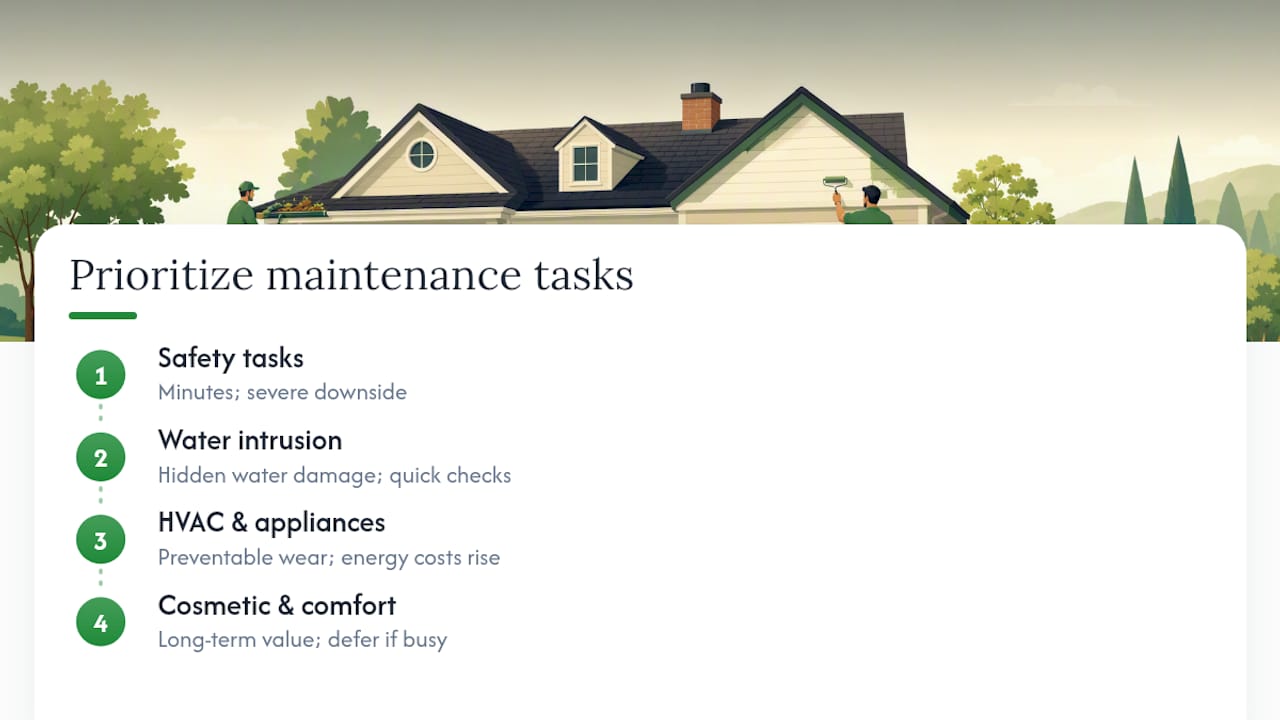
Safety tasks (detectors, GFCIs, gas appliance checks) sit at the top regardless of how busy your month is. They take minutes and the downside of skipping them is severe.
Water intrusion tasks (gutters, sump pumps, pipe checks) come next. Water damage compounds fast and often hides behind walls until it's a five-figure problem, so a 15-minute gutter check in October is worth more than almost anything else on the list that month.
HVAC and appliance upkeep rank third. Skipping a filter change for one month rarely causes damage, but skipping it for a year shortens equipment life and raises energy bills, a point ENERGY STAR's duct guidance makes clearly.
Cosmetic and comfort tasks (caulk touch ups, deck staining) come last. They matter for long-term value but rarely turn into emergencies, so they're the first thing to push to next month when life gets busy.
A Note From Francisco
Most maintenance advice assumes unlimited weekend hours. It doesn't exist for most owners. The system above works because it fits real schedules, and a centralized dashboard removes the mental load of remembering what's due, which is often the actual barrier, not the tasks themselves.
— Francisco
Try Property Command Center for Your Maintenance Calendar
If you're managing more than one property, spreadsheets and sticky notes stop working fast. Property Command Center maps every task from this calendar into recurring reminders tied to each property, so a filter change or gutter clean shows up automatically instead of relying on your memory. Every service record, warranty, and vendor contact lives in one document vault instead of scattered emails and folders.
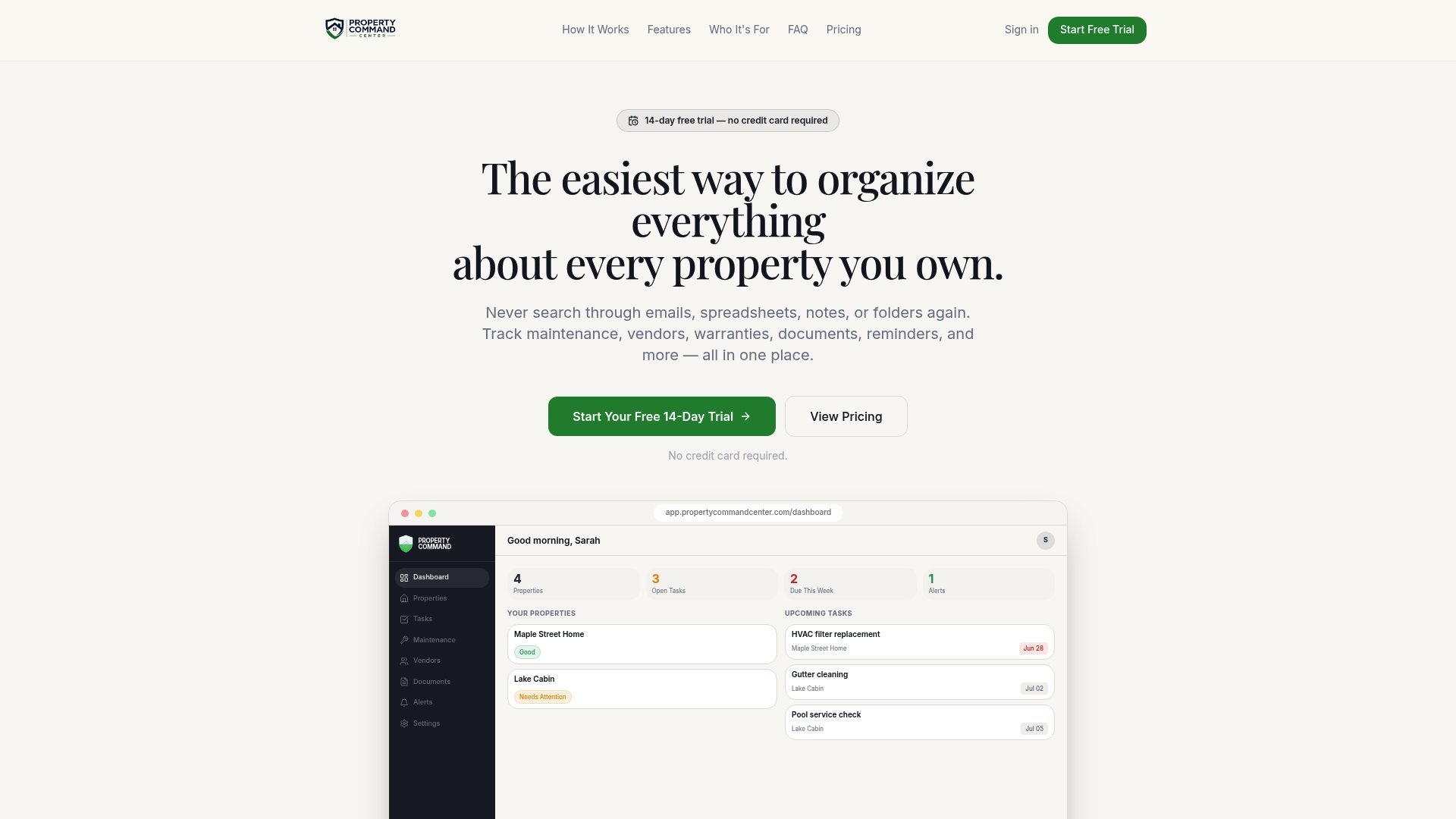
Setting it up takes minutes: import your properties, assign the monthly and seasonal tasks above, and let the reminders run themselves. Start with the onboarding walkthrough to see how the dashboard handles your specific properties, or check the pricing page to see which plan fits your number of homes.
Sources
- Leaks and their cost | NYC.gov
- Sump pump questions | NDSU Extension
- Watering tips | EPA WaterSense
- Duct sealing | ENERGY STAR
- Annual home maintenance checklist | Lowe's