
Build one operating system that covers property records, calendar and rent roll, communications, maintenance, finances, and standard procedures. That single change is what lets an owner manage multiple properties without living in a state of constant catch up. One way to run this system without stitching together spreadsheets is with a dashboard tool, but the framework works with any tool as long as you apply it consistently.
TL;DR:
- Owners should standardize control systems across all properties, including records, calendars, communication channels, maintenance, finances, and procedures.
- Consistent document filing and a master calendar help prevent errors, missed deadlines, and time-consuming searches.
- Reconcile monthly ledger data separately for each property and track insurance, legal compliance, and tax documentation to prevent costly oversights.
- Centralizing communication, maintenance requests, vendor management, and performance reviews ensures timely responses and reduces reactionary management.
- Using a property management platform consolidates all data into one dashboard, streamlining operations and reducing the risk of overlooked tasks or expiration dates.
Table of Contents
- How Do You Organize Multiple Properties?
- Setting Up Property Records and Document Filing
- Building a Master Calendar and an Accurate Rent Roll
- How Do You Keep Tenant and Owner Messages From Piling Up?
- What's the Right Way to Handle Maintenance Requests?
- Keeping Per-Property Finances Straight
- Writing SOPs That Actually Get Followed
- What Should a Weekly and Monthly Review Cover?
- How Property Command Center Runs This System in Practice
- Legal and Compliance Checklist for Multiple Properties
- Insurance Management Across Multiple Properties
- Tax Considerations and Reporting for Multiple Rental Properties
- Emergency and Contingency Planning Across Properties
- Author Perspective: Three Changes to Make This Week
- Start a Free Trial of Property Command Center
- Sources
How Do You Organize Multiple Properties?
Landlords who jump from two properties to five often keep running the same ad-hoc habits: a text thread here, a spreadsheet there, a shoebox of receipts. That works until it doesn't. Practitioner guides on scaling a rental portfolio point to the same conclusion: past a certain size, you either build a standardized operating system or you burn out trying to hold it all in your head.
A portfolio operating system means every property runs on the same six controls, no matter how different the properties themselves are:
- Property records — leases, warranties, inspection reports, and insurance docs, filed the same way every time.
- Calendar and rent roll — one master schedule for move-ins, renewals, and payments across every unit.
- Communications — a single inbox instead of five different apps for five different tenants.
- Maintenance — a standard intake form and a vetted vendor list, not a scramble every time something breaks.
- Finances — a per-property ledger that gets reconciled every month, not every tax season.
- Standard operating procedures — written rules for who does what and when to escalate to you.
Each control feeds the next. A missed maintenance ticket becomes a bad tenant review, which becomes a vacancy, which throws off your rent roll and your monthly numbers. Assign an owner and a proof-of-done requirement to every control (a signed lease uploaded, a repair photo logged, a reconciled bank statement) so nothing depends on memory. Segmenting operations by asset type and geography also helps you decide which controls need a dedicated person versus a shared checklist.
Setting Up Property Records and Document Filing
Every property needs its own folder, and every folder needs the same structure. That consistency is what makes a document searchable in thirty seconds instead of thirty minutes.
A reliable structure looks like this:
- Top level: one folder per property, named by address (e.g., "142 Elm St").
- Subfolders: Lease, Insurance, Tax, Maintenance, Inspections, Warranties, one subfolder per calendar year for anything time-bound.
- File naming: date first, then document type (e.g., "2026-03-Lease-Renewal-Elm-St").
File a document the moment it lands, not at the end of the week. A signed lease, an insurance renewal notice, a warranty card from a new water heater. If it doesn't get filed within 24 hours, it usually gets lost in an inbox for months.
Keep one cloud copy (Google Drive, Dropbox) and one local backup. Cloud storage protects you if your laptop dies; a local copy protects you if the internet doesn't cooperate on the day you need a lease fast.
Pro Tip: Name every file with the date first. Search by year and your entire filing history sorts itself.
Building a Master Calendar and an Accurate Rent Roll
One calendar. Not one per property, not one per tenant. Every lease start date, renewal deadline, inspection, and rent due date lives in a single shared calendar you or a delegate checks daily.
- Consolidate first. Pull every move-in, renewal, and rent due date out of texts, emails, and paper leases and put them in one place.
- Standardize collection. Pick one payment method across every property (an online portal beats checks and cash for reconciliation speed) and require new tenants to use it.
- Reconcile weekly, not monthly. A five-minute check against your rent roll catches a missed payment before it becomes a pattern.
- Automate renewal triggers on a 90/60/30 schedule. At 90 days out, flag the lease for review. At 60, send the renewal offer. At 30, confirm signed terms or start the turnover clock.
A single, standardized rent roll removes one of the biggest time sinks in multi-property ownership: chasing down who paid what, when, and through which channel.
How Do You Keep Tenant and Owner Messages From Piling Up?
Five properties should not mean five inboxes. Route every tenant and vendor message, whether it starts as a text, email, or phone call, into one system you check on a schedule instead of reacting to it in real time.
- Set up one inbox or messaging platform and log everything there, even calls (a one-line note after the call works fine).
- Archive resolved threads weekly so your active queue only shows what's still open.
- Build templates for the events that repeat: rent reminders, maintenance confirmations, lease renewal notices. Set a response time you can actually hit. For example, same-day for standard requests and under two hours for urgent ones.
- Write an escalation rule: if a tenant hasn't heard back in your stated window, the message automatically moves to your personal review queue.
Centralizing tenant communication with templates keeps the tone consistent across properties and stops any single message from getting buried under the next one.
What's the Right Way to Handle Maintenance Requests?
The number one reason repairs slip through the cracks isn't laziness. It's that requests arrive through five different channels and nobody triages them the same way twice.
Standardize the intake first. Every maintenance request, regardless of channel, should capture the property address, the issue description, photos, tenant availability, and an urgency flag. Then triage against a fixed matrix: emergency issues get a response inside 24 hours, urgent issues inside one to three days, standard repairs inside three to seven days, and anything cosmetic waits for the next scheduled visit.
- Build a master vendor list organized by geography, so you're never searching for a plumber at 9 p.m. because your usual guy doesn't cover that zip code.
- Onboard every vendor with the same checklist: proof of insurance, a signed W-9, agreed rates, and a written "definition of done" so you know exactly what finished looks like before you pay.
- Require proof of completion — a photo and a short note — before an invoice gets approved.
An approved vendor list segmented by coverage area prevents the common failure mode where a request sits unanswered because the one vendor you know doesn't work in that part of town.
Pro Tip: Pre-negotiate emergency rates with at least one vendor per trade before you need them. Negotiating during an actual emergency always costs more.
Keeping Per-Property Finances Straight
Every property needs its own ledger, not a blended spreadsheet that lumps five buildings into one number. A useful ledger tracks gross rent, concessions, vacancy loss, mortgage interest, insurance, utilities, maintenance spend, capital expenditures, and net operating income, updated monthly.
- Open a separate bank account per property, or at minimum a separate tracking category, so income and expenses never blur together.
- Reconcile against your bank statement every month, not once a year when your accountant asks for numbers.
- Track net operating income per property as your core KPI. It's the number that tells you which properties are actually earning their keep.
Owners who reconcile monthly instead of annually avoid the scramble that leads directly to burnout when tax season and a dozen unresolved discrepancies collide at once. Your monthly owner report, even if you're the only owner reading it, should show the ledger, a short narrative on anything unusual, and an open issue log.
Writing SOPs That Actually Get Followed
A standard operating procedure that nobody follows is just a document taking up space. The ones that work are short, specific, and include proof.
- Every SOP needs a clear definition of done: not "fix the leak" but "leak repaired, photo submitted, tenant confirms resolution in writing."
- Define who owns each task type (you, a property manager, a virtual assistant) and set a dollar or severity threshold above which they must escalate to you before acting.
- Build in a quality check: a second look at photos or invoices before payment, not blind trust.
- Outsource repetitive, low-judgment tasks first (bookkeeping data entry, scheduling); automate anything rule-based (rent reminders, renewal triggers); keep judgment calls with you until a delegate has proven reliability.
Pro Tip: Write your first SOP for the task you personally dread most. That's usually the one costing you the most stress relative to its actual difficulty.
What Should a Weekly and Monthly Review Cover?
A thirty-minute weekly check and a longer monthly review catch small problems before they become expensive ones.
- Weekly (30 minutes): Confirm rent payments against the rent roll, review open maintenance tickets, and scan the communication queue for anything past its response window.
- Monthly (60 to 90 minutes): Reconcile every ledger against bank statements, review lease renewal timelines, and compile a short report with the P&L, a narrative on anything unusual, and the open issue log.
- Watch for red flags: a maintenance ticket open more than seven days, a rent payment more than three days late, or a vendor invoice sitting unapproved for over two weeks.
Regular review cadences are what separate owners managing their portfolio from owners constantly reacting to it.
How Property Command Center Runs This System in Practice
A dashboard that shows every property's status, upcoming maintenance, vendor contacts, and stored documents in one screen removes the guesswork of remembering which spreadsheet has what. That's the core idea behind Property Command Center's property view: each property gets its own record instead of a row buried in a shared file.
Task tracking and reminders take the mental load off you personally. Instead of remembering that a lease renews in sixty days, the system flags it. The onboarding process walks new users through importing existing property data, and the dashboard planning guide covers how to map your current setup onto the platform.
Legal and Compliance Checklist for Multiple Properties
Compliance obligations multiply with every property you add, and they rarely follow the same schedule. A checklist prevents the kind of oversight that turns into a fine or a lawsuit.
Per-property legal essentials to track:
- Lease compliance. Confirm every lease meets your state and local requirements for disclosures (lead paint for older buildings, security deposit handling, habitability standards). Rules vary significantly by state and even by city, so verify local ordinances rather than assuming one lease template covers every property you own.
- Licensing and permits. Some jurisdictions require a rental license, a business license, or a short-term rental permit renewed annually. Track renewal dates on your master calendar, not a separate system.
- Fair housing compliance. Screening criteria, advertising language, and reasonable accommodation requests must follow consistent, documented standards across every property. Document your screening criteria once and apply it identically everywhere, so you have a defensible paper trail if a decision is ever challenged.
- Habitability and safety codes. Smoke detectors, carbon monoxide detectors, egress windows, and pest control obligations often carry inspection deadlines that differ by municipality.
- Security deposit rules. Many states cap deposit amounts and set strict deadlines for returning deposits with an itemized list of deductions after move-out.
Build a compliance subfolder inside each property's document structure and log renewal or inspection deadlines directly onto your master calendar. A missed permit renewal on one property is a paperwork problem; a missed renewal across five properties, tracked nowhere, is a pattern that eventually costs real money. When in doubt on a specific local requirement, a local attorney or your city's housing department is the actual authority, not a generic online checklist.
Insurance Management Across Multiple Properties
Insurance is one of the easiest controls to standardize and one of the most commonly neglected once an owner has more than two or three properties. Policies renew on different dates, coverage types drift as properties change use (a long-term rental converted to a short-term rental usually needs a different policy), and a lapsed policy is invisible until you need it.
Track four things for every property: the policy type (landlord/rental dwelling, not a standard homeowner's policy), the coverage amount, the renewal date, and the named insured. Store the current policy document in each property's Insurance subfolder and set a calendar reminder 30 days before every renewal, matching the same cadence you use for lease renewals.
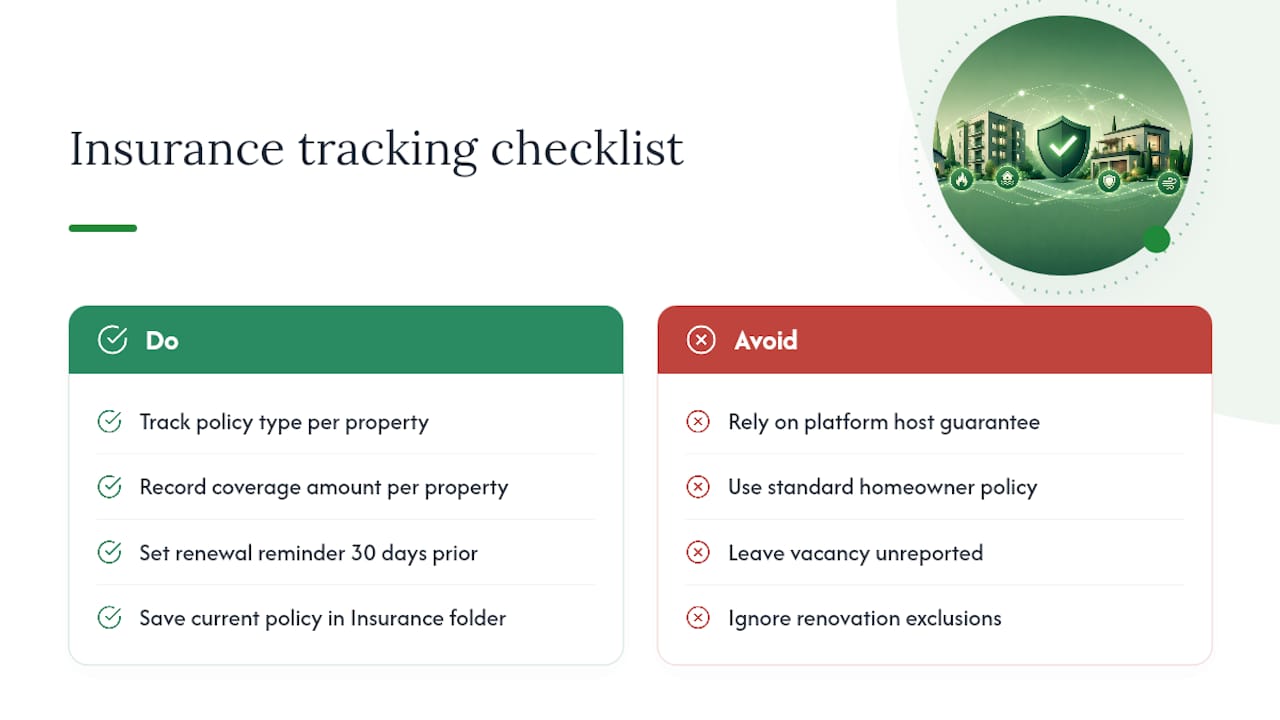
Consider an umbrella policy across your portfolio once you own three or more properties. A single large liability claim on one property can otherwise threaten your other assets if coverage on each individual policy is thin. Ask your insurer directly whether a landlord policy or a builder's risk policy applies if a property is undergoing renovation. Vacant or under-renovation properties are frequently excluded from standard landlord coverage, which is a gap many owners discover only after a claim is denied.
If you manage short-term rentals alongside long-term leases, confirm each property carries the right policy type for its actual use. A standard landlord policy usually will not cover short-term rental liability, and platforms' host guarantees are not a substitute for a real insurance policy.
Tax Considerations and Reporting for Multiple Rental Properties
Filing taxes for one rental property is straightforward. Filing for five, each with different income, expenses, and depreciation schedules, is where disorganized owners lose money they didn't need to lose.
The foundation is the same per-property ledger discussed earlier: gross rent, vacancy loss, mortgage interest, insurance, utilities, maintenance, and capital expenditures, tracked separately for every property rather than blended into one number. That separation matters at tax time because each property is typically reported on its own line of Schedule E, and mixing income or expenses across properties makes it harder to claim deductions accurately or defend them if you're ever audited.
A few practices that make reporting season faster:
- Reconcile every ledger monthly instead of scrambling in March. Twelve small reconciliations beat one massive one.
- Track capital improvements separately from repairs. Improvements typically get depreciated over time; repairs are usually deductible in the year incurred, and confusing the two is a common error.
- Keep every receipt filed in that property's document folder, tagged by year, so you're not searching your email in April for a $400 plumbing invoice from June.
- Work with a tax professional who has actual experience with multiple rental properties. Depreciation schedules, passive activity loss rules, and state-specific rental tax treatment vary enough that generic tax software often misses deductions specific to real estate.
None of this replaces professional tax advice specific to your situation, but a clean, per-property paper trail is what makes that advice actually useful when you get it.
Emergency and Contingency Planning Across Properties
A burst pipe at 2 a.m. is manageable. Three unrelated emergencies across three properties in the same week, with no plan, is how good owners end up making expensive decisions under pressure.
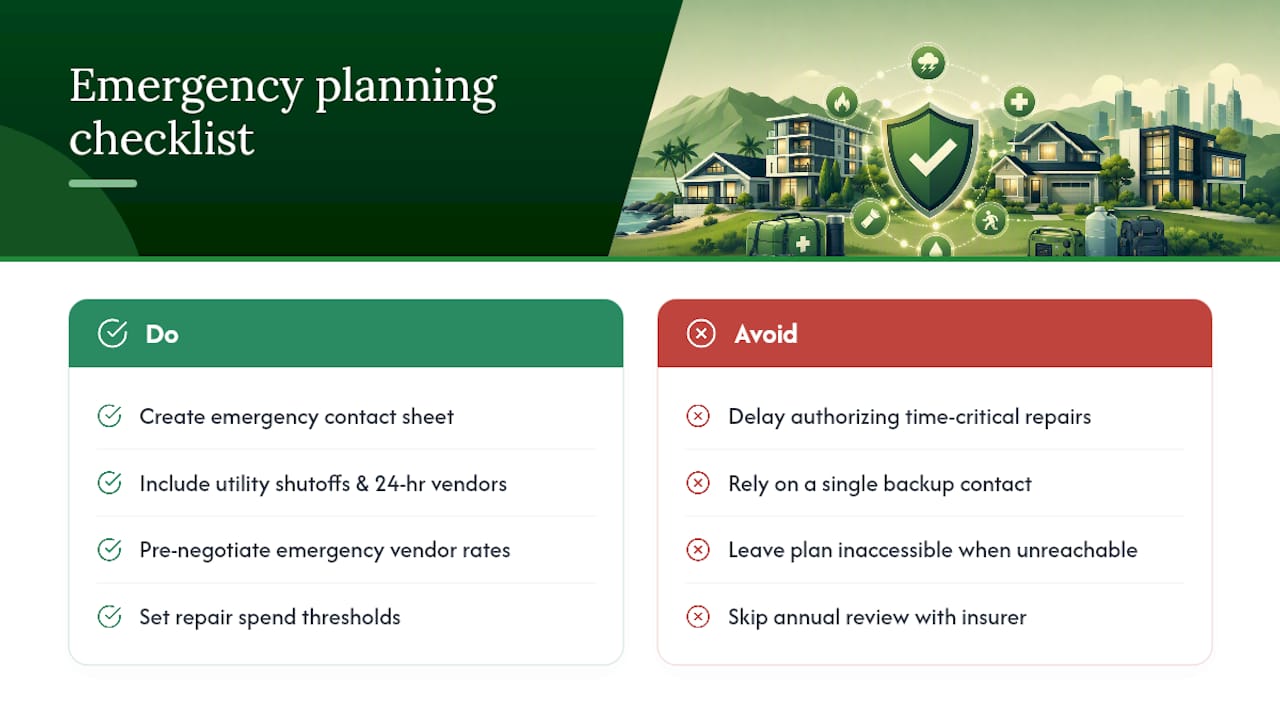
Build an emergency contact sheet for every property that lists the utility shutoff locations, the nearest 24-hour vendor for each trade, your insurance claims number, and a backup contact if you're unreachable. Store it in the property's folder and share the relevant excerpt with any tenant or property sitter who might need it. Pre-negotiated emergency vendor rates, mentioned earlier for maintenance, do double duty here since they're exactly what you want on hand when a pipe bursts on a holiday weekend.
Set spend thresholds in advance so a trusted vendor or delegate can act without waiting for your approval. A repair authorized up to a set dollar amount without a phone call first is the difference between a fixed problem in two hours and a flooded unit sitting untouched for a full day while everyone waits for you to answer your phone.
Plan for the scenario where you're unreachable, not just the scenario where everything runs smoothly. Give one trusted person, a co-owner, property manager, or reliable neighbor, access to your document vault and vendor list so a decision can still get made if you're on a plane or out of signal range. Review this plan once a year alongside your insurance renewals, since it tends to go stale exactly when you need it most.
Author Perspective: Three Changes to Make This Week
Skip the twelve-step overhaul. Pick one payment method and require it for every new tenant, starting now. Create your property folder structure today and file your most recent lease in it before you close this tab. Then block thirty minutes weekly for a portfolio review, and add one vendor contact to a shared list before the week ends. Small, real changes beat a perfect system you never build.
— Francisco
Start a Free Trial of Property Command Center
Spreadsheets and scattered folders work fine for one property. The moment you add a second or third, the same information gets duplicated across apps you have to remember to check, and something eventually falls through. Property management platforms can centralize property status, maintenance schedules, vendor contacts, and document storage in one dashboard, so you stop hunting through old emails for a warranty card or a lease clause.
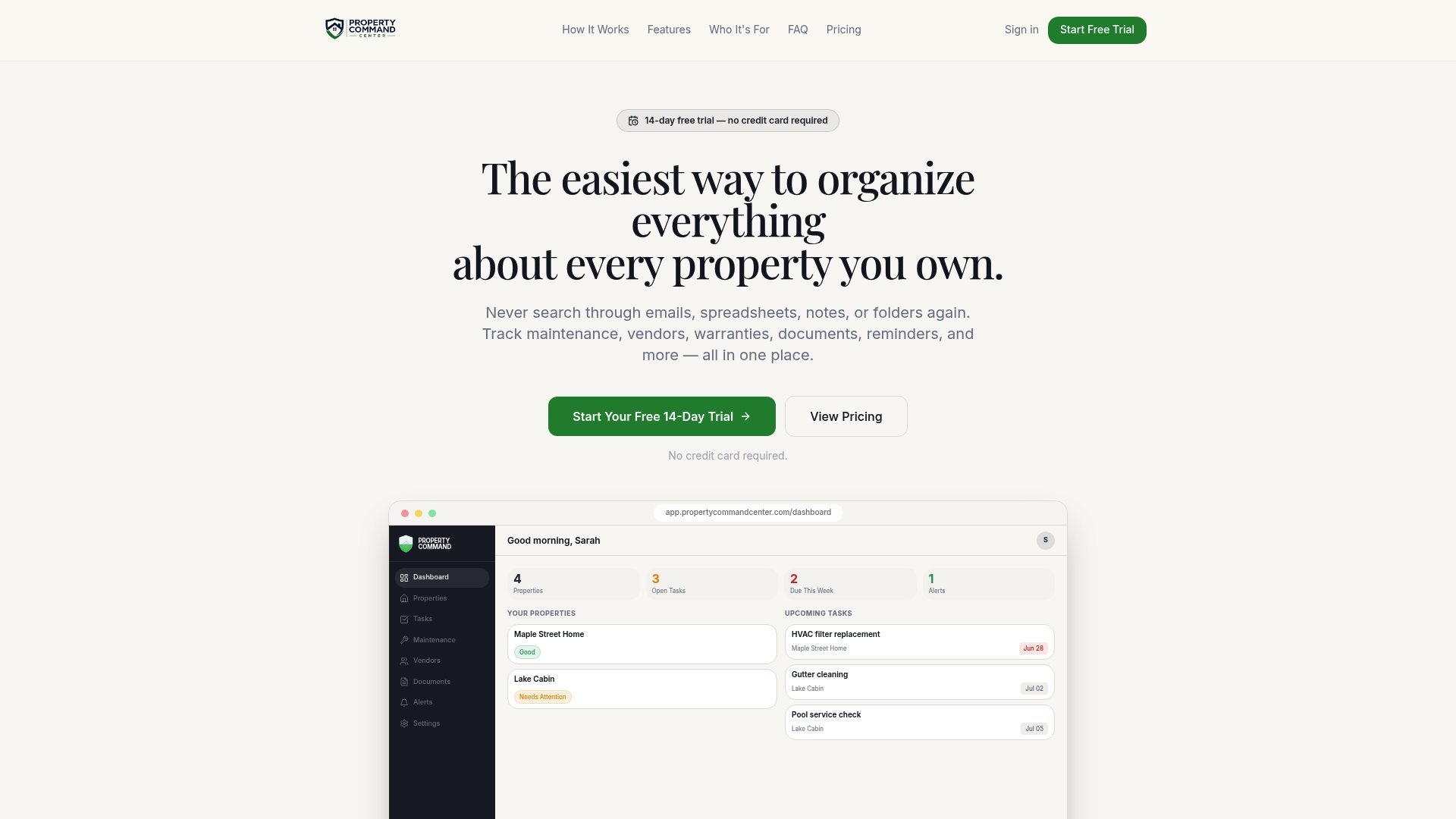
Getting started takes an afternoon, not a weekend. Import your existing property list, upload your current leases and insurance documents into each property's folder, and add your go-to vendors so they're one click away the next time something breaks. Have a specific question about how the platform handles your setup? The Property Query tool answers operational questions directly. Start a 14-day free trial, no credit card required, and see whether one dashboard beats the five apps you're currently juggling.