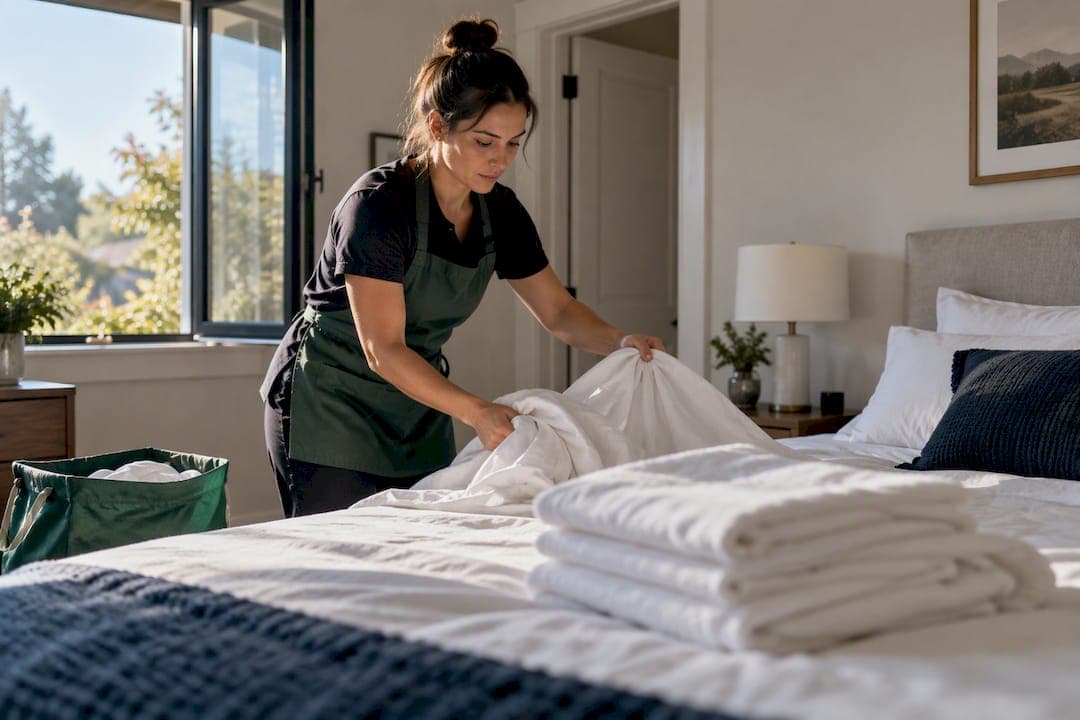
Use a calendar-driven cleaning schedule where every checkout becomes a scheduled turnover row with an assigned cleaner, a measured cleaning window, and a checklist tied to that specific unit. Run each turn through a five-stage sequence: start laundry first, sanitize surfaces, then finish with floors. Close every job with proof, either a timestamped photo or the cleaner's explicit confirmation, logged against that row. Skip any of the three and you'll eventually get a guest walking into a bathroom nobody actually cleaned.
TL;DR:
- Ensuring every turnover has an assigned cleaner and a measured cleaning window reduces the risk of missed spots and guest complaints.
- A detailed room-by-room checklist with specific tasks improves consistency and helps avoid overlooked areas, especially for high-touch surfaces and linens.
- Building a cleaning schedule that accounts for travel time, laundry, and restocking time, plus a contingency buffer, prevents schedule slip-ups.
- Implementing a five-stage cleaning sequence and staging linens in advance streamlines the process and minimizes backtracking during turnovers.
- Using a centralized dashboard or automation tools helps track task status, manage multiple properties, and catch delays or missed confirmations early.
Table of Contents
- What Belongs on a Room-by-Room Airbnb Cleaning Checklist?
- How Do You Build an Airbnb Cleaning Calendar That Doesn't Slip?
- What Is the Five-Stage Turnover Sequence?
- How Do You Handle Laundry for Back-to-Back Turnovers?
- How Often Should You Deep Clean an Airbnb?
- What Should the Final Inspection Confirm Before a Guest Arrives?
- Running Cleaning Schedules Across Multiple Properties
- A Host's Note on Consistency Over Perfection
- Manage Your Airbnb Cleaning Schedule Without the Spreadsheet Chaos
- Sources
- FAQ
What Belongs on a Room-by-Room Airbnb Cleaning Checklist?
A cleaning checklist for Airbnb only works if it's specific enough that a stranger could follow it without calling you. Generic "clean the kitchen" instructions leave too much to interpretation, and interpretation is where turnovers fail. Airbnb's own guidance points to the same pattern: most guest complaints trace back to small, overlooked spots, not big obvious messes, which is exactly why a standardized room checklist and a fixed order of work matters more than raw effort.
Break the checklist down by room so nothing gets skipped in the rush between guests.
Kitchen
- Clear out leftover food from the fridge, freezer, and pantry.
- Run and empty the dishwasher; hand wash anything left in the sink.
- Wipe down and disinfect the stovetop, microwave interior, and countertops.
- Disinfect high-touch points: cabinet handles, faucet, light switches.
Bathrooms
- Scrub the toilet, tub, and shower, including grout lines and drains for hair buildup.
- Replace all consumables: toilet paper, soap, shampoo, and fresh towels.
- Check under the sink and behind the toilet for anything left behind.
Bedrooms
- Strip every bed and replace with fresh linens, no exceptions even if they "look clean."
- Lint-roll upholstered headboards and throw pillows.
- Check under beds, inside drawers, and closets for guest items or dust buildup.
Living areas, entry, and outdoor space
- Vacuum carpets and sweep or mop hard floors.
- Test light bulbs and replace any that are out.
- Wipe down remotes, light switches, and door handles.
- Tidy outdoor furniture, sweep patios, and reset any staged decor.
Every checklist should end with a restock count. Note what's low, what got used, and what needs replacing before the next guest arrives, so the cleaner or the next person in isn't discovering an empty toilet paper closet mid-turn.
How Do You Build an Airbnb Cleaning Calendar That Doesn't Slip?
A cleaning calendar is only useful if it reflects real work, not just open dates on a booking chart. Airbnb warns that a calendar slot that "looks free" isn't proof it's actually serviceable. A four-hour gap between checkout and check-in might look fine on paper and still fail in practice once you account for travel time, laundry cycles, and restocking.
Here's how to calculate a cleaning window that holds up under pressure:
- Start with the raw gap between checkout time and the next check-in time.
- Subtract cleaner travel time to and from the property.
- Subtract the time needed for laundry, especially if there's only one washer on-site.
- Subtract time for restocking supplies and doing a final inspection.
- Add a contingency buffer for anything that runs long, like a stain that needs extra attention.
Airbnb offers an example of a host who builds in six hours between bookings as a workable gap for a thorough clean, though the right number depends entirely on your property's size and your cleaner's speed. If the math doesn't work, something has to change: the booking gap, the cleaning method, the linen strategy, or the staffing. Flag any turnover window that comes in tight and assign a backup cleaner automatically for same-day turns, since those carry the highest risk of a missed slot.
For tracking, small operations can run this on a shared spreadsheet with columns for property, checkout time, check-in time, assigned cleaner, and status. As the number of listings grows, a free template that syncs with iCal removes the manual entry and auto-assigns cleaners based on availability. Whatever the format, every row should move through a simple status workflow: Scheduled, Confirmed, Done, or Exception. That last status matters. It's how you catch a missed turn before a guest does.
What Is the Five-Stage Turnover Sequence?
Airbnb turnover cleaning tips consistently point back to one sequence, because skipping steps or doing them out of order is where most turnovers go sideways. The five stages are: prepare and ventilate the space, clean and remove visible dirt, sanitize high-touch and food-contact surfaces, inspect against the room checklist, then reset and restock.
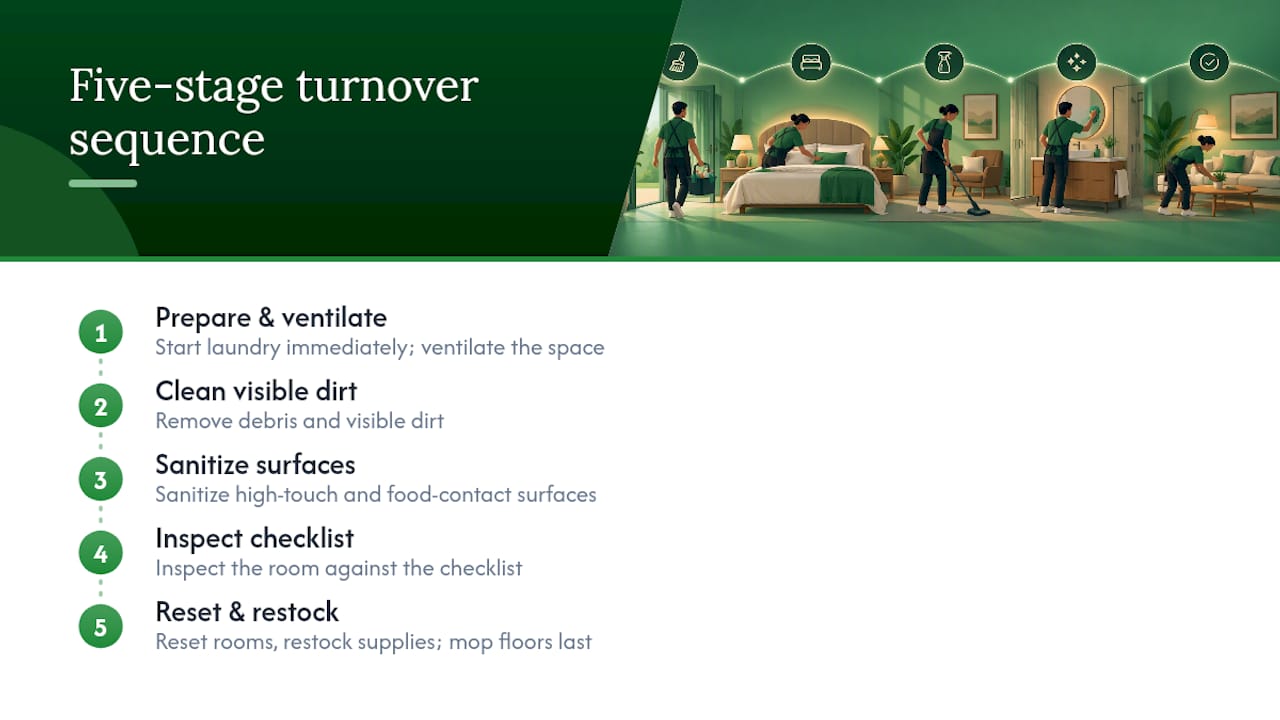
The order isn't arbitrary. Laundry should start the moment the cleaner arrives, since it's the slowest task in the whole process and everything else can happen while it runs. Floors come last for the obvious reason: mopping a floor and then walking across it to clean the bathroom just undoes the work. Cleaners who reverse this order end up backtracking, which eats the exact time buffer you calculated for the turnover window.
This sequence also makes training substitute cleaners fast. Instead of explaining every task from scratch, you hand them five stages and a checklist, and they can execute a full turn on day one without a supervisor standing over their shoulder.
How Do You Handle Laundry for Back-to-Back Turnovers?
Laundry is the bottleneck in nearly every fast turnover, and it's the first thing to plan around rather than the last. Keep a property-specific par list: enough sheet sets, towels, and pillowcases to cover at least one full swap without waiting on a wash cycle to finish.
- Maintain at least two spare linen sets per bed so a clean set is always ready regardless of laundry status.
- Stage clean linens near the bedroom before the cleaner arrives, so beds can be reset while a load is still running.
- For high-turnover properties, consider outsourcing laundry to a service so your on-site cleaner never waits on a machine.
- Record any stained, torn, or missing linens immediately, not at the end of the week, so replacements get ordered before you're short a set.
Airbnb's guidance on stocking cleaning supplies backs this up directly: a linen-swap system paired with spare sets is what makes same-day turns realistic rather than a gamble.
Pro Tip: Keep a third linen set in reserve specifically for damaged or missing items. A cleaner who has to text you mid-turn asking what to do about a torn sheet has already lost ten minutes you didn't budget for.
How Often Should You Deep Clean an Airbnb?
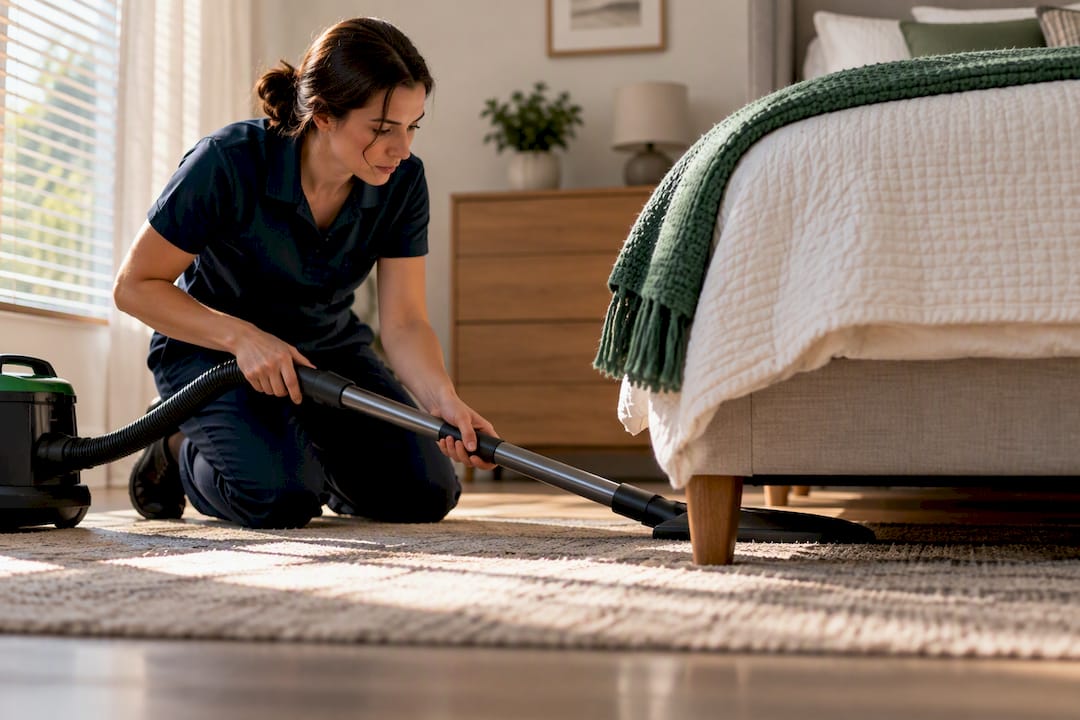
Turnover cleaning and deep cleaning are two different jobs on two different clocks, and mixing them up is how properties slowly degrade even with a spotless-looking turnover every time. Run a full deep clean every two to three months, separate from the standard checkout clean.
Deep cleans catch what a 45-minute turnover simply can't: under beds, inside drawers, cabinet edges, behind and inside appliances, blinds, and outdoor patios. These are the spots that build up slowly and never show up on a quick walkthrough, until a guest opens a drawer and finds it.
Block these dates on your calendar in advance, ideally during natural low-occupancy gaps rather than squeezing them between back-to-back bookings. Track deep-clean and maintenance work separately from your turnover log. A dedicated maintenance schedule keeps recurring checks from getting lost in the same list as daily turnover tasks, and gives you a clean record of what got done and when.
What Should the Final Inspection Confirm Before a Guest Arrives?
The final inspection is the checkpoint that catches what the checklist alone might miss, and it needs to happen before you mark any turnover as complete. Airbnb's own standard for a guest-ready space covers a short, specific list.
- No lingering odors anywhere in the unit.
- Linens are fresh, wrinkle-free, and correctly placed on every bed.
- Toilets and showers are fully disinfected, not just wiped.
- Kitchen is stocked, dishes are clean and put away, and trash has been removed from every bin.
- Staging matches the listing photos, from throw pillows to towel folds.
Every finished job needs completion evidence attached to that turnover's record. That can be a timestamped photo, a checklist marked complete, or explicit written confirmation from the cleaner. Set a clear escalation rule too: if inspection turns up a failure, the backup cleaner or the host gets notified immediately, not after the guest has already checked in.
Running Cleaning Schedules Across Multiple Properties
Hosts running more than two or three listings run into the same failure pattern eventually: assignments go stale, a cleaner assumes someone else covered a unit, and nobody notices until a guest complains. A single operational source of truth, where every property's turnover status, assigned cleaner, and vendor contact lives in one place, closes that gap.
A dashboard exists for this reason: to keep task tracking, vendor directories, and document storage in one place instead of scattered across texts and spreadsheets. For the actual sequencing, a sequenced turnover checklist and a structured inspection checklist give you templates worth adapting property by property. The habits that actually hold up: require confirmations instead of assuming silence means yes, keep a named backup for every cleaner, and write reset standards specific to each unit rather than one generic checklist for a whole portfolio.
A Host's Note on Consistency Over Perfection
The schedule doesn't need to be perfect on week one. It needs to survive contact with a missed flight, a sick cleaner, or a guest who checks out four hours late. Track every exception instead of just fixing it and moving on. Patterns in those exceptions are what tell you where the real schedule needs to change.
— Francisco
Manage Your Airbnb Cleaning Schedule Without the Spreadsheet Chaos
Most hosts start with a shared spreadsheet or a stack of text threads with their cleaner, and it works fine until you're running three or four properties and a turnover falls through the cracks because two people assumed the other one confirmed it. This replaces that patchwork with a dashboard that tracks task status, maintenance reminders, and vendor contacts for multiple properties.
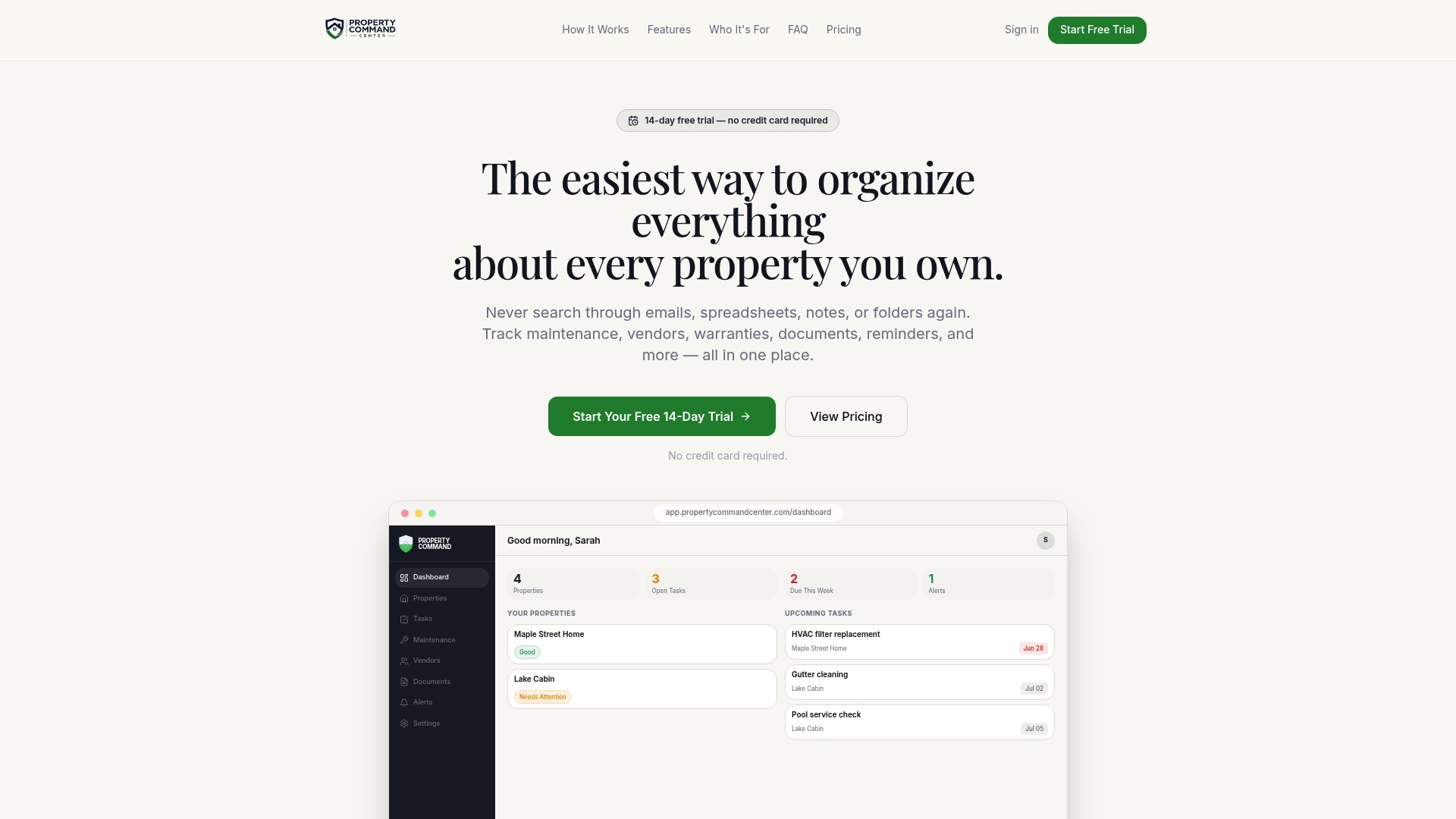
Stale assignments and missing confirmations are the two things that quietly break most cleaning schedules, and they're exactly what a consolidated dashboard is built to catch. Your vendor directory keeps every cleaner and backup's contact info in one spot instead of buried in old texts, and the document vault holds warranties, appliance manuals, and insurance paperwork you'd otherwise dig for during a mid-turn emergency. If you're outsourcing management entirely, a resource like choosing a property management company is worth a look too, but for hosts who want to stay hands-on without drowning in admin, Property Command Center's Starter and Pro plans start at $19 a month. Try the free trial and see whether your next turnover runs smoother with everything in one place.
Sources
- Clean like a pro with these expert tips - Resource Center - Airbnb
- Free Airbnb Cleaning Schedule Template + How to Automate It (2026) - CleanFlow
FAQ
What Is the 80/20 Rule for Airbnb Hosts?
The 80/20 rule generally refers to the idea that 80% of guest satisfaction or revenue tends to come from 20% of your efforts or listings, a common business heuristic rather than an Airbnb-specific standard. Applied to cleaning, it means the handful of high-touch spots (bathrooms, kitchen surfaces, linens) drive most complaints when missed, so prioritizing them protects most of your reviews.
What Is the 5-5-5 Rule for Cleaning?
Definitions of the 5-5-5 rule vary across cleaning and organizing communities, and there's no single Airbnb-endorsed version of it. One common interpretation splits a cleaning session into 5 minutes each on decluttering, wiping surfaces, and resetting a room, which can work as a rough pacing guide but isn't a substitute for a full room-by-room checklist.
What Is the 75-55 Rule in Airbnb Hosting?
There isn't a widely recognized rule tied to Airbnb hosting or cleaning standards by specific numbers. It is safer to rely on measured cleaning windows based on your property's actual turnaround time.
How Much Should a Cleaner Charge to Clean an Airbnb?
Cleaning rates vary widely based on property size, location, and turnover complexity, and there's no fixed industry rate. Rather than anchoring to a specific number, calculate cost based on the actual time your measured cleaning window requires, then compare quotes from a few local cleaners or services against that benchmark.
How Do I Know if My Cleaning Window Is Too Short?
If your cleaner routinely runs late, skips restocking, or laundry isn't finishing before the next check-in, your window is too tight. Measuring the actual workload, rather than just eyeballing the calendar gap, is the only reliable way to confirm a slot is serviceable before you book it.