
Use a property-focused digital vault inside your property dashboard to store each property's declarations, policy numbers, agent contacts, receipts, and itemized inventory. This gets claims moving faster and cuts down on missed renewals, since every document lives in one place, tagged to the right address, instead of scattered across inboxes and file folders.
TL;DR:
- Using a property-specific digital vault allows quick access to declarations, policy numbers, and agent contacts, reducing claim delays and confusion.
- Essential features include tagging, search, encrypted storage, and shareable export options to meet adjusters' standard documentation requests efficiently.
- Building a claim-ready folder in under an hour involves uploading declarations, inventorying items, tagging endorsements, and generating a comprehensive claims packet.
- Regular annual reviews and immediate updates after major purchases or claims keep records current and ensure a smooth claims process.
- Combining digital security measures like encryption and multi-factor authentication with backup exports enhances protection of sensitive legal and financial information.
Table of Contents
- What an insurance document organizer means for owners with multiple properties
- Checklist: essential features your insurance document organizer must provide
- Step-by-step setup: build a claim-ready folder for each property in one session
- Documents to store for claims and renewals: exact items adjusters will ask for
- Security and access: what to require and enable now
- Maintenance rhythm: when to update each property's insurance records
- Types of insurance documents to include beyond home and auto
- Choosing physical vs digital organizers: pros and cons
- Recommended apps or tools for digital document organization
- Backup and disaster recovery strategies for documents
- How to categorize and label documents effectively for quick retrieval
- Legal considerations around storing insurance documents
- A few habits that save real time when a claim happens
- How Property Command Center brings this together
- FAQ
- Sources
What an insurance document organizer means for owners with multiple properties
An insurance document organizer, in the sense that matters here, is a digital vault built into property management software rather than a paper folder or a standalone scanning app. For someone managing one house, a shoebox of papers might work. For owners juggling a primary home, a lake house, and a short-term rental, it falls apart fast: each property carries its own policy, its own endorsements, and its own inventory of belongings.
Keeping those records separate by address matters because mixing them creates confusion exactly when you need clarity most, during a claim.
A vault organized by property should let you:
- See each property's current declarations page and policy number at a glance
- Pull up the right agent contact without guessing which policy applies
- Compare coverage and deductibles across properties side by side
Claims guidance from the Triple-I notes that adjusters commonly request an itemized inventory with purchase dates and receipts, which is exactly what a per-property vault is built to produce on demand.
Checklist: essential features your insurance document organizer must provide
Not every digital folder qualifies as a real insurance document organizer. Before you commit to a system, check it against a short list of non-negotiables.
- Per-property vaults with tagging and search so you can filter by address instead of scrolling through everything at once
- Declarations page and policy-number fields paired directly with agent and insurer contact cards
- Date-stamped photos and receipts attached to an editable inventory line for each item
- A shareable claims packet export you can hand an adjuster or email on request
- Adjustable permissions so a spouse, co-owner, or property manager sees only what they need
- Encryption, multi-factor authentication support, and audit logs to protect sensitive policy data
A system missing any of these forces you back into spreadsheets the moment a claim starts.
Pro Tip: Set up the declarations page field first for every property you own. It's the one document an adjuster or agent asks for immediately, and having it ready removes the first delay in any claim.
Step-by-step setup: build a claim-ready folder for each property in one session
You can get a single property fully claim-ready in under an hour if you work through the fields in order instead of jumping around.
- Create the property record and upload the current declarations page with the policy number attached
- Add the agent's contact card along with your insurer's claim-filing instructions
- Walk through each room and log items with photos, purchase dates, estimated values, and serial numbers where they apply
- Attach warranties, appraisals, or manuals directly to the relevant inventory line instead of storing them separately
- Tag any endorsements (flood riders, scheduled jewelry, home business coverage) and generate a one-page claims packet PDF
The Triple-I notes that adjusters ask for exactly this combination: description, purchase date, actual cash value, and receipts, so building to that standard the first time saves a second pass later.
| Setup step | What it produces | Why it matters at claim time |
|---|---|---|
| Declarations upload | Policy number and coverage limits on file | First document an adjuster requests |
| Room-by-room inventory | Itemized list with photos and values | Matches adjuster's requested format |
| Endorsement tagging | Flagged riders and scheduled items | Prevents coverage gaps from being missed |
| Claims packet export | Single shareable PDF | Speeds the first adjuster contact |
A property information sheet template can help you capture these fields consistently across multiple addresses.
Documents to store for claims and renewals: exact items adjusters will ask for
Claims move faster when the right paperwork is already sitting in one folder instead of being assembled under pressure.
- The current declarations page, including endorsements and deductible amounts
- A room-by-room inventory with photos, receipts, purchase dates, and serial numbers
- Agent and insurer contact information, plus claims-portal login instructions
- Receipts for additional living expenses if you're displaced, and a contractor's certificate of insurance for any repair work
- An exportable or printable claims packet ready to hand to an adjuster on first contact
A dedicated document vault per property speeds claims settlement, according to Triple-I claims guidance, because adjusters request an itemized inventory with purchase dates and receipts as a standard part of settling a loss. The same guidance points out that keeping receipts for temporary living expenses helps substantiate additional living expense claims if you're displaced during repairs.
Security and access: what to require and enable now
Insurance policies carry sensitive personal and financial information, so the platform holding them needs real security behind it, not just a login screen.
- Confirm the platform encrypts data in transit and at rest, and that it can describe a documented security program
- Turn on app-based multi-factor authentication or a security key rather than relying on SMS codes alone
- Use share links with expiration dates and give co-owners or property managers only the access they actually need
- Keep a recovery plan so a trusted family member or co-owner can get in during an emergency
The FTC's guidance on two-factor authentication recommends app-based authenticators or security keys over SMS, since text messages can be intercepted more easily. Under the FTC Safeguards Rule, businesses handling customer information are expected to run a risk assessment and maintain a written security program, a reasonable bar to expect from any platform storing your policies.
Pro Tip: Ask any software you're considering whether it supports app-based MFA before you upload a single document. If the answer is no, keep looking.
Maintenance rhythm: when to update each property's insurance records
A vault is only useful if it stays current, and insurance records go stale faster than most owners expect.
- Review every property's records once a year, timed to line up with each policy's renewal date
- Update immediately after a major purchase, a renovation, or a filed claim
- At each annual review, confirm the declarations page is current, add any new inventory items, check for new endorsements, and verify agent contact details
- Set an automated reminder ahead of each renewal date and assign one person as the owner of updates for each property
The NAIC's home inventory guidance describes a home inventory as a living document that should be updated annually or after significant purchases, a rhythm that applies just as well to the rest of your insurance records.
Types of insurance documents to include beyond home and auto
A property-focused vault handles homeowners and auto policies well, but most owners carry coverage that doesn't fit neatly into either category. Health insurance cards, summary-of-benefits documents, and claims history belong in the same system, especially if you're managing records for family members across multiple households.
Life insurance adds its own layer: policy documents, beneficiary designations, and the contact information for the issuing agent all matter if something needs to be filed quickly. Disability insurance policies, whether short-term or long-term, should include the elimination period and benefit terms, details that are easy to forget between enrollment and the day you actually need the coverage.
If you carry an umbrella policy across your properties, keep its declarations page next to the underlying home and auto policies it supplements, since claims adjusters often need to see how the layers connect. Renters insurance for a vacation property you lease out, flood or earthquake riders, and any business-use endorsements for a home office all deserve their own tagged entry rather than getting buried inside a general folder.
The goal isn't to turn your property vault into a catch-all for every document you own. It's to make sure that when a claim or a renewal touches more than one type of coverage, you're not hunting through email for the policy that matters.

Choosing physical vs digital organizers: pros and cons
A fireproof folder in a filing cabinet still has a place, but it comes with real limits for owners managing more than one address. Paper is immune to a software outage and doesn't require a password, yet it's also vulnerable to the exact disasters that trigger claims in the first place: fire, flooding, and storm damage.
Digital organizers solve the access problem. You can pull up a declarations page from your phone while standing in a damaged kitchen, something a paper folder sitting in that same kitchen can't offer. They also make it far easier to keep multiple properties separated, searchable, and current without retyping anything.
The tradeoff is that digital systems depend on the provider's security and uptime, which is why encryption and multi-factor authentication aren't optional extras, they're the baseline. A reasonable middle ground many owners land on: keep a small physical folder with the declarations page as a last-resort backup, but make the digital vault the system you actually use day to day. The paper copy covers you if your phone is dead or the internet is down during an emergency; the digital vault covers everything else, including the ability to share a claims packet with an adjuster from anywhere.
Recommended apps or tools for digital document organization
The NAIC home inventory guidance points to free tools built specifically for building a room-by-room inventory, a useful starting point if you've never created one before. These general inventory tools are a fine way to get your first property documented, but they weren't built with multiple addresses in mind, so you end up exporting and re-organizing the results somewhere else anyway.
That's the gap a property-focused dashboard is built to close: instead of a standalone inventory app, a document vault that lives inside your property management software ties the inventory directly to the right address, the right policy, and the right agent contact from the start. For readers who want a deeper look at structuring digital assets more broadly, My Affairs in Order's guidance on digital assets inventory covers the same principles applied to estate and record planning.
Whatever tool you choose, the test is simple: can you generate a single claims packet for one property in under a minute? If not, the tool is adding a step rather than removing one.
Backup and disaster recovery strategies for documents
The whole point of a digital vault is that your records survive the event that damages your property. That only holds true if the platform itself backs up data somewhere other than your own device.
Look for a system that stores documents on redundant servers rather than relying on a single device's local storage, so a lost phone or a damaged laptop doesn't mean a lost inventory. It's also worth keeping a periodic export, a downloaded PDF of each property's claims packet saved to a separate cloud account or email, as a secondary copy you control directly.
The Triple-I's guidance on settling claims after a disaster recommends keeping copies of everything submitted to your insurer during a claim, which is easiest when your vault already stores an original copy alongside the submission. Treat your document vault the way you'd treat financial records: one primary system, one backup you control, and a habit of checking both still work after a major update or device change.
How to categorize and label documents effectively for quick retrieval
A vault full of unlabeled files is barely better than a shoebox. The fix is a consistent naming and tagging system applied the same way across every property from day one.
Start by tagging everything to a specific property address first, since that's the filter you'll use most often when a claim or renewal comes up. Within each property, separate documents into a few clear categories: declarations and policy documents, inventory items with receipts, contact information, and supporting records like warranties or appraisals.

Label inventory photos with the item name and purchase date rather than a generic file name, so a search for "kitchen appliances 2023" actually returns something useful. Keep endorsements and riders tagged separately from the base policy, since those are often the documents an adjuster asks about specifically when a claim touches a scheduled item or added coverage.
The sample HO-3 policy from Triple-I shows how a declarations page itself is organized, by coverage type, limit, and deductible, and mirroring that same structure in your own labeling makes it easier to match your records to what your policy actually says.
Legal considerations around storing insurance documents
Insurance records contain personal and financial details, including your address, policy numbers, and sometimes health information if you're storing life or disability documents alongside home and auto. That makes the platform's data-handling practices worth checking before you upload anything.
The FTC Safeguards Rule requires businesses that handle customer information to maintain a written security program scaled to the sensitivity of the data they hold, including risk assessments of the apps used to store or access it. That standard is a reasonable one to hold any document vault to, even outside a strict legal requirement, since it points to encryption, access controls, and a real plan for handling a breach.
Sharing access with a co-owner, property manager, or family member also raises a practical legal point: permissions should be specific to what that person needs, not blanket access to every property and policy you own. If you're storing health or disability insurance details alongside property records, treat those fields with the same caution you'd apply to any medical record, limiting who can see them regardless of what the platform's default settings allow.
A few habits that save real time when a claim happens
I've found the owners who move through a claim with the least friction are the ones who built their declarations page entry first and treated the inventory as a second pass, not the other way around. A ready claims packet, declarations, contact card, and receipts in one file, turns a long adjuster visit into a short one.
Keep a per-property claims packet template ready before you ever need it.
— Francisco
How Property Command Center brings this together
We built the document vault inside Property Command Center around exactly this per-property workflow: one dashboard where every home or rental gets its own tagged folder for declarations pages, policy numbers, inventory photos, and agent contacts, instead of a single pile of files you have to sort through under pressure.
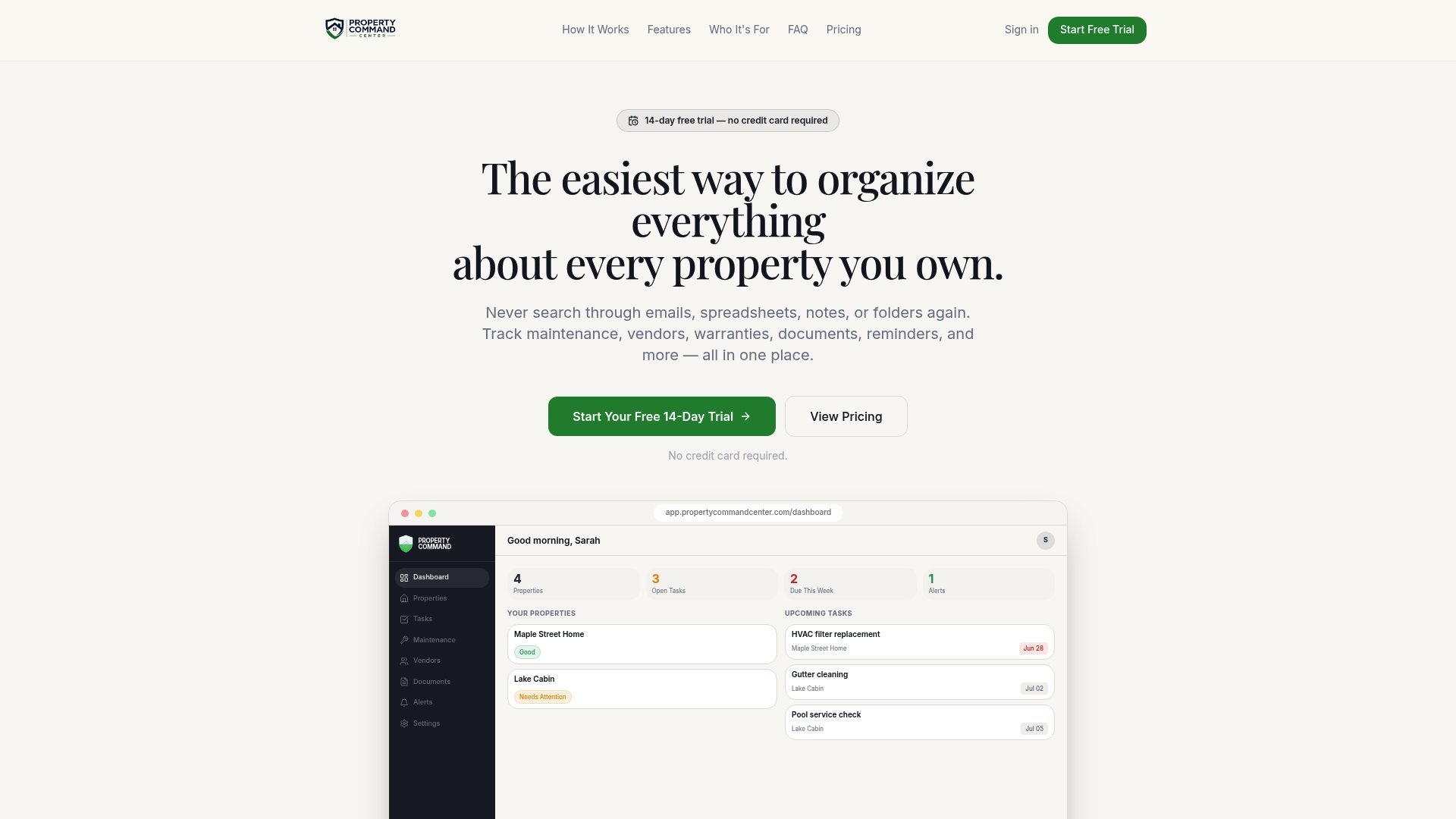
What that looks like in practice:
- A document vault organized by property, with reminders tied to each renewal date
- Inventory capture fields for photos, receipts, and purchase dates, attached to the right address
- A vendor directory that keeps contractor certificates of insurance next to the policies they relate to
- Secure, permission-based sharing so a co-owner sees only the properties relevant to them
We offer a 14-day free trial with no credit card required, and our Starter and Pro plans scale with how many properties you manage. Our 90-day setup guide walks you through onboarding each property's records at a pace that doesn't eat a whole weekend.
FAQ
What should I store first in an insurance document organizer?
Start with the current declarations page and policy number for each property, since that's the document an agent or adjuster asks for first. Add agent contact information and claims instructions right after.
How often should I update my insurance records?
Review each property's records once a year, timed to its policy renewal, and update immediately after a major purchase, renovation, or filed claim. The NAIC recommends treating a home inventory as a living document that gets refreshed on that same schedule.
Is a digital insurance vault more secure than paper files?
A digital vault can be more secure when it uses encryption and multi-factor authentication, protections a paper folder can't offer. The FTC recommends app-based authenticators or security keys over SMS codes for accounts holding sensitive information.
What does Property Command Center cost?
Property Command Center offers a Starter plan at $19 per month and a Pro plan at $49 per month, both available through a 14-day free trial with no credit card required.
What exactly do adjusters ask for during a claim?
Adjusters typically request an itemized inventory with item descriptions, purchase dates, actual cash value, and receipts, according to Triple-I claims guidance. Having a declarations page and that inventory ready in one file speeds up the first adjuster contact.
Sources
- How to file a homeowners claim - Triple-I®
- Home inventory guidance (NAIC)
- Use two-factor authentication to protect your accounts - FTC
- FTC Safeguards Rule: what your business needs to know