
Set up one calendar, add several of your most critical recurring tasks, and schedule two seasonal professional checks: start there. That single move, done this week, replaces scattered sticky notes and half-remembered service dates with a system you can actually see. Following cadences like the ENERGY STAR guidance on filter checks and seasonal HVAC service means fewer missed tasks and reminders that show up before something breaks, not after.
TL;DR:
- The Department of Energy says regular upkeep can reduce heating and cooling costs by 5% to 10%; track completion, overdue tasks, and annual service costs.
- ENERGY STAR recommends inspecting or replacing HVAC filters monthly during peak use, with cooling service in spring and heating service in fall.
- A calendar app can manage reminders for one property, but spreadsheets lack automatic alerts; dashboards become useful beyond two or three properties.
- Start with five critical tasks, test that reminders work, then add remaining tasks over the next week; review completion and costs monthly or quarterly.
Table of Contents
- Why a maintenance calendar matters and what to track
- Organizing tasks by frequency and priority: choosing intervals that actually work
- Seasonal and annual planning for inspections and service windows
- Step-by-step: build your personalized maintenance calendar
- Keeping the calendar current: reminders, accountability, and reviews
- How Property Command Center simplifies calendar setup
- The small-start approach beats the perfect system every time
- Try Property Command Center to get your calendar running today
- FAQ
- Sources
Why a maintenance calendar matters and what to track
A calendar only earns its place on your to-do list if it changes outcomes, not just appearances. Regular upkeep can reduce heating and cooling costs by roughly 5% to 10% and extend the life of your equipment, according to the Department of Energy's guide to home heating and cooling. That's a direct financial reason to move tasks out of your head and into a system.
Regular HVAC maintenance can cut energy costs by 5% to 10%, per the Department of Energy, which makes a basic calendar one of the cheaper upgrades you can make to a property this year.
To make that savings real, your calendar needs consistent data fields for every task, not just a date and a title. Build each entry with:
- Asset (furnace, roof, water heater, gutters).
- Task description and the frequency it repeats on.
- Preferred scheduling window and the vendor assigned, if any.
- Last completed date and next due date.
- Estimated duration and a notes field for part numbers or access instructions.
Once those fields exist, track a few simple numbers: completion rate for scheduled tasks, count of overdue items, and year-over-year service costs. Those three figures tell you whether the system is working or just looking busy.
Organizing tasks by frequency and priority: choosing intervals that actually work
Not every task deserves the same attention, and lumping them into one undifferentiated list is why most calendars fail within a month. Group tasks into bands first, then prioritize within each band.
- Daily or weekly: trash and recycling, quick visual checks on rental turnovers, watering outdoor plants during dry spells.
- Monthly: HVAC filter inspection or replacement during peak heating or cooling months, smoke detector tests, water softener checks.
- Quarterly: deeper HVAC inspection, gutter clearing in wooded areas, pest control treatments.
- Annual: professional furnace and AC service, roof inspection, chimney sweep, septic pumping where applicable.
Prioritize within each band using four filters: safety risk, cost of failure, lease or legal obligations, and manufacturer guidance. A gas furnace inspection outranks a deck stain touch-up because the cost of ignoring it is higher and often tied to warranty terms. ENERGY STAR recommends inspecting or replacing air filters at least monthly during peak use, and having a professional check cooling systems in spring and heating systems in fall.
Manufacturer manuals tend to use vague language like "check periodically" or "service as needed," which is useless on a calendar. Translate that into a specific rule: if a manual says "check annually," pick the season that precedes the system's heaviest use, spring for air conditioning, fall for furnaces, and lock in a date.
Pro Tip: When a manual says "inspect periodically," default to quarterly for mechanical systems and monthly for anything with a filter; you can always loosen the interval later if nothing changes between checks.
Seasonal and annual planning for inspections and service windows
Your calendar should follow the rhythm of the year, not a flat list sorted alphabetically. Spring is for cooling prep and gutter clearing after winter debris builds up. Summer suits exterior checks like deck boards, irrigation lines, and paint touch-ups while weather cooperates. Fall means furnace service and weatherproofing before temperatures drop. Winter is about freeze prevention: insulating exposed pipes and clearing snow-load risks from roofs and walkways.

Timing HVAC visits around these windows matters for more than convenience. ENERGY STAR notes that scheduling contractor checks just before peak seasons, cooling systems in spring and heating systems in fall, can mean shorter wait times and lower odds of paying emergency rates when a system fails mid-season.
One-off annual items like roof inspections, chimney sweeps, and septic pumping don't fit neatly into monthly bands, so give them their own fixed slot each year. For rental properties, align these with vacancy windows or tenant turnover so contractors have clear access.
A sample annual rhythm looks like:
- Spring: AC tune-up, gutter cleaning, exterior inspection.
- Summer: deck and fence checks, irrigation system service.
- Fall: furnace tune-up, chimney sweep, weatherstripping.
- Winter: pipe insulation check, roof snow-load inspection.
Step-by-step: build your personalized maintenance calendar
Getting a working calendar in place takes less time than most owners expect, especially if you start with the systems that matter most.
- Inventory your assets and draft task templates. Walk the property and list every major system (HVAC, water heater, roof, appliances) along with the task, frequency, and any vendor already associated with it.
- Assign frequency and recurrence rules. For each task, pick a realistic interval and a preferred window, then set the recurrence so it renews automatically instead of requiring manual re-entry.
- Choose a platform that matches your scale. Paper logs work for a single property with few tasks but fall apart past five or six recurring items. Spreadsheets add flexibility and let you sort by due date, but they don't send reminders on their own. Calendar apps handle reminders well but scatter vendor contacts and documents elsewhere. A lightweight property dashboard keeps tasks, vendors, and documents together in one place, which matters more as the number of properties grows.
If you're migrating from a mix of spreadsheets and sticky notes, move your five most critical tasks first, confirm reminders fire correctly, then add the rest over the following week rather than trying to transfer everything at once.
- A basic calendar app works well for reminders on a single property.
- A dashboard-style system reduces duplicate entries once you're managing more than two or three properties.
Keeping the calendar current: reminders, accountability, and reviews
A calendar that nobody checks is just a list. Set up three reminder tiers: an alert to yourself a week ahead, a nudge to the vendor a few days before, and an escalation flag if the task passes its due date without being marked complete.
Run a short review every month or quarter: check which tasks were completed on time, which slipped, and whether costs are trending up for any recurring service. Watch three numbers: completion rate, overdue count, and service cost trends, since a rising cost on a recurring task often signals it's time to switch vendors or adjust frequency.
Automate what you can. Runtime-based reminders for HVAC filters, rather than fixed calendar dates, account for actual usage instead of guesswork, an approach covered in more detail in this guide on runtime-based HVAC filter reminders.
Pro Tip: Mark tasks complete the same day you finish them. A one-day delay in logging completion is usually the first crack that leads to a calendar nobody trusts.
- Owner reminder, then vendor confirmation, then escalation if overdue.
- Quarterly review of completion rates and cost trends keeps frequencies honest.
How Property Command Center simplifies calendar setup
A consolidated dashboard can unify maintenance tasks, vendor contacts, and documents in one place instead of three. For owners managing more than one property, consolidating schedules this way cuts out the duplicate entries and missed handoffs that come from juggling separate spreadsheets and inboxes. Our 90 Day Calendar First Property Maintenance Plan for Small Portfolios walks through building that first 90 days of structure step by step.
The small-start approach beats the perfect system every time
Most advice on maintenance calendars front-loads theory: categorize everything, build a comprehensive asset registry, map every dependency before you schedule a single task. That approach sounds thorough and dies within two weeks, because it asks for a week of setup before any payoff.
The better path is a small win in the first 24 to 48 hours. Five tasks on a calendar today beat fifty tasks planned for next month and never entered. Completion builds the habit that makes the system stick, and a habit is worth more than a flawless spreadsheet nobody opens.
What's overrated is the platform choice itself. Paper, spreadsheet, or app, the tool matters far less than whether you actually look at it weekly. What's underrated is the review ritual: a ten-minute monthly check of what got done and what didn't does more to keep a calendar alive than any amount of upfront planning. Start small, track completion, adjust frequencies based on what actually happens, not what a manual guesses you'll need.
— Francisco
Try Property Command Center to get your calendar running today
Our dashboard keeps maintenance schedules, vendor contacts, and property documents in one accessible place, so you stop digging through emails and separate apps to find a warranty or a contractor's number. For owners managing a handful of properties, that consolidation alone saves the admin hours spreadsheets tend to eat up.
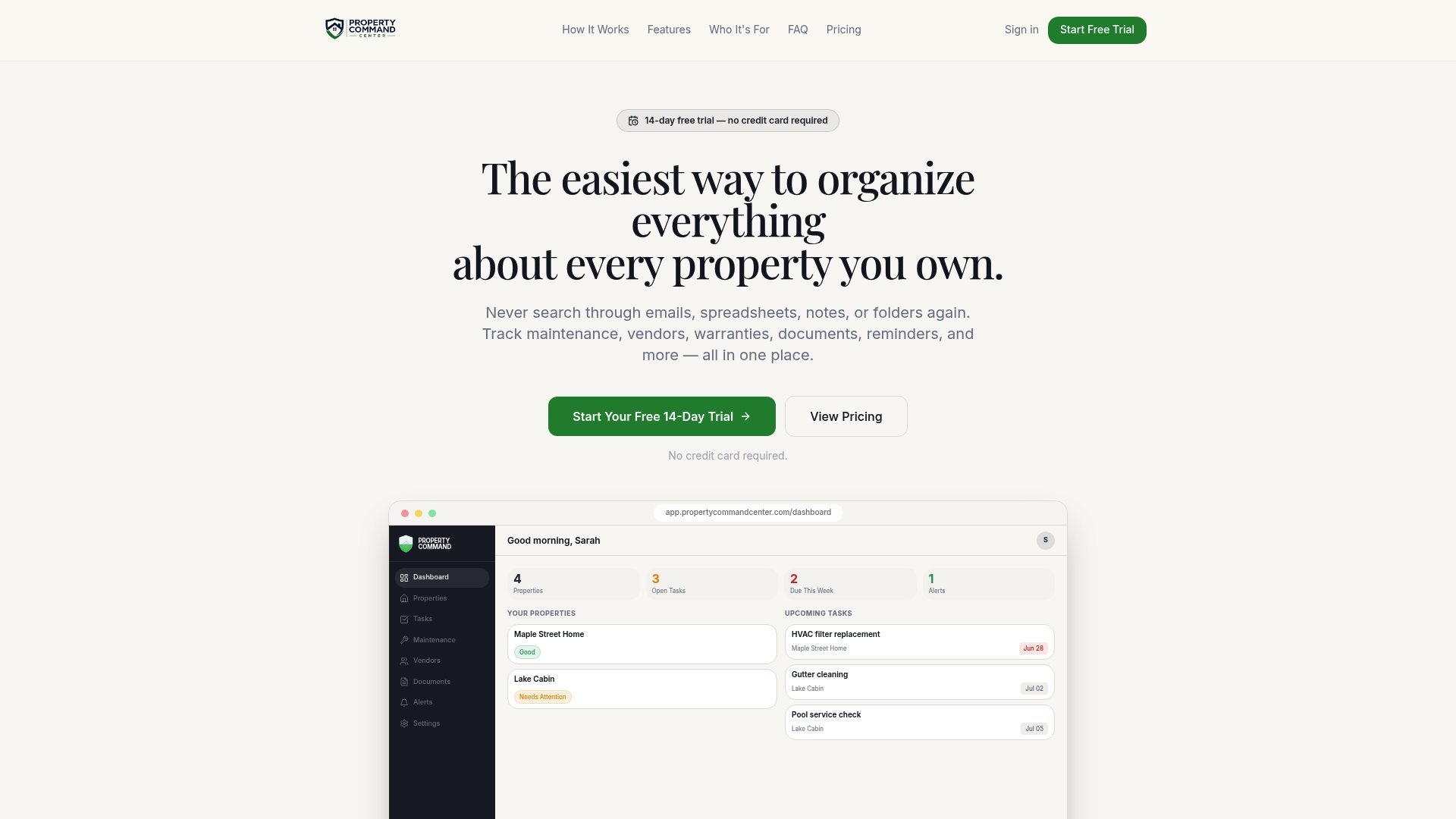
- Start with the Starter plan or try it free before committing.
- Keep vendor contacts attached to the same tasks they service.
- Store warranties and manuals next to the equipment they cover.
| Feature | Benefit |
|---|---|
| Central dashboard | One place for tasks, vendors, and documents |
| Smart alerts | Fewer missed or late maintenance tasks |
| Document vault | Warranties and manuals linked to the right task |
Our Starter plan runs $19 per month and our Pro plan runs $49 per month; both are available through a free trial with no credit card required. Visit our pricing page to compare plans, or check our vendors directory to keep contractor contacts in the same place as your schedule.
FAQ
What is the 30-60-90 rule for car maintenance?
The 30-60-90 rule refers to common vehicle service intervals where manufacturers recommend progressively more thorough inspections and part replacements. It's a vehicle-specific convention and doesn't apply directly to home or property maintenance calendars, though the same interval-based thinking carries over well.
What is the 80/20 rule in maintenance?
The 80/20 rule in maintenance generally suggests that a small share of your assets or tasks, often the critical systems like HVAC and roofing, account for most maintenance costs and risks. Focusing your calendar setup on those few high-impact items first tends to deliver most of the benefit before you expand to smaller tasks.
What are the 3 P's of maintenance?
Definitions vary across industries, but a common version refers to People, Process, and Parts: having the right person assigned, a clear recurring process, and the necessary parts or materials on hand. For a home or small property calendar, this translates into assigning a vendor, setting a repeatable schedule, and tracking any supplies a task needs.
What is a good app for tracking maintenance calendars?
A good option depends on how many properties you manage: a basic calendar app can handle reminders for a single home, while a dashboard built for multiple properties, like Property Command Center, consolidates tasks, vendors, and documents in one place. For reminder-specific needs such as appointment tracking, tools like the one covered in this guide to never missing appointments are also worth a look.
How often should I replace HVAC filters?
ENERGY STAR recommends inspecting or replacing filters at least monthly during peak heating or cooling season. For heat pump systems specifically, ducted setups typically need to filter checks about every 90 days while ductless systems call for monthly cleaning, according to federal heat pump guidance.
Sources
- Maintenance checklist | ENERGY STAR
- Guide to home heating and cooling | U.S. Department of Energy
- You installed an air source heat pump. Now what?