
The best property maintenance plan starts with an asset register listing every major system and component, paired with a calendar that assigns each one a monthly, quarterly, seasonal, or annual task. Build the register first, then schedule your first seasonal round this month. The sections below walk through the components, the budget math, a copyable seasonal checklist, and how to roll it out in your first 90 days.
TL;DR:
- Regularly updating the asset register with detailed information reduces guesswork and prevents unnecessary expenses due to overlooked warranty or age data.
- Scheduling seasonal tasks such as gutter cleaning, roof inspection, and HVAC servicing for each property based on climate and building age optimizes maintenance effectiveness.
- Budgeting around 1% of property value annually, with adjustments to 1.5 or 2% for older or coastal properties, better prepares owners for unexpected repairs.
- Documenting all completed maintenance with photos, invoices, and timestamps creates a solid legal and insurance trail, reducing dispute resolution time.
- Using a dedicated dashboard streamlines task scheduling, vendor coordination, and recordkeeping, making maintenance less burdensome and more consistent.
Table of Contents
- What Is a Property Maintenance Plan, and Why Does Preventive Maintenance Matter?
- Core Components: Asset Register, Standards, Schedule Tiers, and Budget
- Your Season-by-Season Maintenance Checklist
- How to Build Your Maintenance Plan in 6 Steps
- What to Document, and Why It Protects You
- Templates and Tools That Get Your Plan Running This Week
- Maintenance Is a Retention Strategy, Not a Chore List
- Get Your Plan Running Without Building a Spreadsheet Empire
- Sources
What Is a Property Maintenance Plan, and Why Does Preventive Maintenance Matter?
A property maintenance plan is a documented system that tracks every asset in a property, the condition standards it must meet, and the recurring schedule that keeps it there. It's different from a to-do list. A to-do list reacts to what breaks; a maintenance plan anticipates what will break and schedules the fix before it becomes an emergency call at 11 p.m.
The payoff shows up in three places: asset value, cash flow, and tenant retention. Planned HVAC service costs a fraction of an emergency compressor swap. A leaking roof caught during a spring inspection costs a caulk tube; ignored for two seasons, it costs drywall, insulation, and possibly a mold remediation invoice. Preventive scheduling also reduces emergency repair calls and lowers total maintenance spend compared to running everything reactively, according to Oxmaint's analysis of rental property maintenance programs.
Safety compliance is the part owners underweight. Smoke detectors, carbon monoxide alarms, fire extinguishers, and emergency lighting all have testing intervals rooted in OSHA safety standards, and skipping them isn't just a maintenance gap, it's a liability exposure.
A working plan covers:
- Every physical asset and its service history
- Written condition standards for each recurring task
- A frequency tier for every item (monthly through annual)
- A budget tied to actual property value, not guesswork
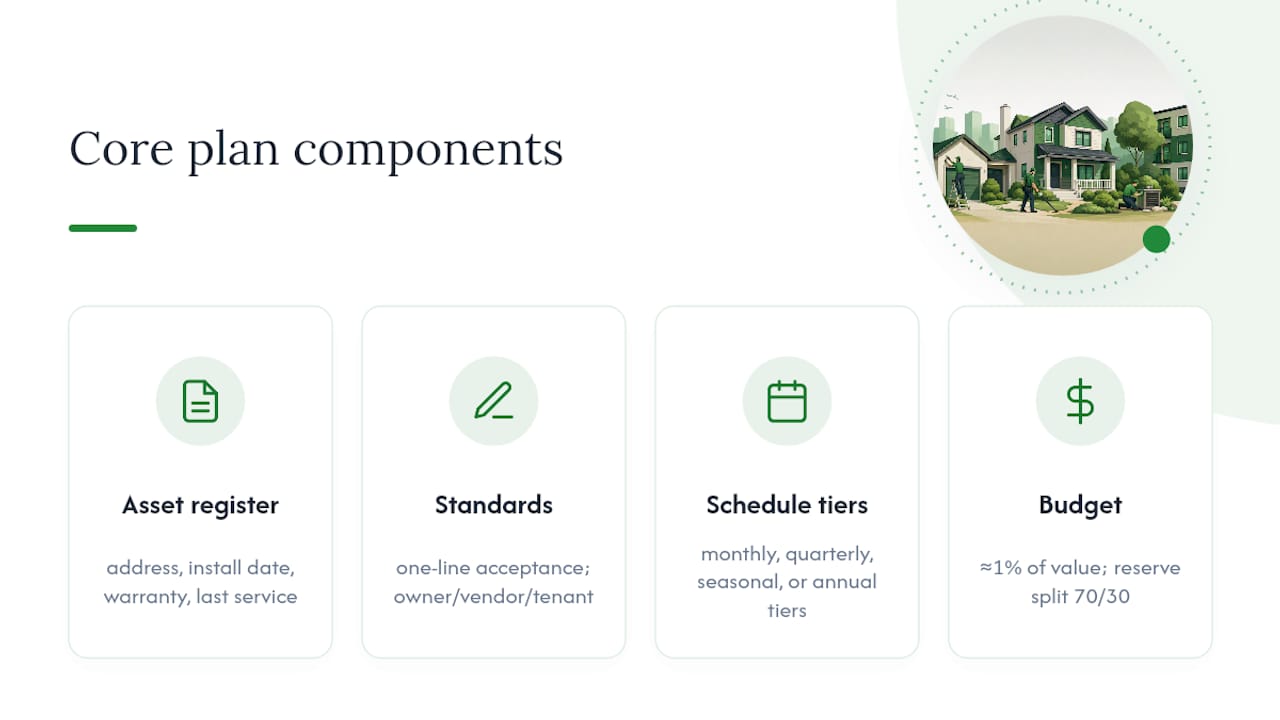
Core Components: Asset Register, Standards, Schedule Tiers, and Budget
Four pieces make a plan functional instead of aspirational. Skip any one of them and the plan collapses into a spreadsheet nobody opens after month two.
The asset register is your source of truth. For each unit, log the address, unit number, asset name (water heater, HVAC condenser, roof), install date, model and serial number, warranty expiration, and date of last service. Without install dates, you're guessing at remaining useful life. Without warranty data, you pay out of pocket for repairs the manufacturer owes you.
Standards and SOPs define what "done" looks like and who does it. Write a one-line acceptance criterion for each task (example: "gutters clear of debris, water flows freely through downspout test") and note whether it's an owner, vendor, or tenant responsibility. This single distinction prevents the most common dispute in self-managed properties: who was supposed to change the filter.
Schedule tiers sort every asset into monthly, quarterly, seasonal, or annual buckets based on failure risk and cost of neglect. HVAC filters go monthly. Gutter checks go seasonal. Water heater flushes go annual. Match the tier to the asset's actual failure pattern, not a generic default.
Budget is where the 1% rule earns its keep. Set aside roughly 1% of a property's value annually for maintenance, meaning a $300,000 property carries about $3,000 in reserve, according to figures compiled in Oxmaint's maintenance schedule template. Split that reserve roughly 70/30 between preventive tasks and reactive buffer, and budget per unit if you manage a multi-unit building rather than a single reserve for the whole property.
Pro Tip: Treat the 1% figure as a floor, not a ceiling. Older systems, coastal climates, and properties over 20 years old often need 1.5 to 2% to stay ahead of failures.
Your Season-by-Season Maintenance Checklist
Two seasons carry the heavy load. Two are lighter check-ins. That rhythm, drawn from industry-standard seasonal maintenance frameworks, is the backbone of a calendar-first plan.
1. Spring (heavy season). Service the air conditioning system before the first heat wave. Clean gutters and check downspout flow. Inspect roof flashing around chimneys and vents for winter damage. Recaulk exterior gaps around windows and doors. Run a pest inspection, especially for termite swarm season in warmer climates.
2. Summer (light season). Swap HVAC filters, one of the highest-return recurring tasks on any list given how directly it affects system efficiency and lifespan, per the DiscoveryMark seasonal schedule. Check deck boards and railings for movement or rot. Monitor for pest activity around foundations. Inspect the condenser unit outside for debris buildup.
3. Fall (heavy season). Service the heating system before the first cold snap. Weatherproof doors and windows with fresh sealant. Clean gutters again, this time clearing leaf drop. Check attic and wall insulation levels, especially in older buildings.
4. Winter (light season). Insulate exposed pipes and shut off exterior spigots to prevent freeze damage. Clear walkways and check exterior lighting for shorter days. Watch rooflines for ice dam formation after snow events. Test sump pumps and any backup systems.
Beyond the seasonal round, layer in frequency-based tasks by system:
- Monthly: HVAC filter checks, visible plumbing leak scan, smoke and CO detector test
- Quarterly: water heater temperature and pressure check, exterior walk-around, dryer vent lint check
- Annual: dryer vent deep clean and water heater flush, both tied directly to fire risk reduction and efficiency, according to the DiscoveryMark schedule
- At tenant turnover: full walkthrough, appliance function test, paint and flooring condition log, rekey locks
Adjust intensity for climate and building age. A 1960s building in a freeze-thaw region needs pipe insulation checks that a 2020 build in a mild climate can skip. Coastal properties need more frequent exterior inspections due to salt air corrosion on metal fixtures.
How to Build Your Maintenance Plan in 6 Steps
Rolling out a plan doesn't require software or a big budget on day one. It requires sequence.
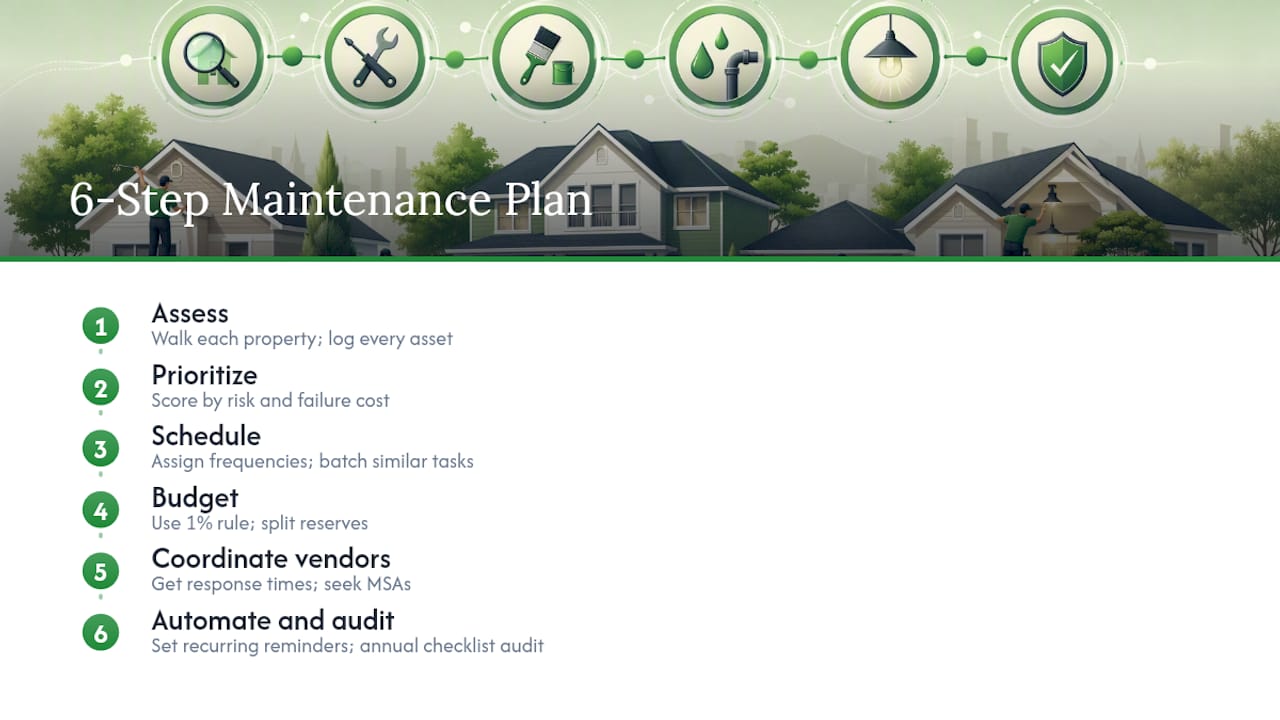
1. Assess. Walk every property and log every asset into your register. Note visible condition issues as you go: cracked caulk, aging shingles, rust on fixtures.
2. Prioritize. Score each item by risk and cost of failure. A failing water heater risks flooding and a four-figure repair; a scuffed baseboard risks nothing urgent. Tackle the register in that order, not alphabetically.
3. Schedule. Assign frequency tiers and batch similar tasks across units. If you own three properties within driving distance, schedule gutter cleaning for all three the same week.
4. Budget. Apply the 1% rule per property, then split reserves between preventive line items and a reactive buffer for surprises.
5. Coordinate vendors. Ask every vendor for their standard response time and whether they offer a master service agreement. Batching recurring work under an MSA cuts the premium you'd otherwise pay for one-off emergency dispatch, and it improves reliability on turnaround, according to Oxmaint's vendor coordination findings.
6. Automate and audit. Set recurring reminders so tasks generate themselves instead of relying on memory. Once a year, pull your repair logs and run a checklist audit, adding tasks tied to recurring failures and cutting ones that never trigger issues, a practice recommended in Apartments.
Pro Tip: Start with your three highest-risk assets, not all fifteen. Momentum matters more than completeness in the first 30 days.
What to Document, and Why It Protects You
A maintenance plan without records is just a good intention. Every completed task should generate five data points: date, task performed, vendor or person who did it, a photo, and the invoice or receipt.
That habit pays off in three specific moments. Security deposit disputes get resolved faster with a dated photo showing pre-existing wear versus tenant damage. Insurance claims move quicker when you can show a maintained smoke detector or a serviced water heater rather than a system nobody touched in three years. Tax season gets simpler when repair costs are itemized with receipts instead of reconstructed from memory. Date-stamped photos, signed service logs, and receipts function as your legal-grade paper trail, and Apartments.com's guide to property maintenance treats this documentation as standard practice, not an extra step.
Documentation habit worth adopting: a simple photo-log template, timestamped and tagged by asset, turns a scattered folder of images into a defensible audit trail the moment a dispute or claim arises.
Keep it simple:
- Photo log tagged by property, unit, and asset name
- Time-stamped entries synced automatically from your phone
- A digital sign-off field for vendors confirming task completion
- A single folder or dashboard per property, not scattered email threads
Templates and Tools That Get Your Plan Running This Week
You don't need to build every template from scratch. A printable Home Maintenance Checklist gives you a starting task list you can adapt to your property type, and a Home Preventive Maintenance Routine guide walks through building habits that survive past month one.
For safety-specific compliance items, a landlord safety inspection checklist covers detector testing and legal-facing recordkeeping in one place.
The friction most owners hit isn't knowing what to do, it's keeping schedules, vendor contacts, documents, and reminders from scattering across five different apps. A single dashboard that links each asset to its recurring work order and photo history solves that without requiring a property management degree to operate.
What a solid template set gives you:
- A starting checklist you can adapt instead of building from zero
- Frequency guidance already mapped to common residential systems
- A structure for logging vendor completion and photo evidence
Maintenance Is a Retention Strategy, Not a Chore List
Owners tend to think of maintenance as overhead, a cost center you minimize. That framing misses the actual return. A tenant who submits a repair request and gets a response within 48 hours renews. A tenant who submits three requests and gets silence starts looking at listings before the lease is even up. Maintenance, done on a predictable cadence, is a retention lever disguised as a chore list.
If you're starting from zero, don't try to build the perfect system in week one. Give yourself 30 days to finish the asset register, 60 days to schedule your first full seasonal round and set up vendor contacts, and 90 days to run your first documentation audit and see what's actually working. Revisit that audit every year going forward. The plan that survives is the one you update based on what actually broke, not the one you wrote once and filed away.
— Francisco
Get Your Plan Running Without Building a Spreadsheet Empire
This platform offers an alternative to juggling scattered spreadsheets, email threads, and sticky notes across multiple properties. Instead of rebuilding your asset register in three different tools, you get one dashboard that automates recurring schedules, holds a vendor directory so you're not digging through old texts for a plumber's number, and stores warranties, manuals, and photo logs in a single document vault.
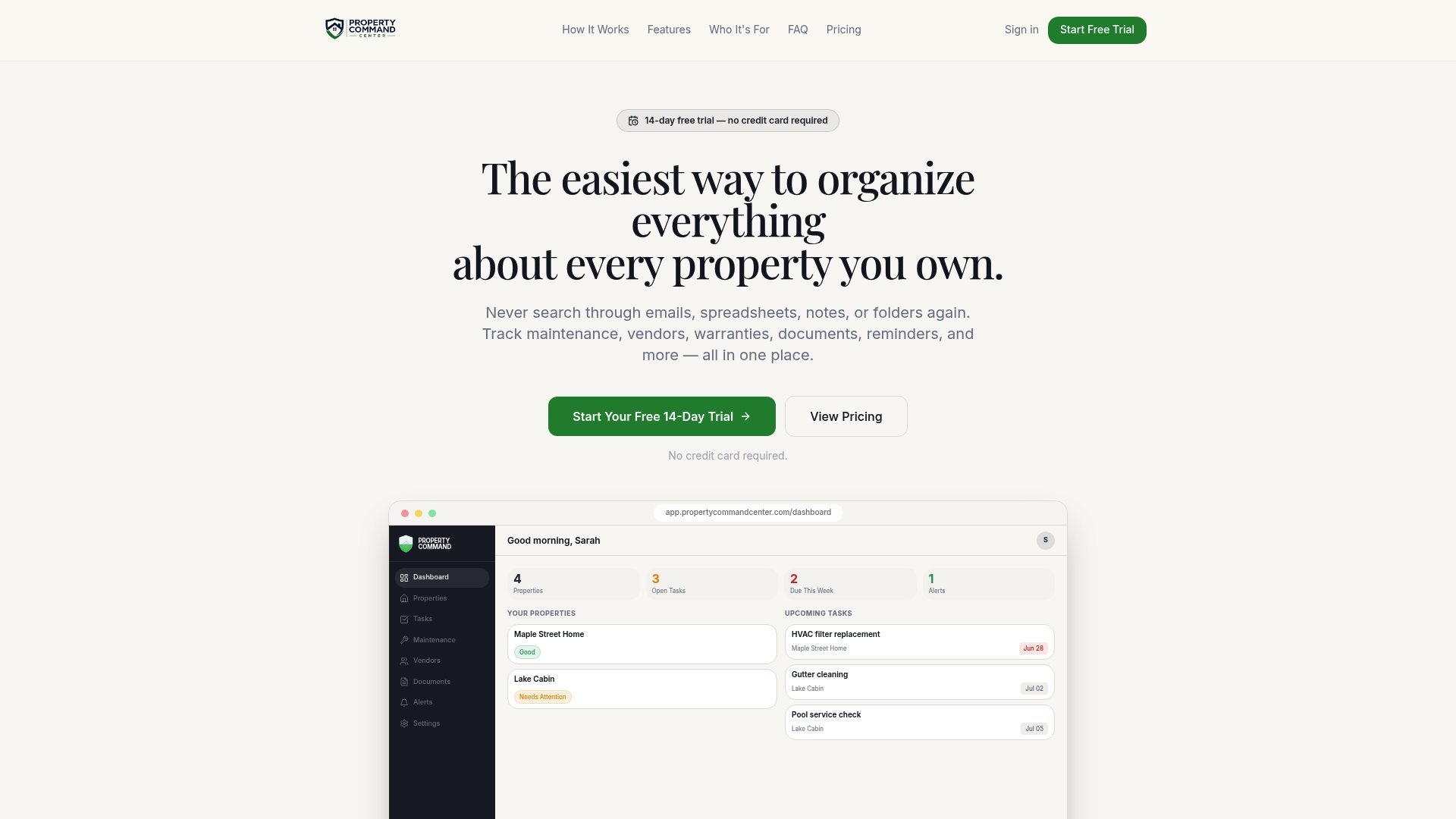
Start by importing your existing asset list or working from the Home Maintenance Checklist if you're building one from scratch. From there, set your recurring tasks once and let the reminders handle the rest instead of relying on memory during a busy season. Check the vendor directory features to see how coordination works across multiple properties, and look at current pricing and trial details to see what fits a portfolio your size. The 14-day trial requires no credit card, so there's no reason not to see your properties on one screen before your next seasonal round comes due.
Sources
- The Rental Property Maintenance Schedule: A Season-by-Season Preventive Plan (2026) · DiscoveryMark
- Preventive Maintenance Schedule for Rental Properties — Oxmaint