
Self-managing rentals makes sense if you own 1 to 3 units, live within about an hour of each one, and can commit at least 10 hours a month to the job. Cross those lines and the math starts working against you. This isn't a philosophical call. It's arithmetic: your time, your legal exposure, and the fees you'd otherwise pay a property manager.
Three thresholds decide it:
- Unit count: 1 to 3 units is comfortable for most first-time self-managers; 4 to 7 is the stretch zone where things start to slip.
- Proximity: under an hour's drive keeps showings and maintenance calls manageable; beyond that, every emergency costs you half a day.
- Time budget: 10+ hours a month, more during turnover season, is the realistic floor, not the ceiling.
The tradeoff underneath all of it: self-managing typically saves 8 to 12% of collected rent, but a single bad tenancy can wipe out years of that savings in legal fees and lost rent.
Key Takeaways
| Point | Details |
|---|---|
| Know your thresholds | 1 to 3 units, under an hour's drive, and 10+ hours a month is the comfortable DIY zone. |
| Vacancy speed drives the math | DIY turnover often runs 30 to 60 days versus 14 to 25 days for a property manager. |
| Legal exposure is the real risk | Inconsistent screening and mishandled deposits are the costliest DIY mistakes owners make. |
| Systematize every task | Written screening criteria, online rent collection, and a maintenance triage process replace most of what a PM does. |
| Centralize your information | Property Command Center consolidates property status, maintenance schedules, vendor contacts, and documents into one dashboard for owners managing multiple properties. |
Table of Contents
- What are the benefits and risks of self-managing rentals?
- What tasks do you need to systematize to self-manage rentals?
- What legal and compliance steps reduce a landlord's risk?
- What tools replace a property manager's workload?
- When should you hire a property manager instead?
- How do you budget for self-managed rentals over time?
- Publisher perspective: does DIY property management actually scale?
- Try Property Command Center for your self-managed rentals
- Sources
What are the benefits and risks of self-managing rentals?
The upside is real and it starts with money. Skip the property manager and you keep a portion of collected rent that would otherwise go to management fees. On a typical unit, that saves you a meaningful monthly and yearly amount, staying in your pocket instead of a management company's. You also get direct control over who moves in, how repairs get handled, and how fast decisions get made. Some owners self-manage purely for the relationship, because knowing your tenants personally tends to produce better communication and fewer surprises.
The risks are less visible until they hit. Here's the case that keeps property managers in business: an owner skips a background check to fill a vacancy fast, signs a tenant who stops paying in month four, and spends three months on an eviction that costs legal fees, lost rent, and property damage on the way out. Experienced investors point to this exact scenario as the single costliest DIY mistake, and it's common enough that it deserves its own line item in your risk planning, not an afterthought.
The core tradeoffs, ranked by impact:
- Time cost — 10+ hours a month minimum, spiking during turnovers, screenings, and repairs.
- Vacancy cost — DIY landlords typically take 30 to 60 days to fill a vacant unit, compared with 14 to 25 days for a property manager with an existing tenant pipeline.
- Legal exposure — inconsistent screening, mishandled deposits, and improper notices are where lawsuits and fines come from.
Quick math: property management fees run roughly 8 to 12% of rent. A vacancy period significantly longer than a PM's typical turnaround can cost you more in lost rent than the annual management fees would have. Vacancy speed, not the management fee itself, is often the real swing factor in whether DIY actually saves money.
What tasks do you need to systematize to self-manage rentals?
Landlording stops feeling chaotic the moment you turn it into a checklist instead of a series of fire drills. Break it into four buckets: marketing, screening, collections, and maintenance, plus the paperwork that ties them together.
Marketing and showings
- Shoot wide, well-lit photos of every room and the exterior; listings with poor photos sit longer.
- Syndicate the listing across two or three platforms rather than one.
- Write a standard showing script covering rent, deposit, pet policy, and move-in date so every prospect hears the same answers.
Screening and leasing
- Set written screening criteria before you have an applicant, not after, and apply them to everyone the same way.
- Run credit, background, income verification (2.5 to 3x rent is standard), and rental history checks on every applicant.
- Use a lease that spells out notice periods, repair responsibilities, and late fee terms in plain language.
Rent collection and delinquency
- Set up online payments on day one; a portal that texts or emails reminders cuts late payments meaningfully.
- Send a written late notice the day after the grace period ends, every time, with no exceptions for "good" tenants.
- Escalate to a formal notice by day 5 to 10 of nonpayment, following your jurisdiction's required format.
Maintenance and vendors
Triage every request into three tiers: emergency (no heat, flooding, no working locks), urgent (appliance failure, minor leaks), and routine (cosmetic, non-urgent repairs). Keep a vetted list of two or three vendors per trade, so you're never Googling a plumber at 11 p.m.

Bookkeeping
Maintain a rent ledger, a folder of receipts by property, and a separate security deposit log noting the amount, date received, and any deductions. This alone prevents most of the deposit disputes that end up costing landlords money.
Turnover
Budget $500 to $3,000+ per unit for make-ready work depending on tenant tenure and condition, and plan for 14 to 25 days between move-out and move-in if you want to match professional-grade turnaround.
Pro Tip: Keep a standing "move-out folder" template with the deposit itemization form, final walkthrough checklist, and forwarding address request already built. You'll use it on a stressful day, so build it on a calm one.
A landlord safety inspection checklist is worth building into your turnover process, since habitability issues are one of the fastest ways a routine turnover turns into a legal problem.
What legal and compliance steps reduce a landlord's risk?
Fair housing violations, mishandled deposits, and improper evictions are where self-managing landlords lose the most money, and nearly all of it is preventable with paperwork discipline.
- Fair Housing: apply the same written screening criteria to every applicant and document why each one was accepted or rejected. Verbal-only decisions are indefensible if challenged.
- Security deposits: provide a receipt at move-in, follow your state's timeline for returning deposits (often 14 to 30 days), and itemize every deduction in writing.
- Evictions: the process commonly runs weeks to months and can cost thousands once you count lost rent, legal fees, and repairs. Bring in an attorney the moment a tenant contests a notice.
- Lease clarity: spell out notice periods and repair responsibilities explicitly. Ambiguous lease language is what turns a disagreement into a lawsuit.
Documentation and consistent screening are the primary risk controls available to a DIY landlord, more so than insurance or luck. If you operate a short-term rental, local rules add another layer, and a short-term rental compliance checklist is worth reviewing before you list a unit.
What tools replace a property manager's workload?
A property manager's real value isn't charm, it's infrastructure: a payment system, a maintenance pipeline, a filing cabinet, and a screening process that runs the same way every time. Replace those four things and you've replaced most of what you're paying for.
- Rent payments: an online portal that automates reminders and records payment history removes the "did they pay" guessing game.
- Maintenance tickets: a simple ticketing system, even a shared inbox with clear triage rules, beats a stack of text messages you'll lose track of.
- Document storage: a central vault for leases, insurance policies, warranties, and inspection records means you're never digging through email during an emergency.
- Screening: a repeatable, documented process matters more than which specific screening service you use.
Standardized systems and centralized digital workflows are what actually raise the number of units one person can manage without burning out or missing a deadline. A single dashboard that pulls property status, maintenance schedules, vendor contacts, and documents into one place removes the scramble of hunting through five different apps when something breaks. If you're comparing landlord software options, weigh how much of your week goes to searching for information versus acting on it.
Pro Tip: Before adopting any tool, list the three tasks that currently eat the most of your time. Pick software that solves those three first. Everything else is a nice-to-have.
When should you hire a property manager instead?
The tipping point for most owners lands in the 4 to 7 unit range, where distance and hours per month start compounding instead of adding up. Watch for these signals:
- Unit count exceeds 4 to 7 and you're spending entire weekends catching up on maintenance requests.
- Distance grows to where a single emergency call means an hour-plus drive each way.
- Turnover frequency rises and you're running the leasing process more than twice a year.
- You're missing legal deadlines on notices, deposit returns, or inspections because there simply isn't time.
A hybrid model often makes sense before going fully managed: keep the units closest to home and hand off the farthest one or the hardest tenant situation.
| Variable | DIY assumption | Managed assumption |
|---|---|---|
| Management cost | $0 (your time) | 8 to 12% of rent |
| Vacancy fill time | 30 to 60 days | 14 to 25 days |
| Your monthly time | 10+ hours | Under 2 hours |
| Legal risk exposure | Higher, self-carried | Lower, shared with PM |
Run this comparison over five years, not one, since a single bad year of vacancies or a lawsuit changes the outcome more than the monthly fee ever will.
How do you budget for self-managed rentals over time?
Set a maintenance reserve of about one percent of the property's value annually, or about one dollar per square foot, as your starting rule. On a $300,000 property, that's $3,000 a year set aside before anything breaks, so a failed water heater doesn't become a financial crisis.
Vacancy speed changes the math more than most owners expect. A 14 to 21 day turnaround versus a 30 to 60 day one on a $1,800/month unit is the difference between losing roughly $840 to $1,260 in rent and losing $1,800 to $3,600. That gap alone can exceed what you'd pay a property manager for the entire year.
Run the "bad tenant" scenario once, on paper, before it happens to you:
- Unpaid rent over several months and the eviction legal fees and process costs can be substantial and take several weeks or more(https://www.biggerpockets.com/blog/pros-and-cons-of-being-a-self-managing-landlord).
- Repairs and cleaning after move-out: $1,000 to $3,000+ depending on damage.
Stress-test your own spreadsheet against vacancy length, one bad tenancy, and a major repair year. Those three variables move the five-year outcome more than any other line item.
Publisher perspective: does DIY property management actually scale?
The conventional advice tells owners to just "get organized" and self-managing will work fine. That advice skips the actual failure mode. Owners rarely fail at self-managing because they're disorganized by nature. They fail because the job has no natural container. A lease renewal date lives in your calendar, the vendor's number lives in a text thread from eight months ago, and the insurance policy lives in an email you'll never find at 9 p.m. on a Saturday when a pipe bursts.
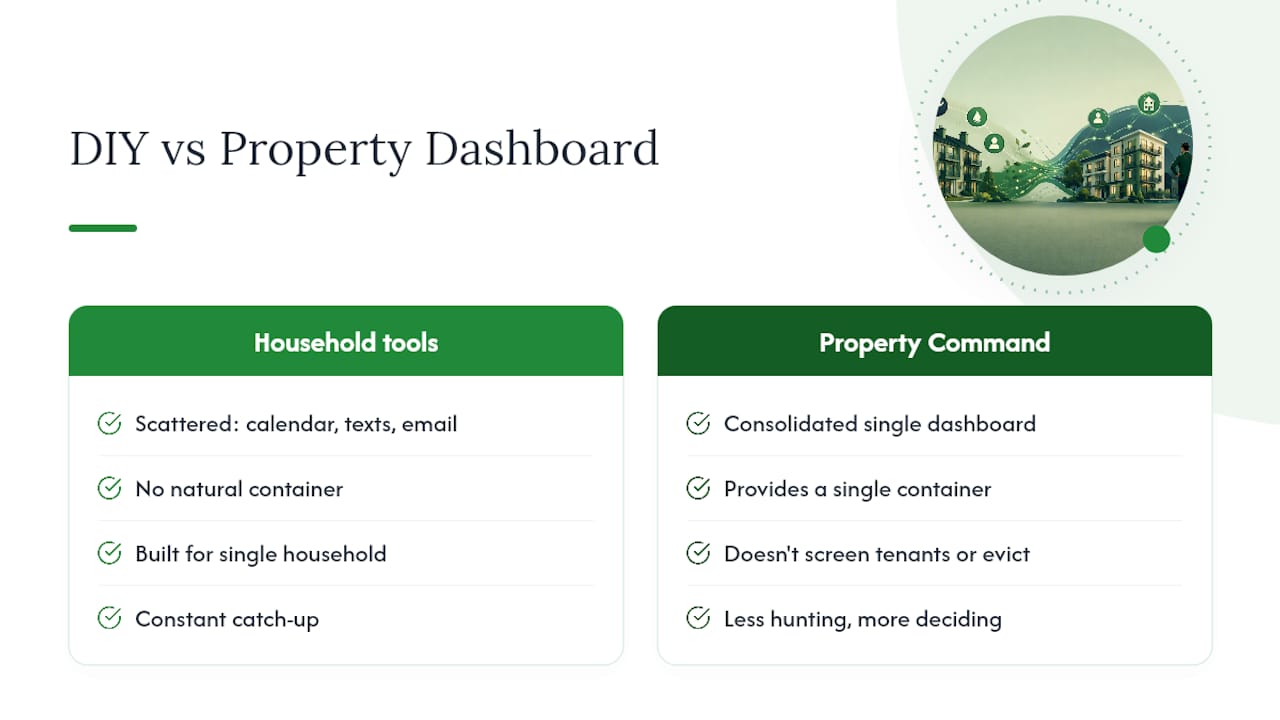
That's the specific problem Property Command Center was built around. The dashboard consolidates property status, maintenance schedules, vendor contacts, and documents into one place, so you're not reconstructing your own system from scratch every time something goes wrong. It won't screen a tenant for you or file an eviction. What it does is remove the friction that turns manageable ownership into constant catch-up. Owners juggling two or three properties consistently report the same thing: less time hunting for information, more time actually deciding what to do with it.
The honest opinion here is that self-managing rentals doesn't fail because owners lack discipline. It fails because most owners are running a small operation on tools built for a single household, not a portfolio.
— Francisco
Try Property Command Center for your self-managed rentals
Self-managing works until the paperwork outgrows a spreadsheet, and that moment usually arrives faster than owners expect. Property Command Center replaces the scattered emails, sticky notes, and half-updated spreadsheets with one dashboard that tracks maintenance schedules, stores your warranties and insurance documents, and keeps every vendor's contact information in one directory instead of three phones and a drawer.
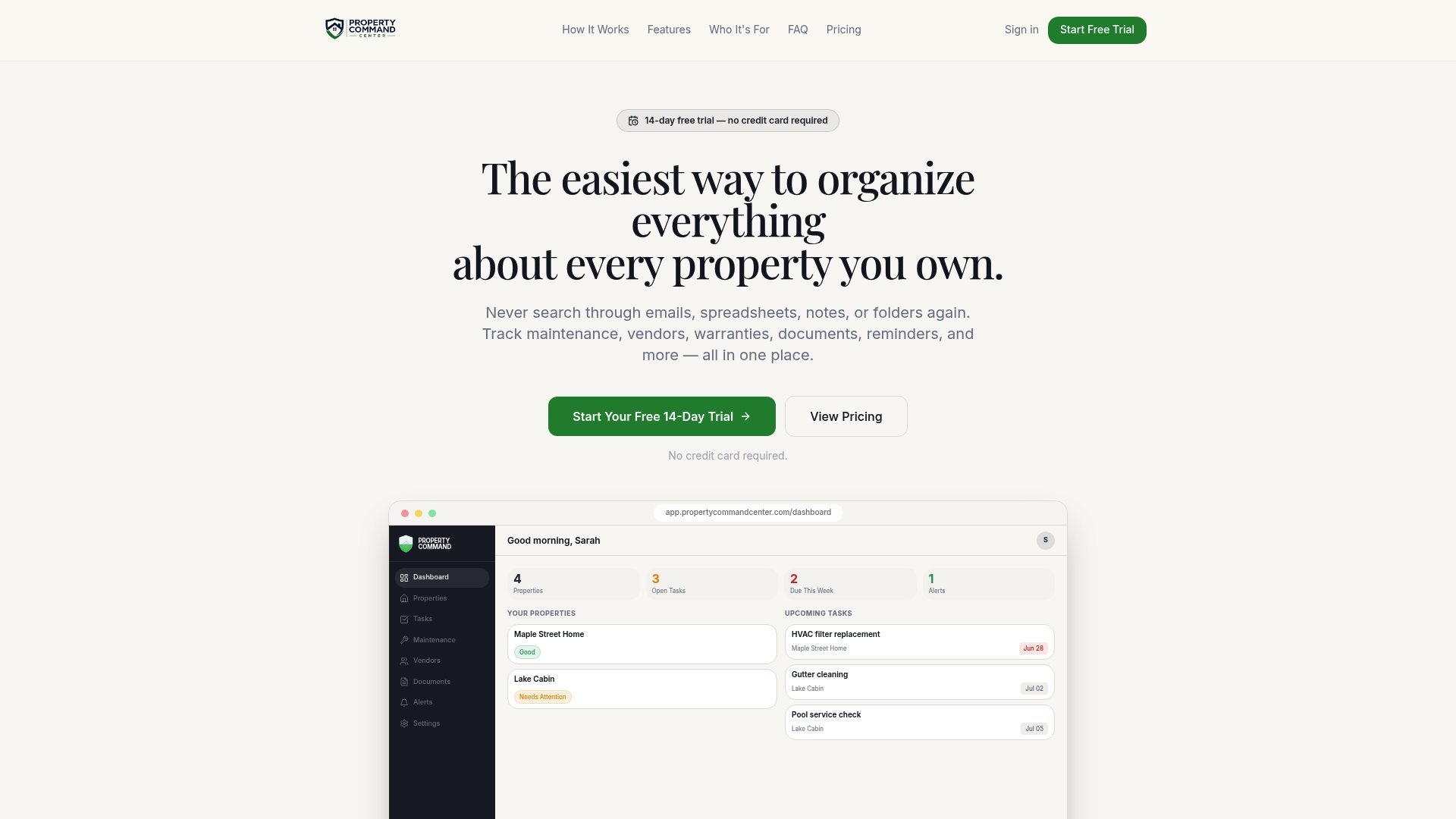
If you're managing more than one property, the vendor directory alone can save you the fifteen minutes you'd otherwise spend digging for a plumber's number during an actual emergency. Pricing scales by property count, so you're not paying enterprise rates to organize a duplex and a rental cabin. Start with the 14-day free trial, no credit card required, and see whether one dashboard replaces the five tools you're currently juggling. Check pricing plans or send a quick question before you commit.
Sources
- Property Management: Self-Managing vs Hiring a PM | REI Prime
- The Pros and Cons of Self-Managing Your Rental Property (From Two Experienced Investors)
- How to Self-Manage a Rental Property | Complete Guide for 1 to 100 Units
- Managing rental properties: A landlord's complete guide