
Most hosts should plan to spend somewhere between 1% and 3% of a property's value on maintenance each year, or roughly 10% to 15% of rental income. AirDNA's host guide gives both ranges for Airbnb-style rentals. The number only becomes reliable when you track what each property actually costs, so your budget improves every year instead of staying a guess. This guide shows how to pick the right rule, split the budget into line items, and keep the records that make it accurate across more than one property.
TL;DR
- Start with 1% to 3% of property value per year, or 10% to 15% of gross rental income. Short-term rentals sit at the higher end because of turnover and furnishings.
- Older homes, harsh climates and heavy booking calendars push you up the range. Newer, well-kept homes let you stay near the bottom.
- Split the budget into routine upkeep, turnover wear and an emergency reserve, and keep repairs separate from improvements for tax purposes.
- Log every repair with date, vendor, cost and category. Two years of records beat any rule of thumb.
- With several properties, one shared record system matters more than the percentage you pick.
Table of Contents
- Three rules of thumb, and which one fits a short-term rental
- Scale the percentage to the age of the home
- What belongs in the budget: line items
- What pushes your number up or down
- Build a reserve for the repairs you cannot predict
- Repairs versus improvements: track them separately
- Records that keep the budget honest
- Keep every property's budget in one place
- Our perspective
- FAQ
- Sources
Three rules of thumb, and which one fits a short-term rental
Budget rules come from long-term rentals, so each one needs adjusting for a property with guests rotating through every few days. Here is what each measures.
| Rule | How it works | Fit for short-term rentals |
|---|---|---|
| Percent of property value | 1% to 3% of value per year | Good starting point. Use the upper half for frequent turnover. |
| Percent of rental income | 10% to 15% of gross revenue | Scales with bookings, so it tracks wear well. |
| Per square foot | About $1 to $2 per square foot per year | Simple sanity check, ignores furnishings and amenities. |
| 50% rule | About half of rent goes to all operating costs | A purchase screening tool, not a maintenance budget. |
The value-based and per-square-foot figures, plus the 50% rule's limits, are laid out in Tristate Property Management's comparison of the rules. That guide also suggests raising the 1% rule to 1.5% to 2% for buildings over 30 years old. The income-based range for short-term rentals comes from AirDNA's maintenance guide, which also puts the value-based range at 1% to 3%.
Why do short-term rentals need more cushion? Guests are not invested in the place, linens and small appliances cycle fast, and furnished homes carry mattresses, sofas, cookware and electronics that an unfurnished long-term rental never has to replace.
A worked example
Say you own a $350,000 lake house that grosses $60,000 a year in bookings. These numbers are illustrative, not a forecast.
- At 1% of value, you would set aside $3,500.
- At 3% of value, $10,500.
- At 10% to 15% of income, $6,000 to $9,000.
The overlap sits around $6,000 to $9,000. A newer, well-kept house might run closer to $6,000. A 1970s build in a snowy climate should plan on the top of that band. Use the overlap as your first-year budget, then replace it with your own history.
Scale the percentage to the age of the home
A flat percentage hides the biggest driver: how old the house and its systems are. Pomegra's STR expense guide scales maintenance as a share of revenue:
- Under 2 years old and in excellent condition: 2% to 3%.
- 2 to 10 years, good condition: 4% to 6%.
- 10 to 20 years, fair condition: 6% to 10%.
- Over 20 years, poor condition: 8% to 15%.
On $35,000 of revenue, that is the difference between about $1,050 and $2,800 a year, based on the guide's own examples. If you own a mix of properties, give each one its own percentage instead of averaging them.
What belongs in the budget: line items
A single percentage is easier to defend when you can see what is inside it. These are typical ranges for short-term rentals.
Cleaning and turnover. AirDNA's guide lists cleaning at $50 to $150 per clean. Most hosts pass this to guests as a cleaning fee and track it as an operating cost, not a maintenance cost. Deep cleans, such as carpets and upholstery, belong in maintenance.
Routine upkeep. The same guide cites landscaping at a minimum of about $200 a month, and seasonal hot tub or HVAC service sessions of $100 to $250. Minor repairs run $50 to $500 per call, and HVAC servicing starts around $500.
Typical yearly line items. Pomegra's breakdown for a mid-range property includes:
- HVAC filters: about $200
- Quarterly carpet cleaning: about $400
- Appliance repairs: $500 to $2,000
- Plumbing: $300 to $800
- Paint touch-ups: $200 to $500
- Furniture repair and mattress replacement: $500 to $1,500
- General handyman work: $300 to $1,000
That guide puts a mid-range property at roughly $1,500 to $3,000 a year before big surprises.
Amenities. Pool, hot tub and lawn service add recurring costs. One statistics roundup cites pool care at $85 to $185 a month, hot tub servicing at $50 to $100 and lawn care at $25 to $75, all compiled on RapidEye's vacation rental cost page. Each amenity is a reason to move toward the high end of your range.

What pushes your number up or down
Two houses with the same value can have very different bills. United FFS's budgeting guide points to these factors:
- Age and system condition. Homes over 20 years old with original major systems need a bigger reserve.
- Size. More square footage means more to paint, clean and replace.
- Climate. Cold areas bring frozen pipes and ice dams. Humid areas need more pest and moisture control.
- Vendor availability. If the one reliable plumber within an hour is booked, you pay rush rates or wait while guests complain.
Emergencies are the costly part. The same RapidEye page reports an analysis of more than 15,000 maintenance work orders in which 32% of repair costs were tied to emergencies rather than planned work, and material costs rose 11% year over year. Planned upkeep is cheaper than reactive repair, which is why a budget with a dedicated reserve works better than one big undifferentiated number.
If you want a calendar for planned work, our post on four cadences for short-term rental maintenance breaks recurring tasks into daily, monthly, seasonal and annual rhythms.
Build a reserve for the repairs you cannot predict
You will not forecast a failed water heater, but you can fund it. A practical way to do this across several properties:
- Set a per-property monthly transfer. Take your annual figure and divide by 12. On the $6,000 to $9,000 band above, that is $500 to $750 a month for the lake house. KDS Development's expense guide uses the same approach, translating 1% to 2% of value into a monthly figure.
- Split planned from emergency. Allocate perhaps two thirds of the transfer to planned upkeep and the rest to a reserve that is only touched for failures. The split is your own judgment, so adjust it as your history grows.
- List big-ticket systems with ages. HVAC, water heater, roof, major appliances, mattresses. Note the install date and expected life, so you know which year a large expense is likely.
- Keep a reserve per property or a clear ledger. One pooled account works only if you track which property drew from it. Otherwise your best and worst performers look identical.
- Review every quarter. Compare actual spending to budget, and move the percentage up or down for that property.
For a deeper look at the long-term rental side of the same math, see our guide to budgeting rental maintenance costs.
Repairs versus improvements: track them separately
The maintenance budget should hold repairs and upkeep. Replacements that upgrade the property belong in a separate capital plan, partly because the tax treatment differs. According to Airbnb's US tax guidance, expenses that do not prolong a property's useful life or add value are generally deductible as repairs, while those that result in a betterment, restoration or adaptation to a new use must be capitalized as improvements. The nature of the work matters, not the dollar amount. Reinforcing a sagging floor is a repair, while replacing the floor is an improvement.
Because the line can be fine, ask your CPA or tax adviser how to classify large jobs before you file, and keep the invoice that describes the work. This is general information, not tax advice for your situation.
Records that keep the budget honest
The most reliable budget is the one built on your own data. United FFS recommends recording these details for every repair or inspection:
- Property address and date
- Issue reported, with photos
- Vendor assigned
- Repair category and whether it was routine, emergency, turnover or capital
- Cost and the invoice
- Parts or materials used
- Any follow-up needed
After a year, those entries tell you which property costs the most, which vendor is cheapest per job type, and which systems are due for replacement. Scattered across spreadsheets, email threads and photo rolls, that information is hard to pull together at budget time. Our posts on rental property maintenance schedules and recordkeeping and on a system for self-managing hosts walk through setting this up.
Two habits pay off quickly. Categorize every expense the day it happens, and store warranties and manuals with the property they belong to. A dishwasher still under warranty is a repair you should not be paying for.
Keep every property's budget in one place

The hard part with several properties is not the arithmetic. It is that the maintenance history of each home lives in a different spreadsheet, inbox or folder. Property Command Center is built for that problem: owners bring their existing spreadsheets, emails and documents into one workspace, and each property becomes a record containing maintenance history, vendors, warranties, tasks and reminders. Its AI-powered Smart Setup is designed to extract and organize information from files you already have, and portfolio import lets you bring in several properties without entering them one by one.
Plans are tiered by the number of properties. Starter is $19 per month and Pro is $49 per month, with a 14-day free trial that needs no credit card. You can see both on the pricing page, and the vendor directory keeps your plumbers, cleaners and HVAC techs attached to the properties they serve.
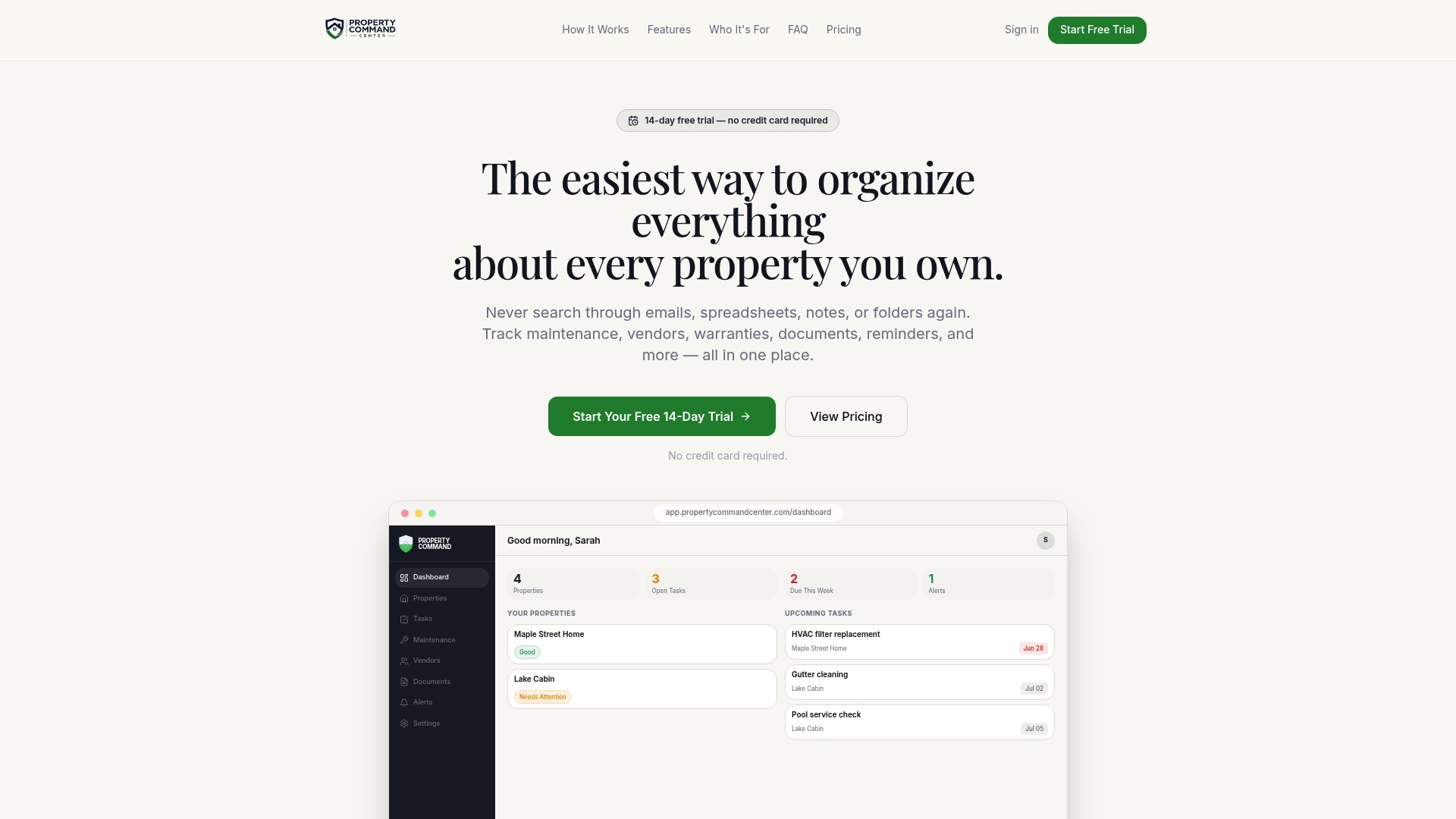
When a pipe bursts at the lake house, you can see its last service date, the vendor who did the work and the warranty paperwork in one place. At budget time, the property's cost history is already organized.
Our perspective
Every host we hear from asks the same question: what percentage should I use? It is a fair starting point, and the ranges above are sensible. But a percentage is a guess about a house you have not lived with yet.
The better budget comes from memory. What broke last spring, who fixed it, what it cost, whether the warranty covered it, and when the next service is due. Owners with a few properties lose that memory in spreadsheets, old emails and text threads, so every budget starts from scratch.
That is why we built Property Command Center around property knowledge instead of rent collection or accounting. We want each property to have a living record, so your budget grows from your own history and your reminders arrive before the failure, not after it.
Pick a rule, fund the reserve, log every job. Within a year, you will know your numbers better than any guide can tell you.
Francisco
FAQ
How much should I budget for short-term rental maintenance each year?
A common starting range is 1% to 3% of the property's value, or 10% to 15% of gross rental income, according to AirDNA's guide. Use the high end for older homes, heavy occupancy or harsh climates. After a year of records, replace the rule with your own average.
Is the 1% rule enough for a vacation rental?
It is a reasonable floor for a newer, well-kept home, but guest turnover and furnishings usually justify more. Tristate's guide suggests raising the figure to 1.5% to 2% for buildings over 30 years old, and many short-term rental guides put hosts higher still. Compare it with the income-based 10% to 15% and budget the overlap.
Should cleaning be part of my maintenance budget?
Track per-stay cleaning as an operating cost, usually covered by the guest cleaning fee, and keep it apart from maintenance. Deep cleaning of carpets, upholstery and appliances is upkeep and belongs in the maintenance budget. Separating them keeps your reserve from being drained by routine turnover.
What is the difference between a repair and an improvement?
A repair keeps the property in its current condition, while an improvement adds value, extends its life or adapts it to a new use. Airbnb's US tax guidance uses a floor example: reinforcing it is a repair, replacing it is an improvement. Confirm treatment of large jobs with your CPA.
Sources
- AirDNA: Mastering Airbnb Maintenance
- Tristate Property Management: What Should I Budget for Rental Maintenance Each Year?
- Pomegra: STR Operating Expenses
- RapidEye: Vacation Rental Maintenance Cost Statistics
- United FFS: Rental Property Maintenance Costs Budgeting Guide
- KDS Development: How to Estimate Rental Property Expenses
- Airbnb: US tax guidance