
Budget around the national per-unit median as your starting point, then split that figure into three separate reserves: preventive, corrective, and capital. Rather than trusting a single flat percentage, pull three years of your own property's repair history and convert your annual estimate into a fixed monthly transfer. This approach adapts as your property ages instead of guessing every January.
TL;DR:
- Using a property-specific repair history over three years provides a more accurate monthly reserve estimate than generic rules like 50% or 1%.
- Splitting maintenance into preventive, corrective, and capital buckets simplifies budgeting and tax tracking, with larger costs allocated to capital reserves.
- Building and periodically reviewing a detailed invoice log helps owners tailor their budgets more precisely and avoid over- or underfunding.
- Proper documentation, including invoices and photos, ensures correct tax classification and prevents costly mistakes during tax season.
Table of Contents
- 1. Common budgeting formulas and when they mislead you
- 2. What national benchmark data actually tells you
- 3. Cost categories and the three-bucket reserve model
- 4. Build a property-specific maintenance budget step by step
- 5. Tax treatment: repair versus capital improvement
- 6. Practical ways to cut maintenance spending
- 7. Centralizing schedules and records to prevent oversight
- 8. A note on keeping the routine simple
- 9. A simpler way to keep the budget on track
- Sources
- FAQ
1. Common budgeting formulas and when they mislead you
Most landlords start with a quick rule, and each one has a place. The 50% rule assumes half of gross rent covers all operating costs, maintenance included, on a $1,500 rent that means $750 a month, though this figure blends taxes, insurance, and vacancy loss with actual repairs.
Each shortcut breaks down under specific conditions.
- The 1% rule overstates costs in expensive, low-rent markets where property value outpaces what the home actually needs in repairs.
- The 50% rule mixes non-maintenance expenses with repairs, so it tends to overestimate the maintenance-only portion for newer properties.
- Per-square-foot estimates ignore age and system condition, understating costs for a property with an original 1990s furnace.
- The 5x rule assumes rent reflects the property's physical condition, which is not always true in appreciating markets.
Pro Tip: Use a quick rule only for your first year of ownership, then replace it with your own three-year repair average as soon as you have one.
2. What national benchmark data actually tells you
The Rental Housing Finance Survey shows median maintenance and repair spending around $1,600 per unit, with notable variation by building size: single-unit rentals report a median closer to $1,800, while properties with 50 or more units report a median near $873 per unit, reflecting economies of scale in larger operations.

A property-specific rolling average beats a national mean for budgeting purposes, because RHFS microdata is topcoded and bottomcoded, meaning extreme high and low values are capped before publication. That capping still leaves the mean skewed upward by a handful of large capital projects, so the median is the safer anchor for a single property.
Converting the median into practice is simple: take the single-unit figure from RHFS, divide by 12, and set a monthly reserve transfer accordingly. Adjust that number up or down once your own invoice history gives you something more specific to your property.
3. Cost categories and the three-bucket reserve model
Splitting maintenance spending into three buckets keeps budgeting and tax treatment clean.
- Preventive and recurring: filter changes, gutter cleaning, seasonal HVAC service, and pest control, typically the smallest and most predictable bucket.
- Corrective repairs: unplanned fixes like a leaking faucet, a broken appliance, or a patched roof section that restores function without extending the asset's life.
- Capital replacement reserve: roofs, HVAC systems, water heaters, and other major components with a defined lifecycle, funded gradually so a five-figure replacement never arrives as a surprise.
A common framing is to weight preventive spending lightest, corrective repairs moderately, and the capital reserve heaviest over a property's life, as a single roof or system replacement can dwarf a year of routine repairs. Separating these buckets also simplifies tax season, since capital items follow different rules than ordinary repairs.
4. Build a property-specific maintenance budget step by step
A workable budget requires some initial setup and should be reviewed periodically to remain accurate.
- Gather three years of records: service invoices, lease turnover costs, and warranty documents for each major system in the property.
- Pick a baseline: start with the RHFS median or a per-square-foot estimate, then adjust upward for an older property, a harsh climate, or added amenities like a pool.
- Set monthly transfers: divide your adjusted annual estimate across the three buckets, then add a separate turnover reserve based on your last one or two tenant transitions.
- Review quarterly: check actual spend against transfers, and flag any bucket running more than 20% over or under projection.
Pro Tip: Keep a simple spreadsheet with one row per service call and one column per bucket. Three years in, that log becomes more useful than any national benchmark.
Owners managing more than one property often find a minimal six-field tracking system enough to build this history without extra software.
5. Tax treatment: repair versus capital improvement
IRS Publication 527 draws a clear line between a deductible repair and a capital improvement that must be depreciated. A repair keeps the property in ordinary working condition, while an improvement betters, restores, or adapts it to a new use, and that distinction determines whether you deduct the cost this year or spread it over the asset's depreciation schedule.
- Save detailed invoices describing the scope of work, not just the amount charged.
- Keep before-and-after photos for any project that could be classified either way.
- Tag each expense by bucket (preventive, corrective, or capital) as soon as it is paid.
- Reconcile these tags quarterly so tax season involves sorting, not searching.
6. Practical ways to cut maintenance spending
Prevention is consistently cheaper than emergency repair. Seasonal checks on HVAC systems, roofs, gutters, and plumbing catch small issues before they become costly failures, and ENERGY STAR's heating and cooling guidance notes that routine maintenance extends equipment life and reduces energy use.
- Build a short list of vetted vendors for common trades instead of searching each time a repair comes up.
- Negotiate flat-rate pricing for recurring visits like HVAC tune-ups or gutter cleaning.
- Batch small repairs into a single vendor visit rather than paying a trip fee for each one.
Pro Tip: A routine HVAC tune-up typically costs far less than an emergency system replacement, and catching a failing component early is one of the more reliable ways to avoid that gap.
7. Centralizing schedules and records to prevent oversight
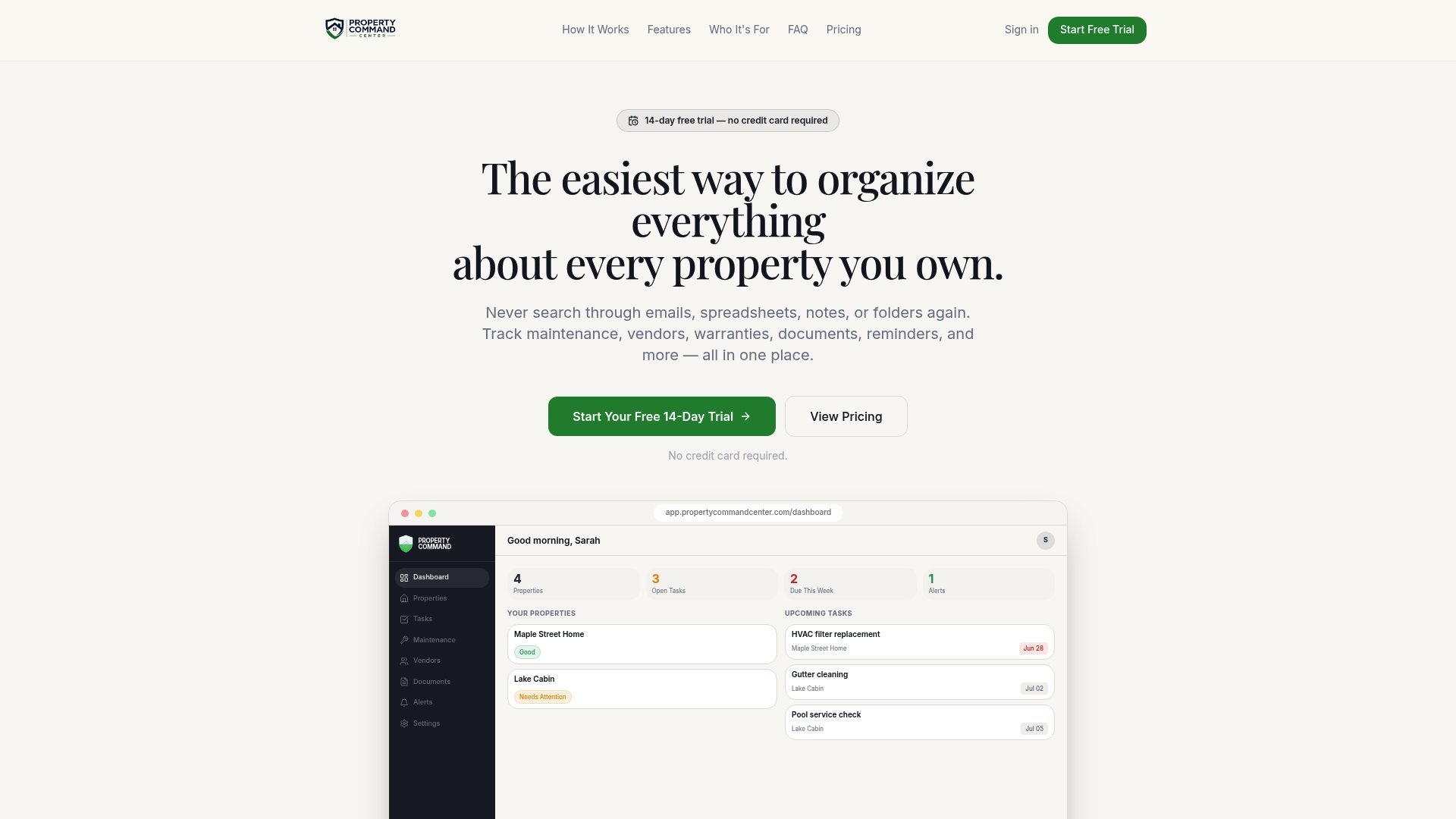
Spreadsheets and scattered emails are where preventive schedules quietly slip. A dashboard that consolidates maintenance schedules, vendor contacts, and a document vault for warranties and invoices gives owners one place to check instead of several. Store before-and-after repair photos, paid invoices, and warranty documents there as you generate them, so the three-bucket log from earlier sections lives in one accessible spot rather than a folder you have to hunt for at tax time. A maintenance task-tracking template can help structure that setup from day one.

8. A note on keeping the routine simple
Start with one property, build a real three-year history, and set monthly transfers before adding a second. The routine matters more than the rule you start with.
— Francisco
9. A simpler way to keep the budget on track
There are dashboards available that centralize maintenance schedules, vendor contacts, and warranty documents in one place, designed for property owners managing multiple homes. Try the 14-day free trial or compare the Starter and Pro plans to see which fits your portfolio.
| Plan | Monthly price |
|---|---|
| Starter | $19 |
| Pro | $49 |
Sources
- Rental Housing Finance Survey (RHFS) data (Census)
- Publication 527 (Residential Rental Property) — IRS
FAQ
What is the 2% rule for rentals?
It addresses acquisition value rather than maintenance budgeting, so it should not be used to estimate repair reserves.
What is the 50% rule for maintenance costs?
The 50% rule assumes roughly half of gross rental income covers all operating expenses, including maintenance, taxes, insurance, and vacancy loss combined. Because it bundles several cost types together, it tends to overstate the maintenance-only share for newer or well-maintained properties.
What is the 30% rule for rent?
It is unrelated to landlord maintenance budgeting and applies to a renter's own finances, not a property's repair reserve.
What is the 1% rule for maintenance?
This can overstate costs in high-value, low-rent markets, which is why pairing it with the RHFS median and your own repair history gives a more reliable number.
How much should I set aside monthly for rental maintenance?
A practical starting point is the RHFS single-unit median of roughly $1,800 per year, split across preventive, corrective, and capital buckets. Adjust that figure once you have a few years of your own property's repair invoices to reference.