
A vendor coverage plan is a documented schedule that lists which service vendor handles maintenance, repairs, and emergencies at each property you own, plus the backup contact for every trade. If you own more than one home or manage a vacation rental alongside your primary residence, build one now. Start with a single step: write down the emergency contact for each trade (plumbing, electrical, HVAC) at every property you own.
TL;DR:
- A vendor coverage plan must include detailed vendor contacts, scope of work, response times, costs, and documentation to be effective.
- Inviting 2 to 4 vendors per trade for a group walkthrough and comparing written bids reduces scope ambiguity and ensures reliable service.
- Regular quarterly and annual reviews of the plan help confirm work completion, update insurance, and renegotiate rates based on current needs.
- Setting backup vendors and clear escalation procedures ensures timely emergency responses and mitigates the risk of vendor non-performance.
- Centralized management platforms streamline vendor information, schedules, and documents, saving time and reducing errors during property emergencies.
Table of Contents
- Core elements every vendor coverage plan must include
- Step-by-step: build a vendor coverage plan for your portfolio
- How to evaluate and contract vendors: questions, contract items, and red flags
- Templates and documentation: what to store and how to organize it
- Ongoing management: audit cadence, renewals, and performance feedback
- Contingency planning for vendor non-performance or emergencies
- Legal and compliance considerations related to vendor agreements and coverage plans
- Why we built Property Command Center for this exact problem
- Try Property Command Center: Starter and Pro plans for multi-property owners
- Primary sources and partner resources
- Sources
- FAQ
Core elements every vendor coverage plan must include
A workable plan is only as good as the fields behind it. Skip a field and you end up calling three numbers during a burst pipe at 11 PM, trying to remember which plumber actually covers that address.
Start with a vendor roster: name, phone, trade, certification status, and the expiration date of their certificate of insurance for every primary and backup vendor. Then define scope per vendor and per property, since a landscaper covering your lake house might only handle mowing while a separate contractor handles snow removal and storm cleanup there. Vague scope is the single most common reason owners end up paying for work they thought was already covered.
Add schedule and service-level fields next: how often each vendor visits, what response time they commit to for emergencies versus routine calls, and how long a repair should realistically take. Round out the plan with cost fields, labor rate, parts markup, travel charge, and any overtime or emergency surcharge, so a quote from vendor A can be compared honestly against vendor B.
- Vendor roster: primary and backup contact, trade, certifications, and certificate of insurance expiration date for each.
- Coverage scope: which tasks are preventive maintenance, which are emergency-only, and which are explicitly excluded, by property.
- Schedule and SLA fields: visit frequency, promised response time, and expected completion window.
- Cost fields: labor rate by skill level, parts, travel charge, and overtime terms.
- Required documentation: signed service plan, operations and maintenance manual, invoices, and photos of completed work.
Without these five categories, a coverage plan is just a contact list, and a contact list does not tell you who shows up when the furnace fails in February.
Step-by-step: build a vendor coverage plan for your portfolio
Building the plan is a sequence, not a single afternoon project. Treat it as five steps and you will have something usable within a few weeks.
- Inventory your systems. Walk each property and list every major system (HVAC, water heater, roof, appliances), noting the age and, where you have it, a link to the manufacturer's operations and maintenance manual.
- Decide coverage level per property. A seasonal lake cabin may only need basic seasonal checks, while a year-round rental needs full preventive maintenance coverage.
- Invite 2 to 4 vendors per trade and run a group walk-through. The EnergyStar operations and maintenance guidance recommends this exact approach, giving every bidder the same documentation and site access so bids stay comparable instead of scattered across different assumptions.
- Collect written scopes and itemized rate sheets, then compare. A vendor who will not put labor and travel rates in writing is telling you something about how invoices will look later.
- Document assignments in a shared schedule and confirm with each vendor in writing, including the response time they agreed to.
Pro Tip: Run the walk-through for all bidding vendors on the same day, back to back, so none of them gets extra time to study the property before quoting.
For owners with a handful of properties, a short sample maintenance calendar can give the schedule step a head start rather than building the calendar from a blank page.
How to evaluate and contract vendors: questions, contract items, and red flags
Screening vendors before you sign anything saves far more time than fixing a bad contract later. Ask every candidate for their operations and maintenance manuals, their preventive maintenance task list, their itemized labor and parts rates, and a current certificate of insurance before you compare a single bid.
- Does the vendor provide a written service plan listing specific tasks, frequency, and expected time per visit?
- Will they commit to a response time for emergencies in writing, not just verbally?
- Do their rates break out labor by skill level, plus separate travel and parts charges?
- Is their certificate of insurance current, and will they send renewal proof automatically?
The playing field matters more than the price. EnergyStar's guidance notes that giving every bidder the same documentation and a shared walk-through produces more comparable bids and cuts down on scope drift after the contract is signed.
Contract essentials include a clear scope of work, the detailed service plan itself, reporting terms (what you get after each visit), an escalation path if work is unsatisfactory, and a stated response time or service-level commitment. A vendor who resists putting any of these in writing, or who quotes a flat rate with no itemization, is a red flag. When a bid seems unusually low or the scope is unusually vague, bringing in a third party consultant to review the contract language before signing is worth the cost. Preventive maintenance guidance from NAA also recommends requiring proof of insurance and qualifications as a baseline before any vendor joins your preferred list.
Templates and documentation: what to store and how to organize it
Once vendors are selected, the plan lives or dies on documentation. Four templates cover nearly everything you need.
- Vendor card: name, trade, primary and backup phone numbers, insurance expiration date, and standard rates.
- Service schedule: task, frequency, expected time per visit, assigned vendor, and the next due date.
- Maintenance log: date of service, issue found, action taken, cost, and photos of the work.
- Incident report: what happened, who responded, how long it took, and whether the response time commitment was met.
Store these centrally rather than scattered across email threads and spreadsheets. A structured contact list is a reasonable starting point for owners with just a few properties, but as the portfolio grows, a dashboard that links vendor cards, schedules, and documents together, the way Property Command Center does, removes the step of hunting through old emails for a certificate of insurance that expired six months ago.
Ongoing management: audit cadence, renewals, and performance feedback
A coverage plan built once and never revisited drifts out of date within a year. Set three recurring checks.
- Quarterly operational check. Confirm every scheduled task happened, every invoice matches the agreed rate sheet, and response times were met.
- Annual contract review. Renegotiate rates, confirm the scope still matches the property's current needs, and renew any certificate of insurance or license that is expiring.
- Ongoing performance tracking. Log response time, task completion rate, and invoice accuracy for each vendor, and set a clear trigger (missed response times twice, or an expired certificate not renewed within 30 days) for when a vendor gets replaced.
Treat the feedback loop as part of the plan, not an afterthought. A vendor who consistently meets response times and submits accurate invoices earns more of your portfolio over time, while one who misses both repeatedly should move to backup status or off the roster entirely.
Contingency planning for vendor non-performance or emergencies
Every plan needs a backup, because even a reliable vendor eventually misses a call, goes out of business, or gets overwhelmed during a regional storm. Assign at least one backup vendor per trade per property, not just one backup list for your entire portfolio, since a backup plumber two hours from your vacation home is not much of a backup.
Write a simple escalation path into the plan itself: if the primary vendor does not respond within the agreed window, who gets called next, and who has authority to approve emergency spending above the vendor's standard rate. This matters most for vacant vacation properties, where a slow leak can run for days before anyone notices.
Keep a short list of emergency contacts per trade separate from your routine maintenance roster, since emergency response and scheduled preventive work are different jobs with different urgency. When a vendor underperforms repeatedly, the contingency plan should already name a replacement candidate, not leave you starting the bidding process over during a crisis.
Document every incident where the primary vendor failed to respond or failed to meet scope. That record becomes your evidence if you need to dispute an invoice, cancel a contract early, or simply decide not to renew.

Legal and compliance considerations related to vendor agreements and coverage plans
A vendor coverage plan is an operational tool, not a legal document, but the agreements behind it carry real legal weight. Every vendor on your roster should carry current liability insurance, and you should keep a copy of their certificate of insurance on file with its expiration date tracked, not just taken on faith when the relationship starts.
NAA's property maintenance guidance recommends formal vendor policies that require proof of insurance and qualifications before a contractor joins a preferred list, a standard that applies just as well to an individual owner with three properties as it does to a larger operation. Written contracts should specify scope of work, payment terms, and what happens if either side wants to terminate early.
Local licensing requirements vary by trade and by jurisdiction, so confirm that any electrician, plumber, or HVAC technician on your roster holds the license required where the property sits, and keep that proof with their vendor card. None of this replaces advice from an attorney or insurance professional for your specific situation, but the baseline, insurance on file, a written scope, and verified licensing, protects you from the most common disputes before they start.
Why we built Property Command Center for this exact problem
We built Property Command Center because the owners we talked to were not missing effort, they were missing a single place to put everything. Vendor contacts lived in a phone, service history lived in email, and insurance certificates lived in a drawer somewhere.
Centralizing vendor cards, schedules, and documents in one dashboard cuts the time owners spend searching for a contract or an old invoice right when they need it most, during an emergency call at an inconvenient hour. That is the gap a vendor coverage plan is supposed to close, and it is the gap we designed the platform around.
— Francisco
Try Property Command Center: Starter and Pro plans for multi-property owners
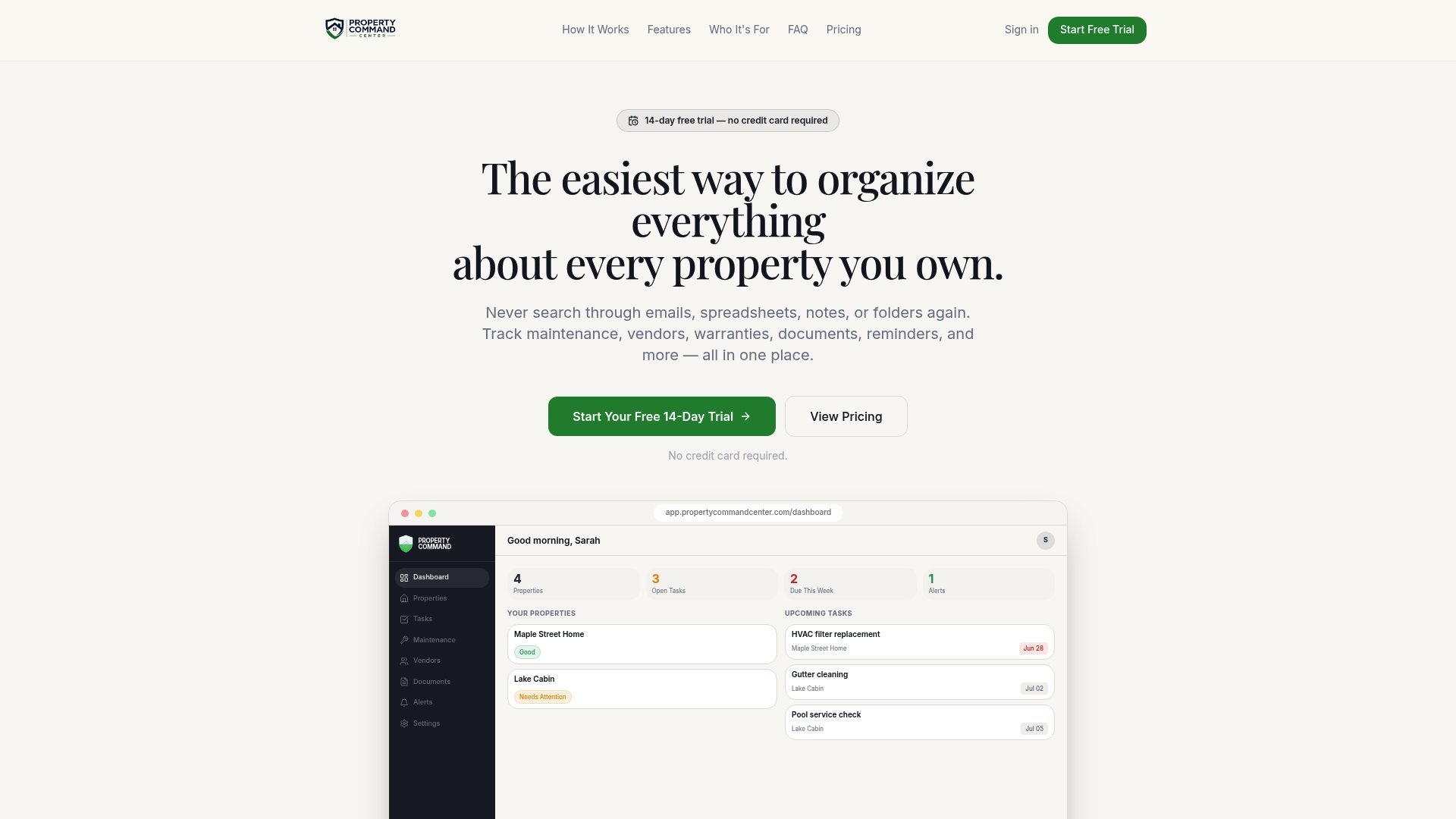
A spreadsheet can hold a vendor coverage plan, but it will not remind you when a certificate of insurance is about to expire or alert you when a scheduled service is overdue. Property Command Center keeps your vendor roster, service schedule, and documents in one dashboard built specifically for owners juggling more than one property, without the training curve of enterprise property management software.
- The Starter plan suits owners with a smaller portfolio who want vendor contacts and schedules in one place.
- The Pro plan fits owners managing several properties who need deeper document and reminder tracking.
Check the pricing page for plan details, or see how the platform organizes recurring vendor responsibilities on the vendors page. A free trial is available with no credit card required.
Primary sources and partner resources
This guide draws on EnergyStar's operations and maintenance contract guidance and NAA's property maintenance guidance for vendor evaluation and documentation standards. For ready-made screening templates, see this partner vendor management checklist.
Sources
- Operations and Maintenance Service Contracts (EnergyStar)
- Property maintenance for managers (NAA guidance)
FAQ
What should be in a vendor coverage plan?
A vendor coverage plan should include a vendor roster with primary and backup contacts, defined scope of work per property, a service schedule with frequency and response-time commitments, cost fields like labor and travel rates, and required documentation such as signed service plans and certificates of insurance.
How many bids should I get before choosing a vendor?
Invite 2 to 4 vendors per trade and give them all the same documentation and a shared walk-through, an approach EnergyStar's guidance recommends to keep bids comparable and reduce scope drift later.
How often should I review my vendor coverage plan?
Run a quarterly operational check to confirm scheduled work happened and invoices match agreed rates, then do a full annual contract review to renegotiate rates and renew expiring insurance or licenses.
What happens if a vendor does not perform?
Your plan should name a backup vendor per trade per property and set a clear trigger, such as repeated missed response times, for when to move a vendor to backup status or replace them entirely. Document every incident so you have a record if a dispute comes up later.
Can property management software replace a spreadsheet for this?
Yes. A dashboard like Property Command Center centralizes vendor contacts, schedules, and documents in one place, which cuts down on the time owners spend searching email and spreadsheets during an emergency. Plans start at $19 per month on the pricing page.