
Choose vendors for a vacation rental in four moves: map the trades your property actually needs, verify each candidate's license and insurance yourself, compare bids against one written scope, and record every job so the roster improves over time. The hard part is rarely finding a plumber. It is keeping contacts, certificates, bids and service history in one place so the decision is easy the next time a guest calls at 9 p.m. That is the job Property Command Center was built for: one record per property, with vendors, documents, tasks and reminders together.
TL;DR
- List the trades by urgency (essential, periodic, emergency) and line up a primary and a backup for each essential trade.
- Check licenses with the state board and insurance with the carrier, not just the paperwork a vendor hands you.
- Send every bidder the same written scope so estimates compare line by line, not by total.
- Start new vendors on a small job, then keep or replace them based on what happened.
- Store contacts, certificates, invoices and warranties per property so the whole roster survives a busy season.
Table of Contents
- Start with the trades your property needs
- Where to find candidates
- Vet every vendor before the first job
- Compare bids on the same scope
- Test with a small job, then decide
- Set up urgency levels and access
- Record everything per property
- Where this breaks down for most owners
- Keep your vendor roster in one place
- FAQ
- Sources
Start with the trades your property needs
Before you call anyone, decide which vendors your property needs. A mountain cabin with a hot tub and heavy snowfall needs different people than a beach condo with a pool, a point Costay Solutions makes when it lists the services vacation rentals commonly need: handyman, plumber, electrician, HVAC technician, appliance repair, locksmith, pest control, landscaping or snow removal, and pool or hot tub service where relevant.
A useful way to sort them is the three-tier grouping in Airbnb Host Advisor's vendor guide:
| Tier | Typical trades | How you use them |
|---|---|---|
| Essential | Plumber, electrician, HVAC technician, general handyman, appliance repair | Called often, usually with a guest in the house |
| Periodic | Roofer, exterminator, landscaper, flooring, painter | Scheduled between stays |
| Emergency | Water mitigation, locksmith, board-up service | Needed fast, rarely, and usually at bad hours |
The same guide recommends at least two vendors for each essential trade. If you own a second home that you visit a few times a year, this matters even more: you cannot drive over and cover for a vendor who does not pick up.
Write down two things for each property: the systems that can fail (well and septic, boiler, hot tub, smart locks, appliances) and the access constraints (gate codes, lockbox, owner closet, pets). Those two lists become the brief you hand to every vendor, and they decide which trades go on your roster.
Where to find candidates
Good candidates come from people who have already depended on them. Airbnb Host Advisor suggests referrals from other landlords and property managers, local hardware and supply stores, online reviews, and trade associations such as a local home builders or plumbing-heating-cooling contractors association. When reading reviews, it recommends looking for consistent positive reviews from the last six months and noting how the vendor answers the negative ones.
Two additions from the vacation rental side:
- Ask your cleaners. They are in the property after every stay and know who fixed what, and who left a mess.
- Ask for rental experience. A contractor who has worked in occupied short-term rentals understands tight turnover windows, guest privacy and the need for photos. West Point Property's screening checklist lists similar rental repair experience as one of its checks.
If you manage several properties, keep one directory instead of a contact list per house. We cover how to structure that in our guide to building a rental vendor directory that works.
Vet every vendor before the first job
Screening is where owners most often cut corners, because the leak is happening now. Do the screening before you need it, so the emergency call goes to someone already vetted.
Licenses
Plumbing, electrical and HVAC work typically require licensing, and the rules vary by state and municipality. The regiSTR advises checking licenses against the state licensing-board database instead of accepting the paperwork alone. West Point Property adds a point many owners miss: an active license does not necessarily authorize every type of repair, so confirm it covers the specific job you want done.
Insurance
Ask for a certificate of insurance. Airbnb Host Advisor's vetting process calls for at least $1 million in general liability coverage, plus workers' compensation if the vendor has employees. The same regiSTR guidance says to confirm coverage directly with the carrier. A certificate can be out of date, and a phone call settles it.
References and a standard questionnaire
Ask for two or three references from other landlords or property owners, and call them. Global Property Management recommends a standardized questionnaire covering insurance, staff training and emergency response, so every candidate answers the same questions and you can compare them fairly.
Questions worth adding for a vacation rental:
- Do you service occupied homes, and what do you do when a guest is present?
- What is your response time after hours, and who answers?
- Will you send before-and-after photos and an itemized invoice?
- Who approves extra work, and at what dollar amount?
- Do you cover our area on holidays and peak weekends?
Score what you learn
West Point Property scores five factors from 1 to 5 for a maximum of 25 points: qualifications and experience, responsiveness, quality of work, communication and accountability. You do not have to copy it exactly, but a simple score beats a gut feeling when you have three plumbers and one favorite. Whatever you choose, keep the score with the vendor's record so you do not repeat the exercise from scratch.
Compare bids on the same scope
The most common mistake in comparing estimates is ranking totals. Numark Services explains that two contractors can price different materials, quantities, preparation or cleanup under the same project description. Its fix is to build a checklist from the project description and mark each item in every estimate as included, excluded, an allowance or unclear, without treating silence as inclusion.
Write the scope once
Painhost's vendor guide says a maintenance scope should state the problem, the desired result, included and excluded work, materials, access window, cleanup, disposal, evidence, permits, warranty and completion deadline. For a rental, add guest constraints: the date the next guests arrive, quiet hours, and whether the vendor may enter without you present.
Send that same document to every bidder. Then your comparison table has the same rows for everyone:
| Item | Vendor A | Vendor B | Vendor C |
|---|---|---|---|
| Labor | Included | Included | Unclear |
| Parts and materials | Allowance | Included | Included |
| Cleanup and disposal | Excluded | Included | Included |
| Photos on completion | Yes | No | Yes |
| Warranty | 1 year | 90 days | Unclear |
| Earliest slot | Thursday | Next week | Friday |
The figures above are an illustration of the layout, not real quotes. Notice what happens: the cheapest bid may be the one with the most "unclear" cells.
Do not buy on price alone
Costay Solutions warns against choosing vendors on price alone: response time and reliability during a guest stay can be worth more than a small price difference. West Point Property says a lower estimate is not a bargain when required qualifications or appropriate coverage are missing. For a rental that earns by the night, a vendor who shows up the same day is often worth a higher hourly rate than one who is cheaper and vanishes.
Put terms in writing
For anything beyond a routine call, a short written agreement should cover scope, exclusions, extra-work approval, payment, insurance, warranty, change orders, termination, and response and scheduling expectations, as this vendor selection guide lays out. Reading the terms closely before signing is a habit that applies to any business agreement, as this guide to business loan agreement terms to check shows for a different kind of contract.
For ongoing vendors such as cleaners, handymen or an HVAC service plan, Global Property Management suggests a service-level agreement that defines emergency categories, acknowledgment and on-site response targets, escalation contacts, before-and-after photos, cause notes, parts information, spending authority and a remedy for missed service levels. Set a spending limit your vendor can use without calling you, so a $150 repair does not wait on a text reply while you are on a plane.
Test with a small job, then decide
Airbnb Host Advisor recommends starting a new vendor with a small repair and judging punctuality, communication, work quality, price fairness and cleanup, then deciding whether to keep or replace them. That is a far cheaper way to learn than discovering a vendor's flaws during a burst pipe.
Good small first jobs: replacing a faucet cartridge, a smoke detector battery sweep, a gutter clean, an annual HVAC filter swap, or a pre-season walk-through. Pick something that needs little guesswork, so you are grading the vendor and not the problem.

Set up urgency levels and access
Choosing a vendor is only half the work. The other half is how you call them.
Painhost separates routine work, urgent guest-impacting work and emergencies, and says that life or immediate safety risks come before contacting any vendor. In practice that means calling emergency services for fire, gas smell or electrical danger first, then your vendor.
For each level, write down who gets called, in what order, and what they are allowed to spend. Our guide to after-hours maintenance contacts walks through building that list.
For access, Oasis Rental Services notes that unique, time-limited smart-lock codes for guests, cleaners and handymen can reduce uncontrolled access, and that routine maintenance is best scheduled during vacancies so it does not disrupt revenue. Real Property Industries recommends recording the property address, work description and assigned contractor on each work order, and giving precise appointment windows rather than vague dates.
A closed-loop routine, as Global Property Management describes it, keeps jobs from slipping:
- Inspect and report the issue.
- Assign a suitable technician.
- Arrange access between turnovers.
- Keep guests or cleaners informed.
- Verify the repair.
- Record the outcome and the receipt.
Cleaning crews are a vendor group of their own, since turnover timing decides when everyone else can enter. See how to coordinate cleaning vendors so repairs and turnovers do not collide.
Record everything per property
The vendor you picked in March is the vendor you will be grateful for in November, but only if you can find what you learned about them. Global Property Management lists the records worth keeping: inspection logs, before-and-after photos, invoices, permits and compliance records, equipment warranties and serial numbers, open work orders, vendor contacts, service history and follow-up dates.
For each vendor, track at least:
- Trade, company name, phone, after-hours number and backup
- License number and expiration date
- Insurance certificate and the date it expires
- Properties served and rates agreed
- Jobs done, dates, cost and your score
- Follow-up items, such as a warranty expiring or an annual service due
The regiSTR treats a vendor roster as operational infrastructure: mapped trades, verified credentials, backups and recurring review, rather than a static contact list. Airbnb Host Advisor suggests reviewing the list every year for licensing, service quality and pricing. Put that review on the calendar, or it will not happen.
Two guides from us go deeper on the habit: tracking vendor performance over 90 days and tracking service history with six fields.
Where this breaks down for most owners
Most owners already have the information, just not in one place. The plumber's number is in a text thread, the insurance certificate is in Gmail, the water heater warranty is a PDF in a Drive folder, and the history lives in a spreadsheet nobody has updated since spring. When something fails, you spend the first hour looking for facts and the second hour choosing someone you have not vetted.
What we think
Vendor selection is a record-keeping problem as much as a hiring problem. Every owner we build for already does the right things once: asks for the certificate, calls the references, writes down the quote. The loss comes later, when those facts are scattered across email, spreadsheets and notes and cannot be found at the moment they matter.
That is why we focus on property knowledge rather than rent collection or tenant screening. Our platform is designed to bring the information you already have into one living record per property: vendors, documents, warranties, tasks, reminders and maintenance history. Smart Setup is designed to help extract and organize details from existing files, emails and spreadsheets, and portfolio import tools let you bring in several properties without typing each one by hand.
We believe a vendor roster only works if it stays attached to the property it serves. When the record shows who did the work, what it cost, where the warranty is and what is due next, choosing the right vendor becomes a lookup instead of a scramble.
Francisco
Keep your vendor roster in one place
If you are replacing spreadsheets and scattered folders, Property Command Center gives each property a record that holds its vendors, documents, tasks, reminders and maintenance history. Our Vendors page shows how the vendor directory works, and the document vault holds warranties, manuals and insurance documents next to the people who service them.
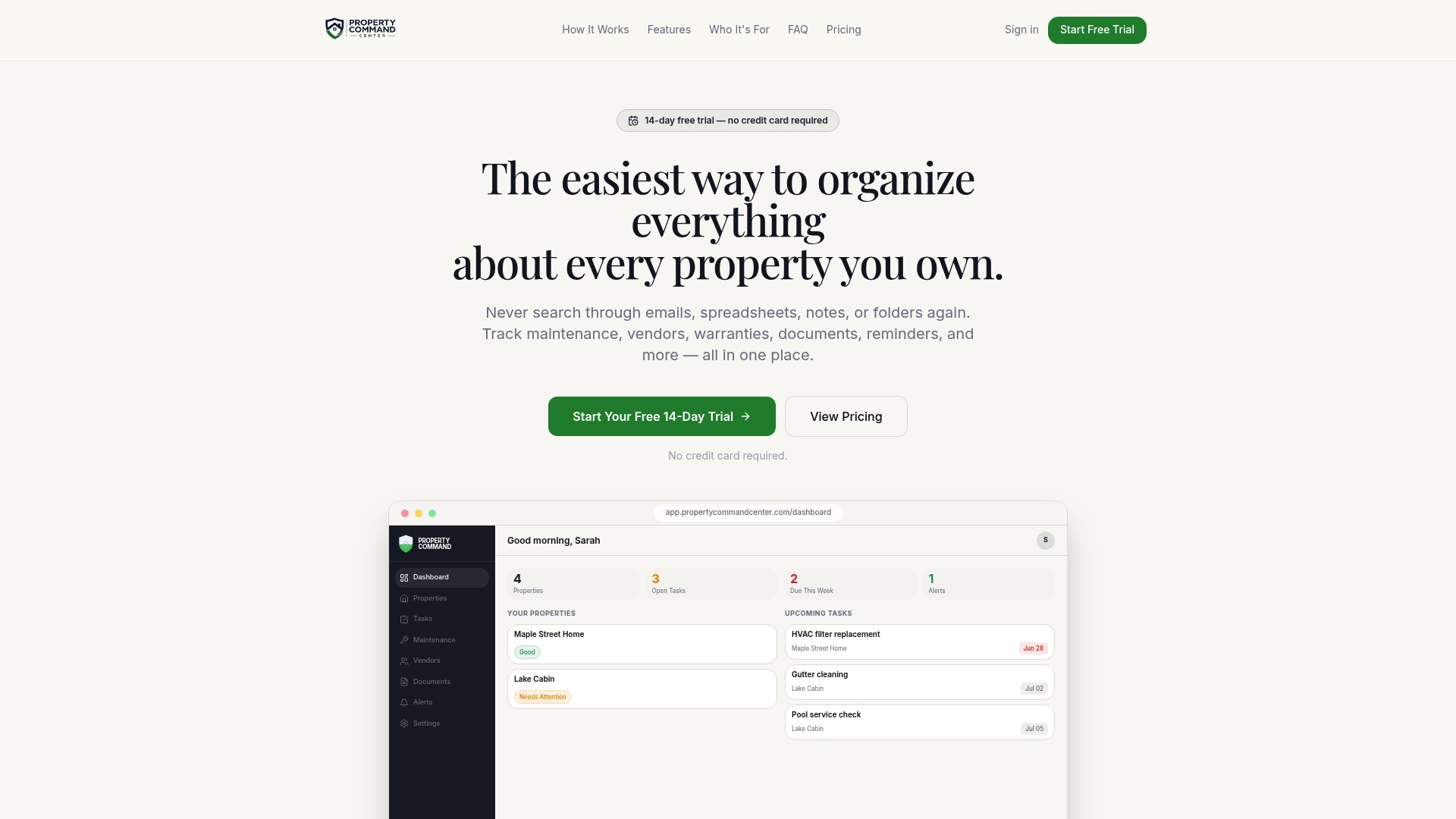
Plans are billed monthly by number of properties: Starter is $19 per month and Pro is $49 per month. You can start with a 14-day free trial, no credit card required. The onboarding page explains how to bring in your existing files.
If you want a maintenance rhythm to go with the roster, start with our four cadences for short-term rental maintenance and the vacation home checklist for remote owners.
FAQ
How many vendors do I need for one vacation rental?
At minimum, one reliable contact for each essential trade: plumber, electrician, HVAC, handyman and appliance repair. Airbnb Host Advisor recommends two vendors per essential trade, and Costay Solutions suggests a primary and a backup for plumbing, HVAC, electrical and general maintenance. Add periodic and emergency trades as your property's systems require, such as pool, hot tub, pest control or snow removal.
What should I verify before hiring a vendor?
Confirm that the license is active with your state licensing board and that it covers the exact type of work. Request a certificate of insurance showing general liability and, if the vendor has employees, workers' compensation, then confirm it with the carrier. Call two or three references from other property owners.
Should I pick the lowest bid?
Not by default. Give each bidder the same written scope and mark every line as included, excluded, an allowance or unclear. Then weigh price against response time, rental experience, warranty and insurance, since reliability during a guest stay is worth real money.
How do I handle emergencies when I am far from the property?
Sort problems into routine, urgent guest-impacting and emergency, and pre-agree who gets called and how much they may spend at each level. For anything involving immediate danger to life or safety, call emergency services first. Keep after-hours numbers and spending limits where you can find them from your phone.
How often should I review my vendors?
At least once a year. Check that licenses and insurance are current, that quality has held, and that pricing is still competitive, and replace anyone who has slipped. Recording each job as it happens makes that review take minutes.
Sources
- How to Build a Reliable Vendor Network for Your Vacation Rental, Costay Solutions
- Building a Vendor Network, Airbnb Host Advisor
- How Property Managers Choose Reliable Maintenance Vendors, West Point Property
- How to Build an STR Vendor Network That Holds Up
- Vendor Management Best Practices, Global Property Management
- How to Compare Contractor Estimates Fairly, Numark Services
- Vacation Rental Vendor Management Guide, Painhost
- Vendor Selection Process Guide
- Business Loan Agreement Terms: What to Check Before You Sign
- Oasis Rental Services FAQs
- Hiring Contractors for Multiple Rental Properties, Real Property Industries
- Does Property Management Include Maintenance?, Global Property Management