
Track service history by centralizing every repair, inspection, and vendor visit in one searchable system, tagged to a specific asset and timestamped from day one. That single habit, more than any app or spreadsheet, is what separates owners who make confident replace-or-repair calls from those guessing at a home's real condition. If you own more than one property, start today by logging six fields on every open work order: asset ID, work details, cost, vendor, warranty status, and photos.
TL;DR:
- Properly tagging and logging six key data points on every work order, including asset ID and warranty status, allows for quick, accurate decision-making.
- Using a centralized digital dashboard suited to your property portfolio size makes tracking repairs, vendor performance, and warranty claims more efficient than spreadsheets or paper records.
- Backfilling missing records should focus on high-risk assets first within 60 days, building habit and connecting past invoices, warranty info, and photos to improve future decisions.
- Regular review of repair frequency and setting automated alerts for recurring issues or warranty expirations can prevent costly failures and surprise bills.
- Consistent, photo-backed, and timestamps-enabled record entries, by all team members, protect against errors, fraud, and disputes, especially when integrated with other property management systems.
Table of Contents
- What to Track: The Six Fields Every Work Order Needs
- What System Should You Actually Use to Store Records?
- How Do You Backfill Years of Missing Maintenance Records?
- How Often Should You Review Your Maintenance Records?
- When Should You Replace an Asset Instead of Repairing It?
- Methods to Prevent Fraudulent or Inaccurate Service Entries
- Connecting Service History to Your Other Property Systems
- Legal and Compliance Considerations for Maintenance Records
- Updating Records From Your Phone While Standing in the Property
- Getting Everyone to Track Records the Same Way
- Why Most Owners Get Maintenance Tracking Backwards
- Ready to Stop Chasing Records Across Five Different Apps?
- Sources
What to Track: The Six Fields Every Work Order Needs
A service record is only useful if it answers a question later. "Did we already fix the water heater in the guest house?" "Is this dishwasher still under warranty?" Those answers depend on capturing the same core data every single time, not just when you remember to.
The six critical data points that make maintenance history genuinely useful for decision making are:
- Unique asset ID — a QR code or simple naming convention (like "Cabin2-HVAC-01") so the record ties to one specific piece of equipment, not a vague property-wide note
- Asset details — manufacturer, model, serial number, installation date and location
- Work order metadata — a work order number, creation and completion dates, priority level, and a plain description of what happened
- Cost breakdown — labor, parts, contractor fees, and a total, itemized rather than lumped together
- Vendor or technician identity — name, company, phone number, and license number if applicable
- Warranty status and photos — whether the repair is covered, any claim numbers, plus before-and-after photos, invoices, and permits
Tag every entry with the property or unit, the system category (HVAC, plumbing, electrical, roofing), and a warranty flag. A complete entry looks like this: "Beach House, HVAC01, WO#4471, 3/12/2026, compressor replacement, $890 parts + $340 labor, Coastal Air Services, 5-year warranty on compressor through 2031, invoice and two photos attached." That single line answers almost any question you'll ask about that unit for years. The Rental Property Maintenance Guide recommends QR-coded asset IDs specifically because they let you scan a unit on-site and pull its entire history instantly, rather than searching by memory.
What System Should You Actually Use to Store Records?
The right system depends on how many properties you manage and how often vendors show up, not on how much software you're willing to learn.
A paper binder still works if you own one home and rarely need to search old records fast. It's low-tech, cheap, and fine for a handful of repairs a year. A spreadsheet or Google Sheet is the next step up, and it's genuinely serviceable for many owners: a simple spreadsheet with consistent fields covering date, cost, contractor, and photos can carry a small portfolio a long way, as long as you actually update it. Notion or a similar flexible template gives you more structure, tagging, and linked pages without full software overhead, which suits owners who want something semi-organized but aren't ready to pay for a dedicated tool. A single dashboard built for property tracking makes the most sense once you're juggling multiple homes, seasonal rentals, or a rotating cast of vendors, because it centralizes reminders, photos, and vendor contacts in one place instead of five.
Whatever you pick, it needs five things: timestamps on every entry, photo and document storage, searchable asset IDs, dedicated vendor fields, and the ability to export records if you switch tools later.
- 1 to 2 homes: a well-maintained spreadsheet is usually enough
- 3 to 10 homes: a Notion setup or lightweight app starts paying off
- 10+ properties or several short-term rentals: a dedicated dashboard becomes worth the subscription
Pro Tip: Pick the system you'll actually open on a Saturday morning standing in a driveway with a contractor. The fanciest tool is worthless if updating it feels like a chore you'll put off until Monday.
How Do You Backfill Years of Missing Maintenance Records?
You don't need perfect history to start making better decisions. You need a plan that gets you from zero to useful in about three months.
- Days 1 to 30: Log every new work order the moment it opens, using all six required fields, no exceptions. This builds the habit before you touch old records.
- Days 31 to 60: Backfill your highest-risk, highest-value assets first, things like HVAC systems, water heaters, and roofs, using old invoices, warranty cards, and photos you already have. Don't chase every light fixture repair from 2019.
- Days 61 to 90: Set a review schedule, turn on reminders for recurring tasks, and archive the paper documents you've now digitized. Connect vendor contacts and upcoming maintenance to your calendar.
Prioritize backfilling any asset where the past 12 months of repair spending is approaching what a full replacement would cost, or where warranty and insurance stakes are high. Partial history focused on your biggest assets beats a complete history of minor repairs you'll never need to reference. A 90-day maintenance plan built around this exact cadence gives small portfolio owners a concrete week-by-week structure to follow.
How Often Should You Review Your Maintenance Records?
Records that sit untouched in a spreadsheet don't save you money. Records you actually review on a schedule do.
- Monthly: Scan the dashboard for open tickets, anything overdue, and what you spent in the last 30 days
- Quarterly: Build a rough vendor scorecard, who finishes on time, who needs a callback, and who's worth calling again
- Annual: Run a full asset health check and update your reserve fund estimate using your real repair history, not guesswork
Repair frequency per asset, tracked over a rolling 12 months, is arguably the single most useful number in your entire record set, because it tells you exactly which units are becoming money pits before the final failure happens. Set automated alerts for three triggers specifically: a repair that repeats on the same asset within 90 days, a warranty approaching its expiration date, and a cost-per-repair that's climbing on a unit that used to be cheap to maintain. Those three alerts do more to prevent surprise five-figure bills than any amount of manual checking.
When Should You Replace an Asset Instead of Repairing It?
Service history turns fuzzy gut calls into math. A water heater that's cost you $420 in repairs against a $750 replacement price is telling you something a single invoice never could.
- Check warranty status before approving any repair over a few hundred dollars, not after the bill arrives
- Log every warranty claim outcome, approved, denied, partial, so you know which manufacturers actually honor their terms
- Use your real historical repair totals, not estimates, when building reserve studies or monthly budget forecasts
- Score vendors on completion rate, on-time delivery, and cost variance against their own quotes, using the history you've already logged
Warranty recovery is the most commonly missed opportunity here. Owners who skip the warranty check before authorizing a repair routinely pay out of pocket for something the manufacturer would have covered. A dedicated warranty tracking approach makes that check a two-second lookup instead of a dig through old paperwork.
Methods to Prevent Fraudulent or Inaccurate Service Entries
Bad data is worse than no data, because it looks trustworthy while quietly leading you to the wrong decision. The fix isn't complicated, but it does require discipline you enforce consistently.
Require photo evidence on every entry above a set dollar threshold, before and after, timestamped automatically by the device that took them. A vendor invoice without a matching photo should raise a flag, not get filed away. Cross-check vendor invoices against your own work order log before payment; if a contractor bills for a part that was replaced eight months ago on the same unit, something needs a second look.
Lock down who can edit a completed record. An immutable audit trail, where closed entries can't be silently altered, protects you in disputes and discourages inflated invoices in the first place. If your system logs who accessed or changed a record and when, that access log becomes your best evidence if a vendor's numbers ever get challenged.
Set a required-fields checklist and make the system reject incomplete submissions. A work order missing a cost breakdown or vendor name shouldn't be marked complete just because someone was in a hurry. Finally, spot-check a handful of records each quarter against the actual invoices in your files. It takes fifteen minutes and catches the kind of small, repeated errors, wrong dates, mismatched costs, that erode trust in the whole system over time.

Connecting Service History to Your Other Property Systems
Your maintenance log shouldn't live in isolation from everything else you track. If you use separate tools for accounting, insurance documentation, or a broader asset inventory, the connections matter more than the tools themselves.
Start with a shared asset ID across every system. If your accounting software calls the water heater one thing and your maintenance log calls it another, you lose the ability to tie repair costs to depreciation schedules or insurance valuations. Standardize the ID once, then use it everywhere.
Export capability matters more than most owners realize until they need it. A system that locks your records in a proprietary format becomes a liability the moment you want to switch tools, hand records to an accountant, or provide documentation to an insurance adjuster. Favor systems that let you pull a clean CSV or PDF export on demand.
If you use a document vault for warranties, insurance policies, and permits, link it directly to the maintenance record rather than storing it somewhere separate. A repair entry that references a permit number or insurance claim ID, with the actual document one click away, saves hours during a dispute or a sale. For owners running several properties, connecting vendor directories to the maintenance log means you're not retyping the same electrician's phone number into three different places every time a new work order opens.
Legal and Compliance Considerations for Maintenance Records
How long you keep records, and how carefully, matters more than most owners assume until a dispute forces the question. A structured system organized around distinct record types, move-in condition, move-out condition, maintenance history, and any lease violations, holds up far better under scrutiny than a folder of loose receipts.
A practical retention standard is seven years for routine maintenance records, and indefinitely for anything tied to habitability issues or capital improvements, since those can matter years later in a sale, an insurance claim, or a legal dispute. Short-term rental hosts face an added wrinkle: guest-facing units often carry stricter local safety inspection requirements, so keep smoke detector, carbon monoxide, and fire safety service records separately flagged and easy to produce on request.
Data privacy applies here too, even for a single-family portfolio. If your maintenance records include vendor contact details, tenant complaint notes, or guest information tied to a repair, treat that data with the same care you'd want applied to your own. Don't store more personal information in a work order than the repair actually requires, and be deliberate about who on your team, if anyone, has access to records containing tenant or guest names. For anyone managing across state lines or with international guests, a property documentation reference covering transaction and disclosure record-keeping is worth a read before you finalize your retention policy.

Updating Records From Your Phone While Standing in the Property
The best maintenance record is the one captured the moment work happens, not reconstructed from memory a week later at your desk. Mobile capture closes that gap, and it's the single easiest habit upgrade available to any owner.
Take photos before a technician starts and again after they finish, every time, even for small jobs. A five-second photo habit costing nothing today can be the difference between an approved insurance claim and a denied one eighteen months from now. Scan or photograph the invoice on-site before the vendor leaves your driveway, rather than trusting it'll get emailed later, because it often doesn't.
If your system supports a QR code per asset, scan it on arrival so the work order auto-links to the correct unit without any manual typing. Voice-to-text notes work well for a quick description while you're still standing next to the furnace, faster and more accurate than trying to remember details later. The goal isn't a perfectly worded entry in the moment. It's capturing the raw facts, date, cost, vendor, photo, while they're still fresh, and cleaning up the wording afterward if needed.
Getting Everyone to Track Records the Same Way
A tracking system only works if everyone touching your properties, family members, co-owners, property managers, or on-site help, uses it the same way every time. One person logging detailed entries while another jots notes on a sticky pad defeats the entire purpose.
Start with a short written checklist of the required fields, laminated or saved as a phone note, so nobody has to guess what "complete" means. Walk any new household member or helper through logging one real work order together, rather than just explaining the system verbally. People retain habits better when they've done the task once with guidance.
Make the easy path the correct path. If your system requires five steps to log a simple repair, people will skip steps under time pressure. If it takes thirty seconds with a photo and a dropdown menu, they won't. Review a sample of entries monthly during the first few months of any new system and gently correct sloppy habits before they calcify. Consistency matters more than perfection, a system where everyone logs the basics reliably beats one where only you fill out every field flawlessly.
Why Most Owners Get Maintenance Tracking Backwards
Most advice on this topic treats record keeping like a filing exercise, something you do to stay tidy. That framing misses the actual point entirely. The value of tracked history isn't organization for its own sake. It's the leverage it gives you in three specific moments: deciding whether to repair or replace, recovering a warranty claim you'd otherwise eat the cost of, and negotiating with a vendor who knows you have their track record on file.
The owners who benefit most aren't the ones with the fanciest system. They're the ones who log the six required fields on every single work order without exception, even for the $80 repairs that feel too small to bother documenting. Those small entries are exactly what builds the repair-frequency pattern that flags a failing unit months before it becomes a $4,000 emergency. Skipping the small stuff is the most common mistake I see in how owners approach this, and it's the one that costs the most later.
A single dashboard that consolidates property status, schedules, vendors, and documents removes the friction that causes owners to skip logging in the first place. When updating a record takes thirty seconds instead of five minutes of searching for the right spreadsheet tab, people actually do it. Resources like the maintenance task tracking guide and the warranty claim tracking guide go deeper into the workflows behind that consistency.
— Francisco
Ready to Stop Chasing Records Across Five Different Apps?
If you're currently splitting maintenance notes between a spreadsheet, a folder of vendor texts, and a shoebox of paper invoices, the fix isn't more discipline. It's fewer places to look. A dedicated property management dashboard puts every property's status, maintenance history, vendor contacts, and warranty documents in one place, so a question like "who fixed the water heater and is it still covered" takes one search instead of multiple apps.
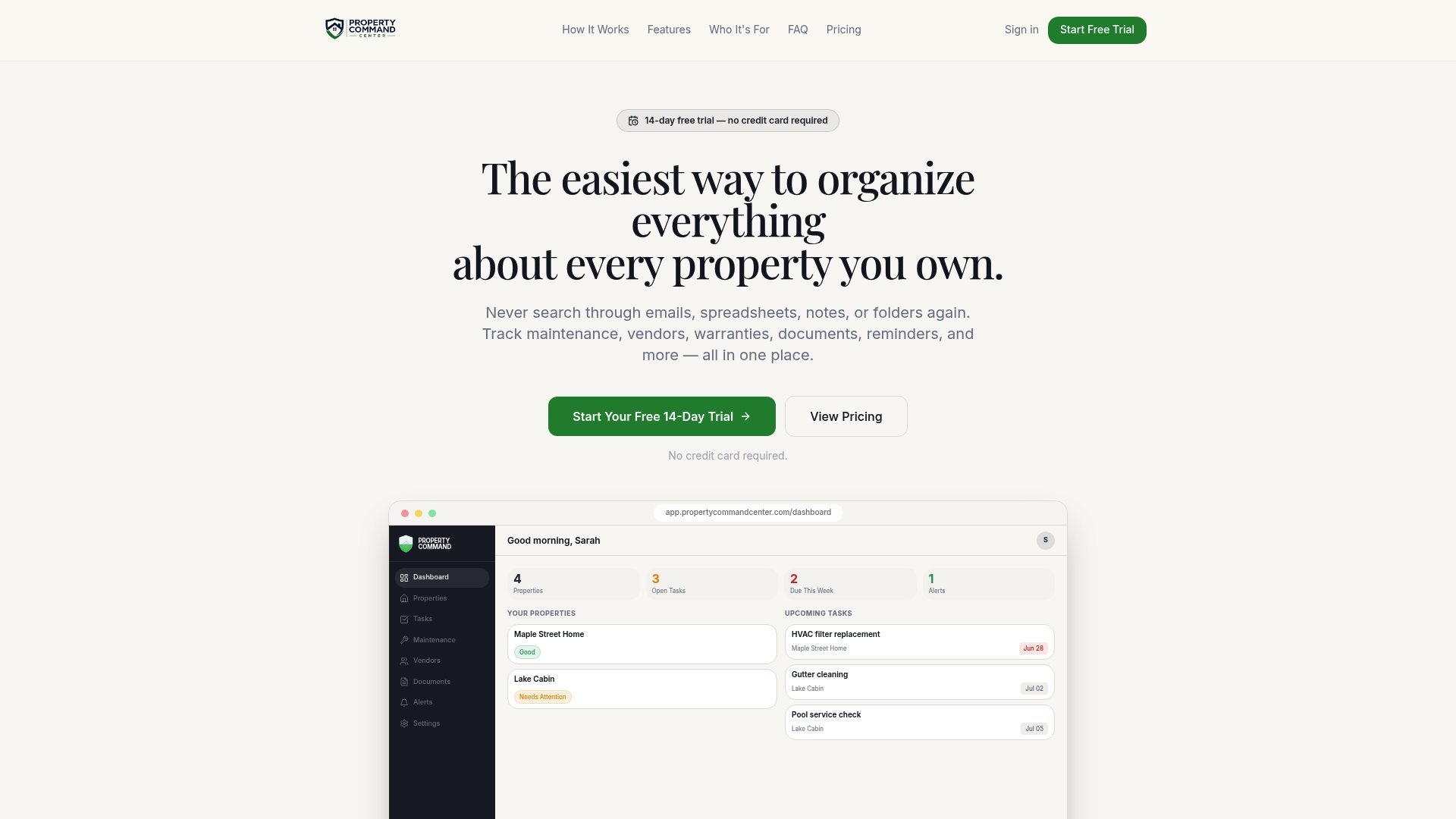
Such dashboards cover essentials discussed here: photo-backed records for work orders, vendor directories, document vaults for warranties and permits, and reminders that flag recurring repairs before they become expensive. If you own one home and update a spreadsheet twice a year, that spreadsheet is probably fine. If you're juggling multiple properties, several vendors, or a short-term rental calendar, a dedicated system becomes more beneficial.
Check the pricing plans to find the tier that fits your portfolio, browse how the vendor directory keeps every contractor's contact and history in one place, and start your free trial today, no credit card required.
Sources
For hands-on setup, use the maintenance log templates to structure your fields, the 90-day maintenance plan for backfilling, and the multi-property dashboard guide for scaling beyond one home.
- How to Track Housing Repairs: 4 Best Methods | Gerald
- Property documentation for landlords: the complete reference (2026) · DiscoveryMark