An after-hours maintenance contact list is a one-page record, kept for every property, that tells a tenant, guest, neighbor or you exactly who to call when something breaks at 11 p.m. It names a primary and a backup for each core trade, says what counts as an emergency, and shows when someone last checked that the numbers still work. If you own more than one property, the list matters most when you are the person who cannot be reached quickly.
Below you will find what belongs on the list, how to choose the people on it, how to tell residents about it, and how to keep a record of every call so the next one is easier.
TL;DR
- Define emergencies in writing before the first call comes in. Fire, gas or electrical failure, water leaks, sewage backup, no heat or cooling, and no water are the usual items.
- For each property, list a primary and a backup contact for plumbing, electrical and HVAC, with an after-hours number, a service area and a last-updated date.
- Set spending limits in advance so a vendor or property sitter knows what they can approve without calling you.
- Log the time you were notified, who responded and what it cost. That record helps with insurance claims and disputes.
- Keep everything in one place per property, not spread across texts, email and a spreadsheet.
Table of Contents
- What counts as an after-hours emergency
- What to put on the contact list for each property
- How to choose who goes on the list
- What about an answering service?
- How to tell tenants and guests
- Record every call
- Our perspective
- Keep your contacts with the rest of the property record
- A 60-minute setup you can do this week
- FAQ
- Sources
What counts as an after-hours emergency
The list only works if everyone agrees on what deserves a midnight call. The National Apartment Association defines maintenance emergencies to include fire, electrical or gas failure, any water leak or sewage backup, no heat or air conditioning, a nonworking refrigerator, no hot or cold water, and a stopped-up toilet in a unit that has only one. The same page is clear on the first step for fire: call 911 before anyone calls maintenance.
That gives you a simple split.
| Treat as an emergency tonight | Can usually wait for business hours |
|---|---|
| Fire or smoke (911 first) | A dripping faucet with no water spreading |
| Gas smell or gas failure | A single burned-out light bulb |
| Active water leak or sewage backup | A slow drain in a home with a second toilet or sink |
| No heat or no cooling | A cosmetic repair such as a scuffed wall |
| No hot or cold water | A loose cabinet handle |
| Electrical failure or sparking | A noisy appliance that still works |
| Refrigerator not working | A stuck window in a safe room |
| Only toilet stopped up | A request to replace a filter |
Two caveats shape how you apply this. First, a lockout is not on the NAA list, and many residents assume it is. If you do not cover lockouts after hours, say so and name a locksmith they can call at their own expense. Second, context changes severity. A dead refrigerator in July with a guest's groceries is not the same as a dead refrigerator in an empty second home. Write the rule down, then let your triage notes handle the exceptions.
Why habitability is the reason to be strict
If you rent a property, your responsibilities do not stop at 5 p.m. HUD's housing counselor training materials list properly functioning plumbing and heating among typical landlord responsibilities and describe a safe, sanitary, generally habitable unit as a tenant right. Local rules vary a great deal. New York, for example, sets specific standards for heat and hot water in multiple dwellings, with penalties when they are not provided, according to the state attorney general's tenant guide. Check your own state and city rules or ask a local landlord attorney what response times apply to your units. Our own breakdown of U.S. landlord maintenance responsibilities is a good place to start building that picture.

What to put on the contact list for each property
One master list for your whole portfolio sounds efficient, but it fails the moment a tenant in one house reads a number meant for another. Build a list per property, then roll them up for yourself.
A solid after-hours template includes the following, based on the fields in a maintenance emergency contact checklist: property identification details, primary and alternate emergency contacts with phone and email, and a last-updated date. Add the items below because they save time on a real call.
- Full address and access notes. Gate codes, lockbox location, which unit, where the water shutoff and breaker panel are.
- Your own number and a backup person. A co-owner, family member, trusted neighbor or local property sitter who can answer when you cannot.
- Primary and backup vendor for each core trade. Plumbing, electrical and HVAC at minimum. Industry guidance recommends storing primary and backup vendors with after-hours numbers, confirmed availability and pre-negotiated rates.
- Utility emergency lines. Gas, electric and water companies each run their own outage and leak numbers. Look them up for each address and add them.
- Shutoff instructions. Two sentences on where the main water valve is and how to turn it. This one line prevents more damage than any vendor can undo.
- Spending limit. What the vendor or sitter may approve without calling you.
- Last verified date. If the date is more than a year old, the list is a guess.
We go deeper on how many names to keep in three vendors per trade for multi-property owners. The short version: a single plumber is a single point of failure, and the plumber is always on vacation the night your pipe bursts.
A sample entry
Here is what one trade looks like when it is filled in properly. The names and numbers are placeholders for illustration.
| Field | Entry |
|---|---|
| Trade | Plumbing |
| Primary | Company name, after-hours cell, confirmed available nights and weekends |
| Backup | Second company, different owner, after-hours number |
| Service area | Counties or ZIP codes they cover |
| Rate note | After-hours call-out fee and hourly rate, as quoted |
| Approval limit | Up to a dollar amount without calling the owner |
| Last verified | Month and year of your last test call |
The most useful habit is the test call. Phone each number once, introduce yourself as the owner, and ask whether they really answer after hours and whether they serve that address. A number on a website is not the same as a person at the other end.
How to choose who goes on the list
Picking an emergency vendor while water is running down a wall is how owners overpay. Do the selection in daylight.
Screen before you need them
Guidance for landlords recommends confirming insurance and licensing for all after-hours service providers, because vetting ahead of time prevents delays when something fails. Licensing rules differ by state and trade, so check your state licensing board's lookup for plumbers, electricians and HVAC contractors rather than relying on a business card. Then collect:
- Proof of liability insurance.
- Their actual after-hours hours and how fast they say they respond.
- The area they serve.
- Their call-out fee and hourly rates, in writing.
- Who answers the phone at night: the owner, a technician or an answering service.
Agree on money and authority up front
An emergency plan should set roles, decision rights and spending limits ahead of time, including who approves vendor work and at what dollar thresholds. For a small owner this can be one sentence: "Call us for anything over a set amount; below that, stop the damage and send the invoice." Pick the figure that fits your properties and your own tolerance, and put it on the list.
Keep more than one name per trade
Plans that publish roles, triage rules and a 24/7 escalation path also keep multiple vendors per trade so that one busy contractor does not stall a repair. If your first call goes to voicemail, the list should tell the resident what to do next, with no improvising. Once your list is running, track how each vendor actually performs; our guide to vendor performance tracking over 90 days shows how to turn call records into a ranking you can trust. If you want to map coverage gaps across several properties first, the five-step vendor coverage plan walks through it.
What about an answering service?
Many owners ask whether a 24/7 call center should sit in front of the list. For a portfolio of a handful of homes, it can be worth considering, but it adds a layer: someone who does not know your properties takes the call, decides whether it is urgent and then forwards it. If you use one, give them your written emergency definition, the contact order for each property and your spending limits, and test it by calling in a mock emergency. If you do not use one, make sure the number residents call reaches a real person or a backup within minutes, not a mailbox you check in the morning.

How to tell tenants and guests
A perfect list that nobody can find is useless at night. Put it where residents will look when they are stressed.
- Tenants: include the after-hours instructions in the lease packet, in the welcome message and on a card inside the unit near the electrical panel or on the refrigerator.
- Vacation rental guests: place the emergency numbers in the house manual, the digital guidebook and the pre-arrival message. Lead with the line "If it is a fire, call 911."
- Everyone: ask them to describe the problem, where it is and whether water, smoke or sparks are involved. Request a photo if safe. Tell them which shutoff to use while they wait.
Keep the wording short. Three bullet points beat a page of policy. An example: what counts as an emergency, the number to call, and what to do first while help is on the way.
Second-home owners
If your property sits empty for weeks, the "resident" might be a caretaker, a cleaner or a neighbor who keeps an eye on it. Give that person the same card and clear authority to act. Long-distance owners should also read how to build repeatable routines for long-distance landlord maintenance, since the weakest point is often the gap between the incident and the moment you hear about it.
Record every call
The call is only half the job. The record afterward is what protects you and makes the next incident cheaper.
Landlords are advised to note the exact time they received notice, their response time and all communication with the tenant, to show good-faith compliance and to support insurance claims or disputes. After an incident, the same kind of guidance recommends keeping timestamped photos, damaged items, vendor estimates and invoices, mitigation steps, witness statements and incident reports, then using that data for root-cause analysis so the problem does not repeat.
A practical incident log has these fields:
- Property and unit.
- Date and time the report arrived, and how.
- What the resident reported, with photos.
- Who you or your backup called, and when they arrived.
- What was done, and whether the fix was temporary.
- Invoice amount and where the invoice is stored.
- Follow-up task, such as a permanent repair or a warranty claim.
For short-term rentals, guest-caused damage needs its own evidence. We cover what to capture in guest damage documentation, and the insurer side in landlord insurance documents to keep.
Our perspective
Most owners we talk to do not lack information. They have the plumber's number in a text thread from 2022, the water heater warranty in an email, and the gate code in a note on their phone. The problem is that all of it lives in different places, and an emergency is the worst time to go searching.
That is why we built Property Command Center around property knowledge instead of rent collection or leasing. We think an after-hours contact list should not be a separate document you have to remember to update. It should be part of a living record for each property, next to the maintenance history, the vendors who did the work, the warranties and the open tasks. When a pipe bursts, you should be able to open one property, see who to call, see what was repaired last time and see what the warranty covers.
Our Smart Setup is designed to pull that information out of the spreadsheets, emails and files you already have, so you are not retyping your portfolio one property at a time. We believe the owners who handle emergencies calmly are the ones who did the organizing on a quiet Tuesday.
Francisco
Keep your contacts with the rest of the property record
If your emergency numbers are scattered, the fastest fix is to move them into one organized home. Property Command Center gives each property a record that holds its vendor directory, document vault, tasks, reminders and maintenance history, so the after-hours contacts sit beside everything else you know about the house. Reminders can prompt you to re-verify a vendor before the list goes stale.
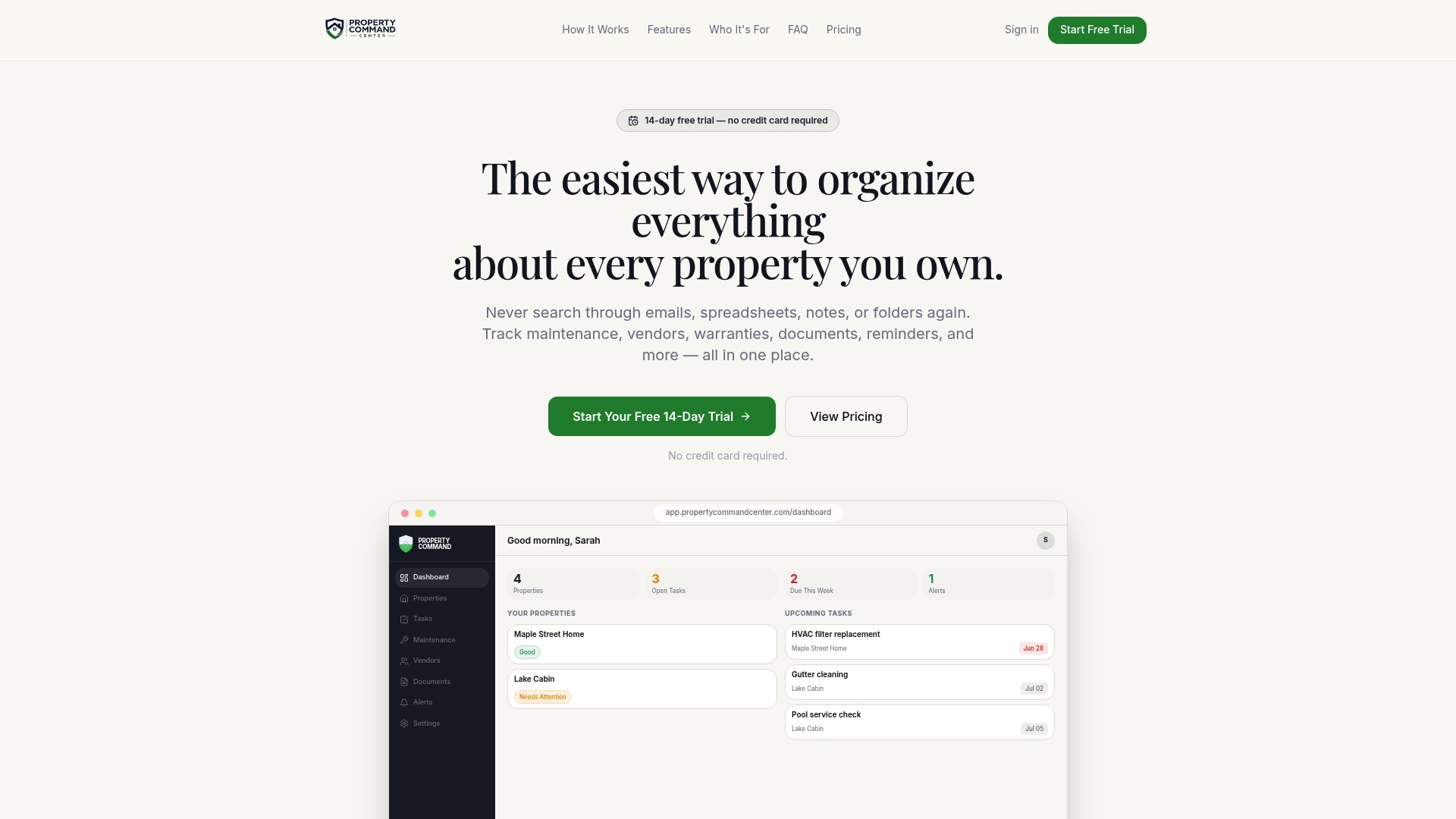
Plans start at $19 per month for Starter, with Pro at $49 per month, and there is a 14-day free trial with no credit card required. You can see the details on the pricing page or start from the main site. If you want a step-by-step build, our 60-minute emergency maintenance plan includes a checklist you can finish in one sitting.
A 60-minute setup you can do this week
If you do nothing else, work through this order for each property.
- Minutes 0 to 10: Write your emergency definition from the table above and adjust for the property. Add the local fire, police and utility numbers.
- Minutes 10 to 25: Gather vendor names you already use from texts, invoices and email. Choose a primary and a backup for plumbing, electrical and HVAC.
- Minutes 25 to 40: Call each one. Confirm after-hours availability, service area and call-out fee. Note any who do not answer and replace them.
- Minutes 40 to 50: Write shutoff locations and access notes. Take a photo of the water main and electrical panel.
- Minutes 50 to 60: Set your spending limit, add the last-verified date and publish the card to residents or guests.
Then put a reminder on the calendar to repeat the test calls every six to twelve months, and any time a vendor changes hands. For recurring checks beyond emergencies, see our guide to rental property maintenance schedules and recordkeeping, and for lease-turn paperwork, the rental document checklist.
FAQ
What is considered an after-hours maintenance emergency?
The National Apartment Association's list covers fire, electrical or gas failure, any water leak or sewage backup, no heat or cooling, no hot or cold water, a nonworking refrigerator and a stopped-up toilet when it is the only one. For fire, call 911 first. Put your own definition in writing so residents do not have to guess.
Who should be on an after-hours contact list?
List yourself, a backup person who can act for you, and a primary and backup vendor for plumbing, electrical and HVAC. Add the gas, electric and water utility emergency lines for that address. Include a phone number that reaches a person, a service area and a last-updated date for each entry.
How fast do I have to respond to an emergency repair?
That depends on your state, city and lease. HUD describes functioning plumbing and heating as typical landlord responsibilities, and some states set specific standards for heat and hot water. Ask a local landlord attorney or your housing agency for the exact timeline that applies to your property.
What should I record after an emergency call?
Note when you were notified, when you responded and who you spoke with. Keep timestamped photos, estimates, invoices and what was done to limit damage. That record supports insurance claims and shows good-faith effort if a dispute arises.
Sources
- Maintenance Emergencies Defined, National Apartment Association
- HUD Housing Counselors Training Module 6.1
- Residential Tenants' Rights Guide, New York Attorney General
- Maintenance Emergency Contact List Checklist Form Template, Jotform
- Emergency Maintenance: A Guide for Property Managers in 2025, Re-Leased
- Emergency Maintenance Requests: How to Handle Them Quickly, VerticalRent