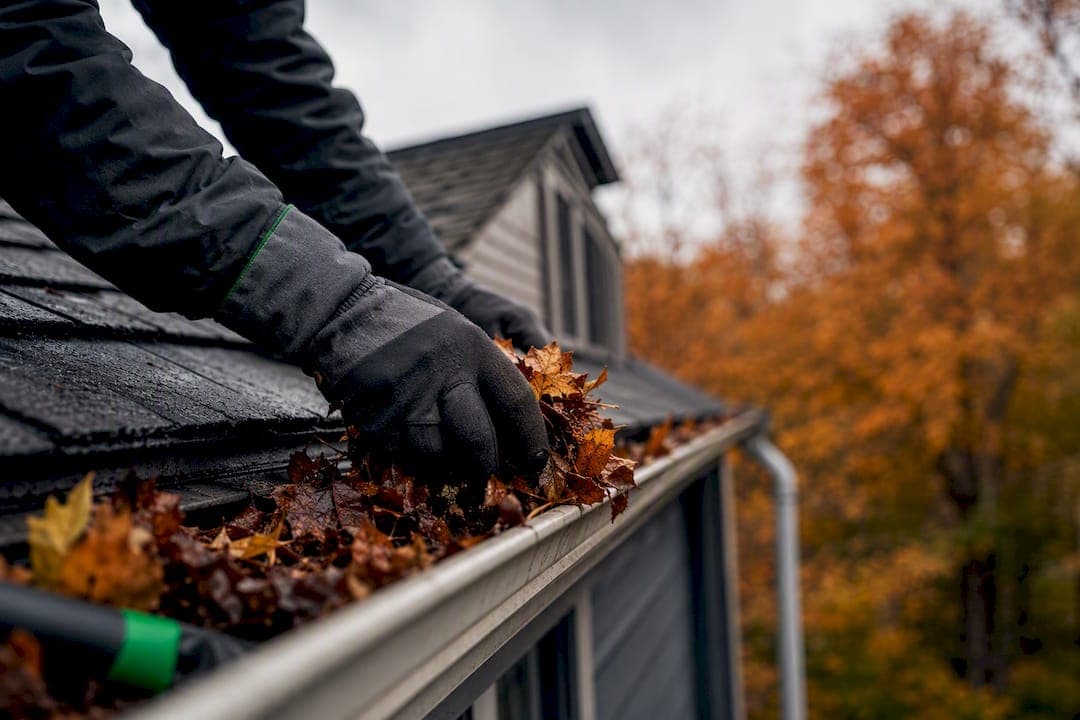
Most homeowners should clean their gutters twice a year, once in spring and once in fall. If you have heavy tree cover, pine needles nearby, or live somewhere with frequent storms, you may need to clean them more often. Beyond the calendar, inspect after any major storm, and clean immediately if you notice overflow, sagging, or plants growing out of the gutter.
TL;DR:
- Heavy tree cover, frequent storms, or pine needles demand more frequent gutter checks, often exceeding the standard twice-yearly schedule.
- Waiting until gutters overflow or sag can cause hidden damage including mold, foundation issues, and fascia rot that are costly to repair.
- Spring and fall are the optimal seasons for cleaning, but the timing should be adjusted based on local climate, vegetation, and storm activity.
- Post-storm inspections are essential because debris buildup can occur between scheduled cleanings, especially in storm-prone areas.
- Proper maintenance routines, including video records and timely inspections, prevent larger repairs and keep gutters functioning effectively.
Table of Contents
- Why a Gutter Cleaning Schedule Actually Matters
- What's the Right Gutter Cleaning Frequency for You?
- What Raises or Lowers Your Cleaning Frequency
- A Seasonal Calendar You Can Actually Follow
- Signs Your Gutters Need Cleaning Right Now
- DIY Safety Rules and When to Call a Pro
- Turning This Into a Checklist You'll Actually Use
- Why a Schedule Beats Waiting for Warning Signs
- Keep Every Gutter Date and Vendor in One Place
- Sources
- FAQ
Why a Gutter Cleaning Schedule Actually Matters
Clogged gutters don't just look bad. They redirect water somewhere it was never designed to go, and that's where the real damage starts.
Water that can't drain properly backs up under roof shingles and rots the fascia board behind your gutters. It also pools at the foundation, where it seeps into basements and crawl spaces. That moisture creates the exact conditions the EPA warns about in its mold guidance: once water intrudes and lingers, mold growth tends to follow, and it's a public-health issue as much as a structural one.
The cost math is not close. A standard gutter cleaning runs a fraction of what a fascia repair, a foundation crack seal, or mold remediation costs. Waiting until you see obvious overflow is a gamble, because by the time water is spilling over the edge, The Spruce notes that damage has likely already begun somewhere you can't see yet.
Pro Tip: Take a photo of your gutters looking clean right after each cleaning. Six months later, compare it to what you see. The difference tells you instantly whether your current frequency is enough.
There are secondary risks people overlook. Standing debris in gutters becomes a nesting spot for birds, mice, and mosquitoes breeding in trapped water. In wildfire-prone regions, dry leaves and pine needles packed into a gutter are kindling sitting a few feet from your roofline, ready to catch embers carried by wind. None of these risks show up on a home inspection report until they've already become a repair bill.
What's the Right Gutter Cleaning Frequency for You?
Twice a year is the number nearly every credible source lands on, and there's a logic behind those two specific windows. Spring cleaning clears out the seed pods, catkins, and grit that winter and early spring dump into your system. Fall cleaning clears leaves before they mat down and freeze solid. LeafFilter's general guidance puts it simply: clean at least twice a year, but adjust based on your climate, your trees, and whether you already have gutter guards installed.
That baseline isn't universal, though. Some homes can stretch to once a year. Others need to double or triple that.
You can likely get away with one cleaning a year if:
- You live in an arid or desert climate with minimal rainfall.
- There are no trees within dropping distance of your roofline.
- Your gutters already have well-maintained guards and you check them each fall.
You probably need three to four cleanings a year if:
- You have pine or fir trees nearby, since needles slip through screens that block leaves.
- Your property sits under dense deciduous canopy that drops leaves in waves rather than all at once.
- You live somewhere that gets frequent heavy storms, which wash debris into gutters between your usual cleaning dates.
BobVila's reporting on cleaning frequency backs the same pattern: two cleanings a year is standard, but heavy tree cover pushes that number up, and any home should get a post-storm check regardless of season.
Think of it less as a fixed rule and more as a starting point you adjust based on what your specific roofline actually collects. A ranch house with no trees for fifty feet in any direction has a completely different risk profile than a two-story colonial shaded by three mature oaks. Both might get labeled "average" on a national survey, but they need different calendars.
What Raises or Lowers Your Cleaning Frequency
Four variables do most of the work in deciding whether you're a twice-a-year household or a four-times-a-year household. Walking through them honestly will get you closer to the right number than any generic rule ever could.
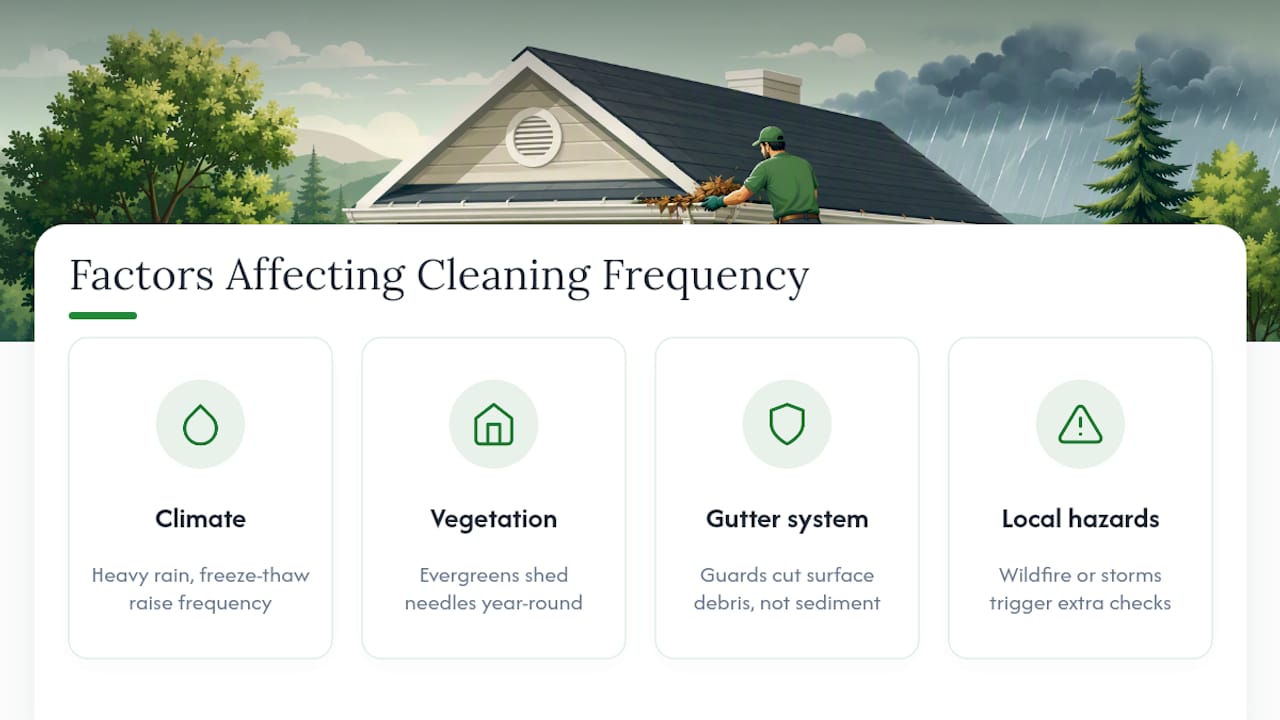
Climate and precipitation set the baseline risk level. Regions with heavy, sustained rainfall push more water volume through your gutter system, and freeze-thaw cycles compound the problem: water that pools and refreezes repeatedly can crack seams and pull fasteners loose over a single winter. CleanPro's state-by-state frequency guide shows a range of one to four cleanings a year across the country, driven largely by forest cover and precipitation, with most states landing in the two to three range.
Vegetation type matters more than most homeowners assume. Deciduous trees drop leaves in a concentrated window, which makes fall the obvious priority. Evergreens and pines drop needles steadily all year, and those needles are small enough to slip through wider gutter screens that would stop a maple leaf without issue. Dense canopy over a roof also means less sun exposure, so debris stays damp longer and decomposes into sludge instead of blowing away.
Your gutter system itself changes the math. Gutter guards reduce surface debris significantly, but they don't eliminate maintenance. Sediment and fine grit still filter through most guard systems over time, and a guarded gutter still needs periodic inspection to confirm water is actually draining rather than pooling behind a clogged guard. Pitch, material, and downspout count all affect how fast water clears once it hits the trough.
Local hazards create trigger-based checks that fall outside any fixed calendar. Wildfire-prone areas need debris cleared before fire season regardless of what month it is. Storm-heavy regions need a walk-around after any named storm, hail event, or high-wind day, since debris and displaced roof granules can clog a system that was clean a week earlier.
A Seasonal Calendar You Can Actually Follow
Spring and fall aren't interchangeable placeholders. Each season has a specific window where cleaning does the most good, and missing that window in either direction costs you.
Spring cleaning should happen after snowmelt has fully drained but before the season's heavy rains arrive. Clearing gutters too early, while snow is still melting off the roof, means you'll be back up the ladder in three weeks once the last of it comes down. Wait too long, and a spring downpour hits a gutter still packed with winter debris, sending overflow straight down your siding.
Fall is genuinely the peak season for gutter cleaning, and timing it precisely matters more than most people realize. LeafFilter's peak-season guidance recommends cleaning after most leaves have dropped but before the first hard freeze. Cleaning too early may mean repeating the task soon after, while waiting until after a freeze can cause leaves to form a frozen block that's harder to remove and may damage gutters.
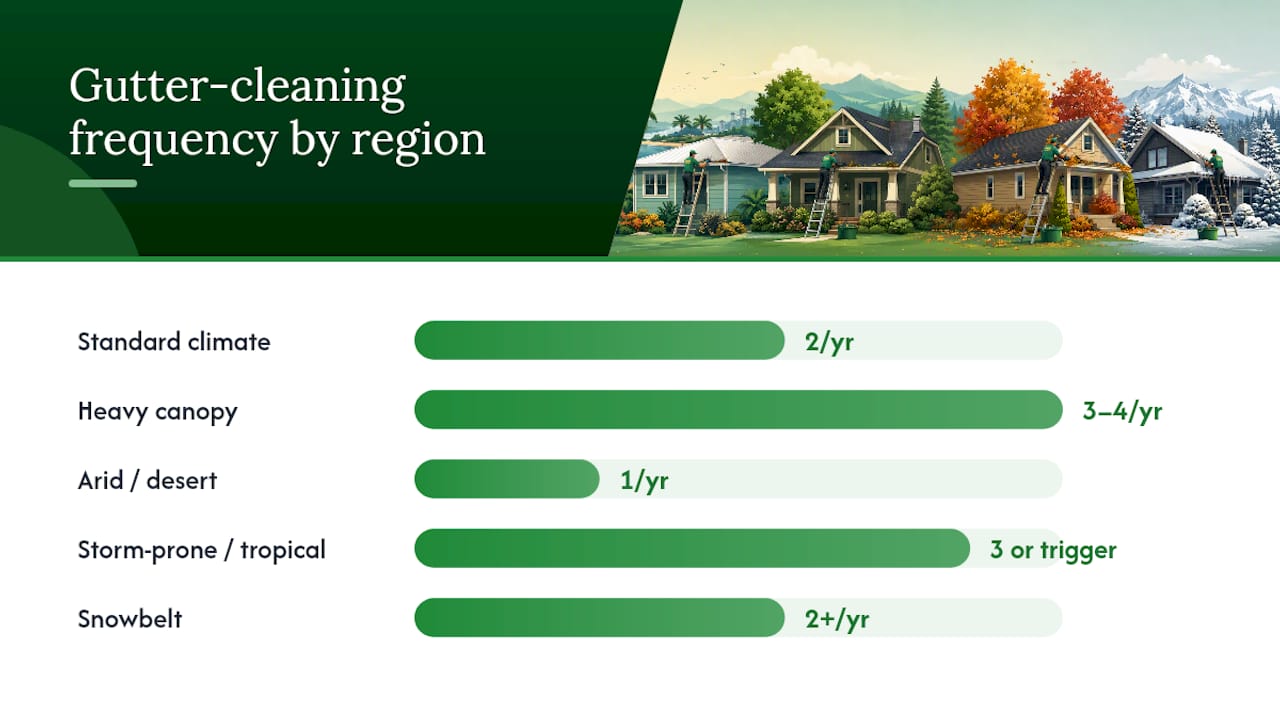
Summer and dry climates run on a different logic entirely. Desert and arid regions may only need an annual dust and debris check, since there's little rainfall to expose problems and little vegetation to clog the system. Storm-prone and tropical regions need a mid-summer check tied to hurricane or monsoon season rather than a fixed date, since a single tropical storm can undo months of clean gutters overnight.
Snowbelt regions need a slightly different rhythm than the standard twice-a-year plan. Fall cleaning needs to happen before the first sustained freeze locks debris in place, and spring cleaning should wait until after snowmelt is complete rather than starting the moment temperatures rise. Any cold-weather inspection is safest done midday on a warmer day, when ladder surfaces and roof edges aren't coated in frost or ice.
| Region type | Recommended timing | Frequency per year |
|---|---|---|
| Standard climate, moderate trees | Spring (after snowmelt) and fall (after leaf drop, before freeze) | 2 |
| Heavy deciduous or pine canopy | Add a mid-summer check between spring and fall | 3 to 4 |
| Arid or desert climate, no trees | Late fall or early spring, once a year | 1 |
| Storm-prone or tropical region | Pre-storm-season check plus standard spring/fall | 3 or trigger-based |
| Snowbelt region | Pre-freeze fall cleaning, post-thaw spring cleaning | 2, with post-storm checks |
Signs Your Gutters Need Cleaning Right Now
A calendar schedule handles the predictable half of gutter maintenance. The other half is knowing when to skip the calendar entirely and go check things immediately, because certain warning signs mean a clog has already formed.
- Water overflows the sides during rain instead of running through the downspout. This is the clearest sign of a full blockage.
- You can see plants or grass sprouting from the gutter itself. Debris that's been sitting long enough to support plant growth has been there for a while.
- The gutter is visibly sagging or pulling away from the roofline. This usually means standing water has added enough weight to strain the fasteners.
- Water trickles weakly or not at all from the downspout during a steady rain, which signals a clog further down the line rather than at the trough.
- After any major storm, walk the perimeter within a few days and look for displaced debris, roof granules collecting near downspouts, or gutters pulled loose from wind.
Do this ground-level check from a safe distance with binoculars if needed, and take a photo of anything questionable. If a section is sagging badly, pulling away from the fascia, or you can't tell what's causing a blockage from the ground, that's the point to call a professional instead of climbing up to find out.
DIY Safety Rules and When to Call a Pro
Ladder falls send more people to the emergency room than almost any other home maintenance task, and gutters are one of the top reasons homeowners end up on a ladder. OSHA's ladder safety standards cover the basics worth following even for a residential job: maintain three points of contact, never stand on the top rung, and set the ladder on level, stable ground before you climb.
A few conditions should make you hire a professional instead of doing it yourself:
- Your home is two stories or taller, where a fall carries far more serious consequences.
- Gutters run near power lines, where an aluminum ladder or gutter tool becomes a real hazard.
- Ice, heavy debris buildup, or steep roof pitch make footing unpredictable.
- You have any mobility limitation that makes ladder work risky on a good day, let alone a wet one.
Wear closed-toe shoes with real tread, work gloves, and eye protection, and only climb in dry, calm weather. Skip it entirely after rain or in wind.
Professional gutter cleaning typically runs in a moderate range for a single-story home with straightforward access, and climbs from there. Price increases with a second story, longer gutter runs, heavy debris from overhanging trees, and any minor repairs bundled into the visit. What you're often paying for beyond the labor is thoroughness: a professional crew tends to flush downspouts fully, tighten loose fasteners, and flag small issues like a cracked seam or a coming-loose bracket before they become expensive problems.
Turning This Into a Checklist You'll Actually Use
A schedule only works if it survives contact with a busy month. The fix is treating each cleaning like a five-step routine instead of a vague chore.
- Clear all visible debris from the trough by hand or with a scoop.
- Flush the system with a hose to confirm water moves freely through each downspout.
- Inspect seams, fasteners, and the fascia board for soft spots, rust, or gaps.
- Photograph the cleaned gutter and any issue you noticed, for your own before-and-after record.
- Record the date, what you found, and who did the work, whether that's you or a hired crew.
Once you've done that once, the real win is not having to remember to do it again. Set recurring reminders for your spring and fall windows, plus a standing trigger to check gutters within a few days of any major storm. A seasonal home maintenance calendar built around these checkpoints tends to actually get followed, since the task shows up on its own instead of depending on you remembering it. Pairing that with a month-by-month maintenance calendar gives you a template to copy the spring and fall dates into.
Pro Tip: Keep a one-line note with each entry about whether you have gutter guards and their condition. Guards reduce debris, but sediment still filters through over time, and that note saves you from re-diagnosing the same system every single visit.
If you hire a pro, store their contact info, the invoice, and their notes in the same place as your dates. Scattered texts and paper receipts are exactly how a simple two-visits-a-year habit falls apart after year one.
Why a Schedule Beats Waiting for Warning Signs
Most people don't neglect their gutters on purpose. They just wait for a sign before acting, and by the time a sign shows up, the fix is bigger than it needed to be. A fixed schedule flips that logic: you're not reacting to sagging gutters or a wet basement, you're preventing them from happening at all.
The homeowners who actually stick with a twice-a-year routine tend to have one thing in common: they've made it automatic rather than something they have to remember. That's really the whole argument for building gutter maintenance into a broader preventive maintenance routine instead of treating it as a standalone task you occasionally think about in October. Adjust the frequency to your actual trees and climate, not someone else's, and the schedule will hold up.
— Francisco
Keep Every Gutter Date and Vendor in One Place
Juggling gutter cleaning dates across two or three properties by memory or scattered text threads is how a simple twice-a-year plan quietly falls apart. This type of platform is designed to solve this problem by providing a dashboard where you can set recurring spring and fall reminders, log the trigger-based checks after a storm, and track which property is due next.

It works especially well if you own more than one property, split time between a primary home and a vacation rental, or just prefer one screen over five different apps and a sticky note on the fridge. The vendor directory keeps every gutter cleaner, roofer, or handyman's contact info attached to the property they service, so you're never digging through old texts to find who did the work last fall. Photos, service notes, and invoices may be attached to each maintenance entry, helping make gutter history searchable instead of scattered.
If you're ready to stop tracking this in your head, check the pricing plans and start a free trial. No credit card required to see whether it fits how you manage your properties.
Sources
This schedule draws on guidance from LeafFilter's timing recommendations, The Spruce's preventive maintenance framing, BobVila's frequency reporting, and CleanPro's state-level frequency data. For a broader home maintenance calendar, see the printable maintenance checklist and the 90-day maintenance plan for small portfolios.
For homeowners planning other seasonal projects, energy efficiency best practices offer a useful room-by-room companion to gutter upkeep, and winter curb appeal tips pair well with a pre-freeze fall cleaning.
- Best Time to Clean Out Gutters: Year‑Round Guide & Timing Tips — LeafFilter
- Why You Should Clean Your Gutters in Spring, Home Experts Say — The Spruce
- A brief guide to mold, moisture and your home — EPA
FAQ
How frequently should gutters be cleaned?
Most homes need cleaning twice a year, in spring and fall, but heavy tree cover, pine needles, or a storm-prone climate can increase cleaning frequency.
What's a trick people miss for cleaning gutters?
Flushing each downspout with a hose after clearing debris by hand catches hidden clogs further down the line that a visual check from the trough alone would miss.
What is the best month to get your gutters cleaned?
Late fall, after most leaves have dropped but before the first hard freeze, is the single best window, since debris hasn't yet frozen into a solid, hard-to-remove mass.
How much should you expect to pay for gutter cleaning?
Cost varies with home height, gutter length, and debris volume, with two-story homes and heavy tree cover pushing prices higher than a straightforward single-story job.