
A home inventory for insurance is a room-by-room record of what you own, what each item is worth and the proof that you owned it. If you hold more than one property, the inventory is only one piece of a larger record: the policy, the receipts, the warranties and the repair history for each home need to sit beside it, in one place you can open after a loss. That is how we set up property records at Property Command Center, and this guide shows you how to build the inventory itself and then keep it from going stale.
TL;DR
- A detailed inventory can speed up a claim and keeps the insurer from estimating your losses for you, which can lead to underpayment.
- Record each item's description, make, model, serial number, purchase date, receipt and replacement cost today, and support it with photos or video.
- Keep a copy outside the home, in at least two places, and refresh it every season or after any big purchase.
- With several properties, keep each home's inventory, policy, receipts and warranties together instead of scattered across apps, drives and inboxes.
- Property Command Center brings those records into one vault per property, with reminders to keep them current.
Table of Contents
- Why an inventory changes what a claim looks like
- What to record for each item
- How to build the inventory, step by step
- Where to keep it, and how often to update it
- The multi-property problem
- Put your property records in one place
- FAQ
- Sources
Why an inventory changes what a claim looks like
After a fire, burglary or storm, you are asked to say what was lost. Memory is a poor tool for that. The Oklahoma Insurance Department notes that research suggests almost half of all Americans don't keep an inventory of their possessions, and says the information in the file can make a settlement faster and easier.
The Iowa Insurance Division adds the part that costs money: your policy covers personal property up to the limit on the declarations page, and without an inventory insurers may default to estimating the value of lost items, often leading to underpayment. The declarations page is the summary sheet at the front of your policy that lists your coverage limits.
There is also a before-the-loss benefit. The California Department of Insurance describes a complete inventory as a record of contents, their value and serial numbers, and as an indication of whether your coverage is adequate. It suggests talking to your agent after each update to see whether you need additional coverage. If the total of your belongings is higher than you assumed, you learn that while you can still change the policy.
What to record for each item
The state insurance departments and the large insurers agree closely on the basics. Pulling their guidance together, each entry should carry:
- Description. Not "ring" but enough detail that a stranger could identify it. American Family's example is an emerald cut diamond ring with a white gold shank, accent stones and an inscription.
- Make, model and serial number. The Iowa Insurance Division lists these among the details to capture room by room, with photos, receipts or estimated worth.
- Purchase date and where you bought it. State Farm lists value, place of purchase and purchase date alongside the description.
- Replacement cost today. More on this below, because it is where most owners go wrong.
- Proof. Allstate explains that receipts, bank statements, photos or registrations verify that an item was yours before it was damaged or stolen.
The Kansas Insurance Department's guide lists the supporting documents worth keeping: receipts, purchase orders or invoices, canceled checks, warranty and registration papers, manuals and card or bank statements. Notice how many of those are warranties and manuals. They are property records, not just contents records, and that matters later in this guide.
Group the small stuff
You do not need a line for every spatula. Chubb advises grouping lower-value items into a single entry, such as decorative items, sporting goods or kitchen goods, and giving individual entries to the valuable pieces. State Farm suggests listing clothing by type and count, for example three black dress pants and two white button-down shirts. Put your time into electronics, appliances, jewelry, art, tools and furniture.
How to build the inventory, step by step

1. Walk the property with a camera
The Texas Department of Insurance recommends using your smartphone to take pictures or video of each room, opening closets and drawers, and recording serial numbers of appliances and electronics. It also reminds you not to forget the garage or shed, where tools, lawn equipment and sporting goods tend to be.
The Oklahoma Insurance Department's guide adds practical photo advice: take wide-angle and close-up shots, open closet doors to show how much clothing you have, photograph open drawers, hold the camera at a 45-degree angle for shiny surfaces, and consider having a family member appear in pictures to help verify ownership. Chubb suggests four to six images per room from different angles, with high-value items photographed individually.
Where it goes wrong: owners shoot a video, name the file "kitchen" and never connect it to a list. Months later nobody can say which receipt belongs to which item. Decide up front where the photos, the list and the receipts will live together.
2. Capture serial numbers and valuables in detail
Serial numbers are on the back or underside of most electronics and appliances, and photographing the label is faster than typing. For specialty items, Chubb recommends recording artist signature, medium, title, date and edition number for artwork, photographing rugs front and back, and documenting one full place setting of silver or china with its hallmarks. State Farm recommends appraisals for antiques, art, jewelry, collectibles and electronic equipment.
3. Attach the paperwork
A list that says "55-inch TV, $900" is a claim. A list that says the same thing and links to the receipt is evidence. Scan receipts as you go and file each one against the item or the room. Our guide to capturing repair receipts in one minute covers the habit for the work done on each home, which also supports the condition of the property when you file.
4. Value everything at replacement cost
American Family points out that the value of items may be different today than when you bought them, especially jewelry and other valuables, so record the estimated cost to replace each item today, not only what you paid. Update those figures when you review the inventory. A television bought years ago may be cheaper to replace now, while a piece of jewelry or art may cost far more.
A worked example for one room:
| Item | Detail | Purchase | Replacement today | Proof |
|---|---|---|---|---|
| Living room TV | Brand, model, serial number | Month and year, retailer | Current price for the same or equivalent model | Receipt scan, photo of label |
| Sofa | Maker, fabric, dimensions | Month and year | Current retail price | Receipt, two photos |
| Small decor | Grouped entry, count | Various | Estimated total | Wide photo of shelves |
The table is a pattern, not a template you must follow. What matters is that every row has a value and a way to prove it.
Where to keep it, and how often to update it
An inventory that burns with the house is useless. The California Department of Insurance recommends keeping an updated copy, on paper or electronically, in at least two of these: a fire-resistant safe at home, a locked cabinet at work, a family member's home, your accountant or lawyer, or a safety deposit box. It suggests updating three to four times a year, at the start of each season, and reporting major purchases to your insurer.
The Maryland Insurance Administration recommends storing the list with your policy, pictures and receipts, says a digital copy can live in the cloud, and suggests updating once a year or whenever you add something you value. It also notes you do not have to give your insurance company a copy of the list. State Farm adds that you can email the list to your agent so they can review whether you need extra coverage or a personal articles policy.
For a deeper look at backups, see our digital home records playbook, which lays out a simple vault-plus-backups structure.

The multi-property problem
Everything above works for one home. Now picture a lake house, a rental condo and your primary residence. You have three sets of belongings, three policies, three sets of appliance warranties, and a filing cabinet, a spreadsheet and a Gmail label for each, none of them consistent. This is the point where most inventories quietly fail: not at creation, but at retrieval and upkeep.
An insurance-ready record for a multi-property owner needs more than a contents list:
- The policy and declarations page for each property, so you know each limit.
- The inventory and photos for each property's contents, including furnishings you supply in a vacation or short-term rental.
- Receipts, manuals and warranties for appliances and systems, which the Kansas guide lists as supporting documents.
- Maintenance and repair history, with who did the work and when.
- Vendor contacts, so you can reach the roofer, plumber or restorer who knows the property.
- Dates: renewals, seasonal inventory refreshes, warranty expirations.
Our claim-ready insurance document organizer walks through assembling that set across properties, and the home document checklist shows what to keep for each one. If you are unsure which of your papers is insurance and which is a warranty, home warranty versus insurance explains the difference for owners with several homes.
If you also think about how your belongings and property are titled and protected, read about private asset protection strategies alongside your documentation. A good record of what you own is the foundation for any of those decisions.
A realistic 90-day plan
- Week 1: Collect every policy and declarations page. Put one property's documents in one place first.
- Weeks 2 to 4: Walk through that property with your phone. Photograph rooms, labels and valuables. Build the list.
- Weeks 5 to 8: Repeat for the next property. Attach receipts and warranties as you find them.
- Weeks 9 to 12: Assign values, group small items, set a seasonal reminder to review, and email your agent a summary if you want coverage reviewed.
Our property information sheet guide follows a similar 90-day approach for the property facts that belong next to the inventory.
Our view: the inventory is a living record
Most advice treats a home inventory as a one-time project: do it once, save the file, hope for the best. Owners with several properties know how that ends. The spreadsheet lives on one laptop, the receipts are in an email thread from two years ago, and the warranty PDF is in a folder nobody remembers naming.
We built Property Command Center around a different idea. Each property becomes a living record that holds its documents, maintenance history, vendors, tasks, reminders and important dates. Insurance documents, warranties and manuals belong in that same record, so when you need to prove what you had and what you did to maintain it, you are not hunting across five tools.
The hardest part is usually getting started with files you already have. That is why our Smart Setup is designed to help extract and organize information from existing files, emails and spreadsheets, and why our portfolio import tools let you bring in multiple properties without entering them one at a time.
Insurance regulators say to keep your inventory current and stored away from home. Reminders and one organized vault per property are how we help owners actually do that.
Francisco
Put your property records in one place
Property Command Center is built for owners who manage more than one property and want their insurance documents, warranties, maintenance history, vendors and reminders in a single organized system. Starter is $19 per month and Pro is $49 per month, and you can start with a 14-day free trial that needs no credit card.
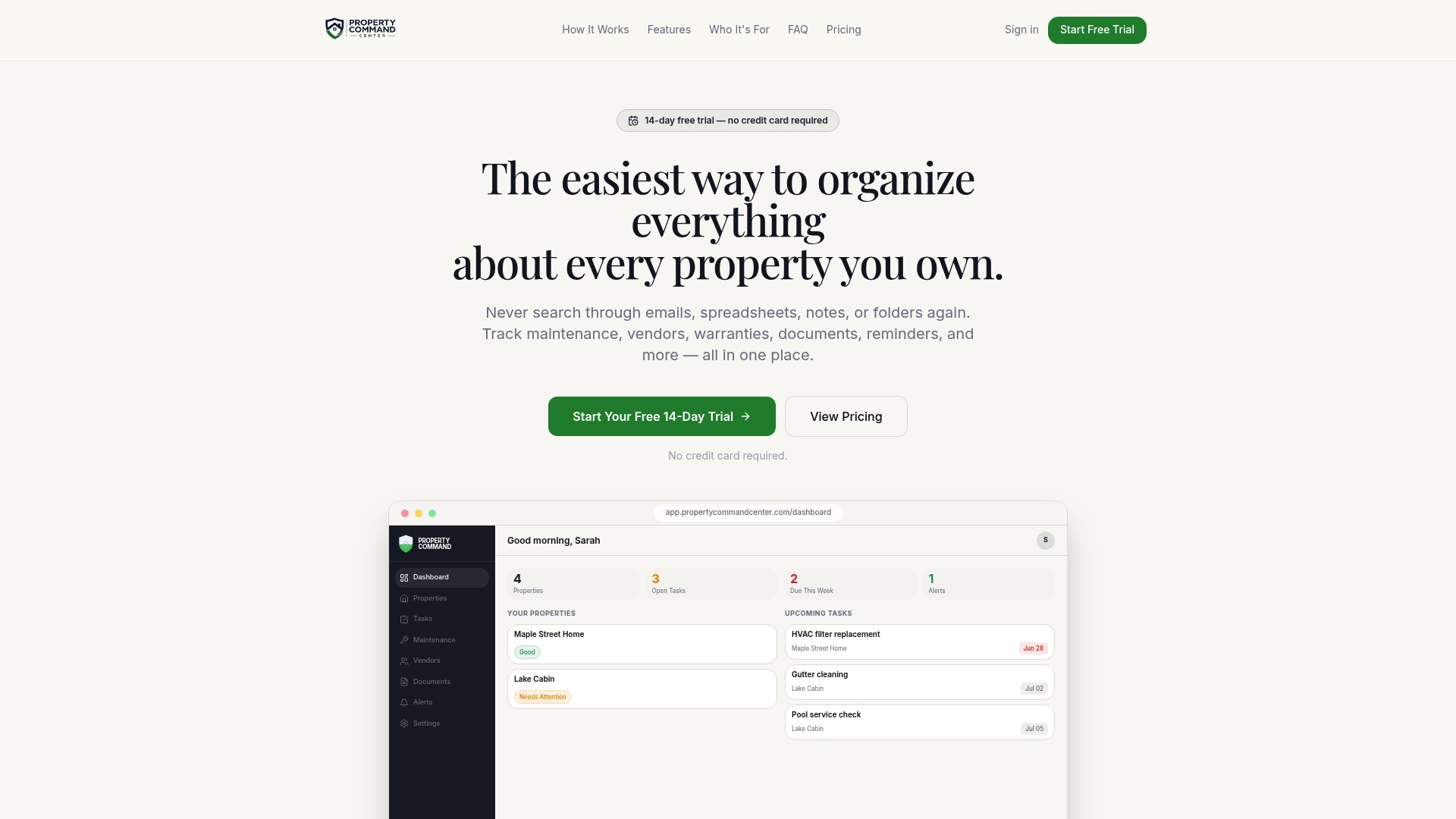
See the plans on the pricing page, or look at how the vendor directory keeps contacts attached to each property.
FAQ
Should I keep an inventory of items I own for insurance purposes?
Yes. The Oklahoma Insurance Department says an inventory means you know what you own and what it is worth before you need to file a claim. The California Department of Insurance also treats it as a way to judge whether your coverage is adequate, so it helps before a loss as well as after one.
How do I itemize belongings for an insurance claim?
Go room by room and record a description, make, model, serial number, purchase date, receipt and replacement cost today for each valuable item. Group low-value items, such as kitchen goods or decor, into single entries. Attach photos or video so the list is backed by evidence.
Is there a free home inventory app?
The Texas Department of Insurance says many insurers offer apps or online forms, and that the free NAIC Home Inventory app is available if yours does not. These cover the contents list. If you own several properties, we recommend keeping contents, policies, warranties and repair history together, which our 14-day free trial lets you set up without a credit card.
Where should I store my home inventory?
Keep it outside the home as well as inside it. State regulators suggest a safety deposit box, a fire-resistant safe, a family member's home or cloud storage, with copies of your policy, photos and receipts. California recommends at least two locations.
How often should I update it?
The California Department of Insurance suggests three to four times a year, at the start of each season, while Maryland suggests at least once a year or whenever you add something valuable. Update after any large purchase, and review replacement values when you do.
Sources
- A home inventory: Why you need it and how to do it, Texas Department of Insurance
- Home Inventory Guide, California Department of Insurance
- The Importance of a Home Inventory, Iowa Insurance Division
- Building a Home Inventory, Oklahoma Insurance Department
- Home Inventory Checklist, Oklahoma Insurance Department
- Home inventory guide, Kansas Insurance Department
- Home Inventory, Maryland Insurance Administration
- How to create a home inventory, Chubb
- How to create a home inventory list for insurance claims, American Family Insurance
- Home Inventory: How To Create One, State Farm
- Proof of Ownership and Proof of Loss, Allstate