
A home document checklist is the list of papers you need to prove you own a property, protect it, insure it, maintain it, and eventually sell it. The core set is the deed and title papers, closing documents, mortgage records, insurance policies, tax records, warranties, and a running file of repairs and improvements. Below is the full list, how long to keep each item, and a simple way to organize it when you own more than one place.
TL;DR
- Keep ownership papers (deed, title, closing documents) for as long as you own the home, and often longer for tax purposes.
- Add insurance policies, a home inventory, warranties, manuals, permits, inspection reports, and every improvement receipt.
- Sort records into active, permanent, and inactive groups, and keep a backup copy somewhere other than the house.
- If you own several properties, use one identical folder structure for each so nothing depends on memory.
- Landlords and short-term rental hosts need a few extra records: leases, deposits, rental income and expenses, permits, and tax filings.
Table of Contents
- Why a home document checklist matters
- The home document checklist
- How long to keep each document
- Extra documents for landlords and short-term rental hosts
- How to organize it so you can find it
- What we think: a checklist is a habit, not a project
- Put the checklist in one place
- A one-afternoon plan to finish your checklist
- FAQ
- Sources
Why a home document checklist matters
Most people think about home paperwork twice: at closing, and when something goes wrong. A roof claim, a refinance, an IRS letter, a buyer's inspection request, or a dishwasher that dies two months after the warranty window all send you digging through email, drawers, and a folder of "important stuff."
The Federal Trade Commission's guidance on which documents to keep, updated June 10, 2025, says to hold on to a home's title or deed, mortgage or loan documents, home-improvement receipts, rental agreements and leases, and major-appliance receipts and warranty information while you own the home. That is a short sentence with a long paper trail behind it.
The checklist below turns that guidance into categories you can actually work through in an afternoon.
The home document checklist
Work through these groups in order. Tick off what you have, and write down where the rest lives.
1. Ownership and closing documents
These prove the property is yours and show what you paid. State Farm's homeowner guide lists the deed, title information, the mortgage note, the loan estimate, the Closing Disclosure, escrow records, and proof of homeowners insurance as core records to retain. It also suggests keeping the title-insurance policy, survey and plat, and any HOA documents.
- Recorded deed or transfer documents
- Title-insurance policy and title papers
- Purchase contract or purchase and sale agreement
- Closing Disclosure and settlement statement
- Survey and plat map
- HOA declarations, rules, and fee schedules
- Property-tax receipts paid at closing
Redfin's guide to selling documents adds recorded releases for mortgages and home-equity loans to the retain list. That release is the proof a lien is gone, and you will want it years later.
2. Mortgage and loan records
- Signed mortgage note and loan terms
- Monthly or annual mortgage statements
- Escrow analysis statements
- Home-equity loan or line-of-credit paperwork
- Refinance documents
- Payoff letter and recorded satisfaction of mortgage once the loan is paid
- Year-end interest statements (Form 1098)
If you want a tighter system for this group, our post on three moves that help homeowners organize mortgage documents walks through it.
3. Insurance records
- Current homeowners, landlord, or vacation-home policy and declarations page
- Flood, umbrella, or other add-on policies
- Claims history, including photos and adjuster correspondence
- Home inventory with photos or video
State Farm recommends keeping a current home inventory, partly for use in insurance claims. Utah State University Extension's what-to-keep guide says to update that inventory at least once a year. If you own more than one home, the claim-ready insurance document organizer shows how to keep each policy tied to its property.
4. Tax records
- Annual property-tax bills and proof of payment
- Assessment notices and appeal paperwork
- Capital-improvement records (more below)
- Forms 1098 and 1099-S
- Proof of primary residence, where it matters for tax treatment
EisnerAmper's real estate retention guide says property-tax bills, payment evidence, and improvement records should be kept until the applicable statute of limitations expires. It describes the general period as three years after the return due date, subject to exceptions. A tax professional can tell you whether an exception applies to you.
5. Maintenance, repair, and improvement records
This is the group people lose first, and it is the one that pays you back at sale, claim, or warranty time. Save:
- Home inspection report from purchase, plus any later inspections
- Building permits and final sign-offs
- Receipts and invoices for repairs and upgrades
- Service history for the furnace, air conditioner, water heater, roof, and septic or well systems
- Contractor warranties and contact details
- Before-and-after photos of larger projects
The Hubstone home binder frames this as a file that supports insurance, warranty, refinance, and sale needs, and it also lists energy audits, HOA rules, and furnace and air-conditioning records. The American Homeowners Association's new-homeowner kit likewise recommends a home file for manuals, receipts, and service contacts.
Two of our own guides help here: capturing repair receipts in one minute and tracking service history with six fields. For the recurring side of upkeep, use the home maintenance checklist.
6. Warranties, manuals, and appliance records
- Appliance sales receipts and warranty cards
- Home warranty or service-plan contract
- Manuals and model and serial numbers
- New-construction builder warranty, if applicable
The University of Florida's IFAS Extension household inventory guide includes guarantees, warranties, bills of sale, and appliance and electronics manuals among the papers worth protecting.
7. People and vendors
- Trusted contractors, electricians, plumbers, and HVAC techs
- Property manager or caretaker, if any
- Insurance agent and mortgage servicer contacts
- Utility account numbers and shutoff locations
This is not a legal document, but it is what you reach for in an emergency. See how to organize contractor contacts by property if you own more than one place.
How long to keep each document
Retention is where owners either hoard everything or shred something they needed. EisnerAmper's guide sorts records by what they do, and the table below follows its logic. State rules can differ, so check yours.
| Document type | Typical retention |
|---|---|
| Deed, condo records, title papers | As long as you (or your spouse) own the property, often longer for tax purposes |
| Improvement receipts, inspection reports | As long as you own the property, then through the tax limitation period after sale |
| Insurance policies, warranties, service contracts | Until they expire, then archive any claim records |
| Repair receipts | Until the warranty expires; keep those tied to capital improvements longer |
| Paid-mortgage papers, certain closing records | Indefinitely |
| Tax returns, property-tax bills | Until the statute of limitations expires, generally three years after the return due date, with exceptions |
The Utah State University guide makes the same point in one line: keep ownership records for the duration of ownership, longer if tax rules require it.
A practical rule: do not shred a home record until you have sold the property and the tax period on that sale has passed. Deleting a scan is as final as shredding a page, so apply the same rule to digital copies.
Extra documents for landlords and short-term rental hosts
If any property earns rental income, the checklist grows. The IRS's Publication 527 on residential rental property is the starting point for what counts as rental income and what you can deduct. It covers, for example, how security deposits are treated: a deposit you plan to return is not income when you receive it, but money you keep becomes income that year. It also says vehicle and travel deductions require records that follow IRS rules.
That is a good reason to keep these on file for each rental:
- Signed leases or rental agreements and any addenda
- Security-deposit records and move-in and move-out condition photos
- Rental income and expense records, with receipts
- Mileage and travel logs for trips to the property
- Depreciation basis: purchase price, closing costs, and improvement costs
- Landlord or short-term rental insurance policy
- Local rental registration, license, or permit, where your city requires one
- Occupancy or lodging tax filings and platform payout reports (short-term hosts)
- Cleaning and turnover logs, supplier invoices, and guest-damage documentation
Rules for registration and lodging taxes differ by city and state, so confirm yours with the local government. Our rental document checklist and turnover workflow goes through the seven items we see matter most for small landlords and hosts.
How to organize it so you can find it
A checklist is only useful if the papers are findable. The University of Wisconsin Extension's Keeping Organized guide recommends designing a system that is easy to use, maintain, and update, and that another household member or trusted person can understand. It also suggests a regular paperwork routine.
Its storage logic is sound:
- Current active records: things you touch regularly, such as this year's bills, open projects, and current policies.
- Permanent records at home: deeds, closing documents, and improvement history.
- Permanent records in a safe-deposit box: originals you rarely need.
- Inactive records: old paid-off items kept for the retention period.
Back up what matters
The Financial Security for All guide advises keeping frequently used records in home files, duplicates in a safe-deposit box or a fireproof, waterproof, burglar-proof home safe, and another copy some distance away. For a house fire or flood, that third copy is the one that saves you. A scan in secure cloud storage counts, as long as you can open it without the original.
Keep a property-by-property inventory
The same guide suggests a record for each property: the owner, type of ownership, acquisition date, a description, where the title information is kept, and notes. That one page is what a spouse, adult child, or estate attorney will thank you for.
We built a template for exactly this in our property information sheet, and the 30/60/90 property binder shows how to build the full set over three months rather than one exhausting weekend.
A simple folder structure for multiple homes
With more than one property, use the same skeleton every time:
Property name
  01 Ownership and closing
  02 Mortgage and loans
  03 Insurance
  04 Taxes
  05 Maintenance and improvements
  06 Warranties and manuals
  07 Vendors
  08 Rental (if applicable)
The number prefixes keep the order stable. The moment two properties use different structures, you will start guessing where things are, which is the exact problem you are trying to remove.
What we think: a checklist is a habit, not a project
We talk to a lot of owners with a vacation home, a rental, or a house inherited from a parent. Almost none of them are missing documents because they are careless. They are missing them because the paperwork arrives in five places: an email inbox, a contractor's text, a glovebox receipt, a mailed statement, and a drawer.

So we believe the best checklist has two parts. The first is the one in this article: what to keep. The second is a single capture point, meaning one place where every new document goes the day it arrives. Our post on organizing home documents with one capture point explains the idea. Once that habit exists, the yearly review shrinks to a short check rather than a scramble.
We also believe owners should not need training to do this. A system you need a manual for will be abandoned by the second busy month. That is why we built Property Command Center around the few things owners actually use: property status, tasks and repairs, maintenance reminders, vendor contacts, and a document vault, without the landlord and tenant machinery you will never touch.
— Francisco
Put the checklist in one place
If you would rather not build folders and reminders by hand, Property Command Center gives each property its own dashboard with a document vault for warranties, manuals, and insurance papers, plus maintenance schedules, a vendor directory, and smart alerts. Plans are priced by the number of properties: Starter is $19 per month and Pro is $49 per month, and you can try it free for 14 days without a credit card.
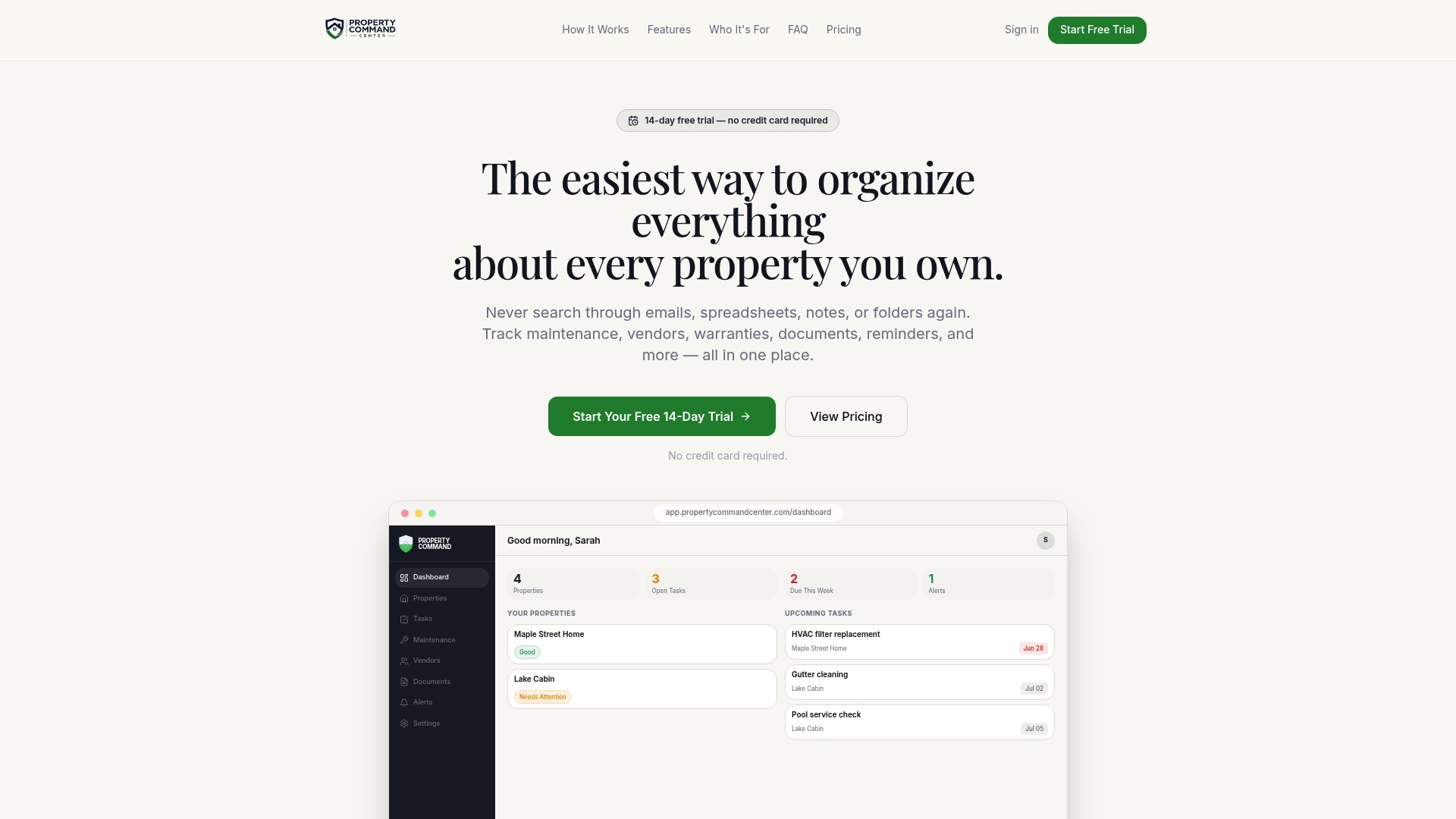
It is built for individual owners, families with several homes, and short-term rental hosts, not for property management companies or tenant and rent collection. If your contractors are the missing piece, our vendor directory page shows how that part works.
A one-afternoon plan to finish your checklist
- Gather (60 minutes). Pull everything for one property onto a table: drawers, email searches for "receipt," "invoice," "warranty," and "closing."
- Sort (30 minutes). Place each item into the eight groups above.
- Mark the gaps (15 minutes). Write down what is missing. Deed copies can be requested from your county recorder. Closing papers can come from your title or escrow company or your lender. Policies can be re-issued by your insurer.
- Scan (45 minutes). Digitize anything permanent and name files consistently, such as "2026-03 Roof replacement invoice."
- Back up (15 minutes). Put copies in a second location, and note where originals live.
- Schedule (5 minutes). Put a yearly review on your calendar: update the home inventory, add the year's improvements, and archive expired warranties.
Then repeat for the next property. The first one takes longest because you are making the rules; the second goes much faster.
FAQ
What documents should every homeowner keep?
At minimum, the deed and title papers, closing documents, mortgage records, homeowners insurance policy, property-tax records, improvement receipts, and appliance warranties. Add a home inventory, inspection reports, permits, and service history. The FTC lists title or deed, mortgage documents, improvement receipts, and appliance warranty information as records to keep while you own the home.
How long should I keep home improvement receipts?
Keep them for as long as you own the property, and then through the tax limitation period after you sell, since they can adjust your cost basis. EisnerAmper describes that period as generally three years after the return due date, with exceptions. Ask a tax professional about your situation before discarding anything.
Should I keep paper originals or digital copies?
Both, for the permanent items. Keep originals of deeds, titles, and recorded documents in a fireproof safe or safe-deposit box, and keep scans in a secure location away from the house. Extension guidance recommends an additional copy some distance away, so one disaster cannot take every version.
What extra paperwork do I need if I rent out a property?
Leases, deposit records, income and expense receipts, depreciation basis records, rental insurance, and any local permit or registration. Short-term hosts should also keep lodging tax filings and platform payout reports. The IRS's Publication 527 explains how rental income and deductions work, and your city or state sets licensing and tax rules.
How do I organize documents for more than one home?
Use one identical folder structure for every property and one place where new documents land. Keep a single information sheet per property that says where originals are stored. That way a family member or trusted person can find anything without asking you.
Sources
- Protecting your personal information: which documents to keep, which to shred (FTC)
- Home Closing Documents To Keep (State Farm)
- What To Keep Where and For How Long? (Utah State University Extension)
- Keeping a Household Inventory and Protecting Valuable Records (UF/IFAS)
- 40 Real Estate Forms You Need to Sell Your House (Redfin)
- Home Binder (Hubstone)
- AHA New Homeowner Resource Kit
- Real Estate Document Retention: How Long to Keep Records (EisnerAmper)
- Keeping Organized (University of Wisconsin Extension)
- Record of Important Papers (Financial Security for All)
- Publication 527, Residential Rental Property (IRS)