
The most reliable approach to long distance landlord maintenance combines vetted local help, clear tenant communication protocols, routine inspections, and one centralized system for tracking repairs and documents. Following IRS Publication 527 for recordkeeping and HUD fair housing rules for screening keeps you compliant while you manage from afar. Build those four pieces first, then refine.
TL;DR:
- Apply screening rules consistently, verify income at two to three times rent, and write lease terms covering repair reports, emergencies, vendor entry, and approval limits.
- Require same day acknowledgment, allow 24 to 48 hours for routine repairs, dispatch emergencies immediately, and request photos or videos with each report.
- Schedule annual in person inspections and quarterly photo checks, with in person visits for water damage or roof, foundation, and structural concerns.
- Keep two licensed, insured vendors for each trade, verify references, and test backup contractors on a small job before an emergency.
- Set aside roughly $1,800 yearly for a typical single family rental, adjust for age and size, and carry landlord insurance rather than standard homeowners coverage.
Table of Contents
- Quick Action Checklist for Remote Landlords
- Tenant Screening and Lease Terms That Prevent Headaches
- Setting Up Tenant Communication and Repair Approval Workflows
- How Often to Inspect and What to Check Each Season
- Building a Local Vendor Network You Can Trust from Afar
- Budgeting for Maintenance and Understanding Insurance and Tax Basics
- Operational SOPs and How a Dashboard Keeps Them Running
- What Usually Breaks Down and the Simple Fixes That Hold Up
- Put Your Maintenance System in One Place
- FAQ
- Sources
Quick Action Checklist for Remote Landlords
If you manage a rental property from another city or country, a few moves this week will cut your risk of a small problem turning into an expensive one. Start with the basics before worrying about anything advanced.
- Confirm your tenant has a working emergency contact number and a clear channel (text, email, or portal) for reporting issues.
- Schedule a local or virtual inspection within the next 30 days if one hasn't happened recently.
- Build a centralized folder, digital or otherwise, holding your lease, insurance policy, vendor contacts, and appliance manuals.
- Set aside a maintenance reserve and confirm your insurance policy actually covers a rental, not just an owner-occupied home.
- Write down your top three local vendors (plumber, electrician, handyperson) even if you haven't used them yet.
These five steps take a weekend, not a month. Owners who skip step three often end up hunting through old emails during an actual emergency, which is the worst time to discover a missing warranty document or an outdated vendor number. A maintenance schedule and recordkeeping system gives you a place to keep all of it without juggling spreadsheets.
Tenant Screening and Lease Terms That Prevent Headaches
The tenant you choose and the lease you write do more to protect your property than any app or vendor relationship. Screening well and writing clear repair clauses up front avoids half the calls that would otherwise land on your phone at odd hours.
- Verify income (generally two to three times the rent), request references from at least one prior landlord, and confirm identity with a government-issued ID.
- Run a background and eviction history check through a licensed screening service rather than relying on a tenant's self-report.
- Apply screening criteria consistently to every applicant to stay within HUD fair housing guidelines.
Your lease should spell out how tenants report repairs, what counts as an emergency, and when you or your vendor may enter the unit with proper notice. Add a clause naming your approved vendor list so tenants know who to expect, and set a dollar threshold (for example, repairs under $300) that your point of contact can approve without waiting for you.
Pro Tip: Send new tenants a short welcome packet with emergency numbers, vendor contacts, and a one-page "how to report a repair" guide so nobody has to guess during move-in week.
Setting Up Tenant Communication and Repair Approval Workflows
A tenant who doesn't know how or when to reach you will either sit on a leaking pipe or call you at midnight for a flickering light bulb. A simple, written protocol fixes both problems.
- Use a ticketing app or shared portal for routine requests, and reserve phone or text for anything urgent like no heat, no water, or a safety issue.
- Set a response window: same-day acknowledgment for all requests, 24 to 48 hours for routine repairs, and immediate dispatch for emergencies like gas leaks or flooding.
- Ask tenants to send a photo or short video with every request so your vendor can triage the issue before a truck ever rolls out.
- Set a pre-approved spending threshold (many owners use $200 to $500) so your property manager or trusted vendor can act without waiting on a call back.
This structure keeps small issues small. A tenant who sends a photo of a slow drain gets a plumber scheduled within a day, while a tenant who smells gas knows to call the utility company first and you second.
How Often to Inspect and What to Check Each Season
Inspections catch small problems before they become expensive ones, and they matter more when you can't just drive by. A mix of scheduled visits and virtual check-ins covers most situations.
- Walk through, in person or via a trusted local contact, at move-in and move-out to document condition with photos.
- Schedule an annual or semi-annual in-person inspection covering HVAC filters, smoke detectors, water heater condition, and signs of pest activity.
- Request a quarterly virtual inspection: ask your tenant or property manager for timestamped photos or a short video walk-through of key areas.
- Require an in-person inspection instead of a virtual one whenever a tenant reports structural concerns, water damage, or anything involving the roof or foundation.
- Line up seasonal tasks ahead of time: gutter cleaning and HVAC servicing in fall, pipe winterization before freezing temperatures, and exterior checks each spring.
Properties in humid or coastal climates need closer attention to mold and moisture, and homes left vacant for stretches benefit from more frequent remote checks since small leaks go unnoticed longer in an empty rental. If you manage a short-term rental, your cadence should shift with occupancy, and a cadence template built for short-term rentals can help you match inspection frequency to turnover.
Building a Local Vendor Network You Can Trust from Afar
A rental property is only as manageable as the people you can call when something breaks. Building this network before you need it, rather than during a crisis, is what separates landlords who sleep well from those who don't.
- Source vendors through referrals, local property management associations, or a directory like NARPM, which connects owners with vetted residential property management professionals.
- Confirm every vendor carries a valid license and liability insurance, and ask for two references from recent jobs similar to yours.
- Put scope of work, response time expectations, approval limits, and payment terms in writing before the first job, even for a handyperson.
- Keep at least two vendors per trade (plumber, electrician, HVAC) so a single unavailable contractor doesn't stall an emergency repair.
- Rate each vendor after every job on reliability, cost, and communication so your roster improves over time instead of staying static.
Pro Tip: Call your backup vendor for a small, non-urgent job once a year just to confirm they still answer, still do good work, and still fit your budget.
Budgeting for Maintenance and Understanding Insurance and Tax Basics
Most maintenance surprises are really budgeting failures. Setting aside money in advance, categorized by type of expense, turns a surprise repair into a line item you already planned for.
- Separate your reserve into routine upkeep (lawn care, filters, minor repairs), capital expenses (roof, HVAC replacement, major systems), and an emergency fund for anything unplanned.
- A straightforward starting point many owners use is roughly $1,800 a year set aside for a typical single-family rental, adjusted up for older homes or larger properties.
- Carry a landlord-specific insurance policy rather than a standard homeowners policy, since rental properties carry different liability and loss-of-rent exposure.
- Review your policy annually to confirm coverage still matches the property's use, especially if you've shifted to short-term rental.
According to IRS Publication 527, many rental expenses, including repairs, maintenance, insurance, management fees, and even travel for property management, are generally deductible when properly documented. Keep receipts and mileage logs, and separate repairs from capital improvements, since the two are treated differently at tax time.
Operational SOPs and How a Dashboard Keeps Them Running
Checklists only work if you actually follow them every time, which is where a written operating procedure and a central system for tracking it both matter. A 90-day onboarding period gives you time to set up the pieces above without rushing.
- Weeks 1 to 2: finalize your vendor roster, confirm licenses and insurance, and load contact information into one place.
- Weeks 3 to 6: complete a baseline inspection, document the property's condition with photos, and store warranties and manuals in a shared folder.
- Weeks 7 to 12: run your first maintenance ticket through the full workflow, from tenant report to vendor dispatch to invoice, and adjust response windows based on what you learn.
A 90-day plan built around U.S. landlord maintenance responsibilities walks through this onboarding in more detail, and a task tracking approach for small portfolios shows how to keep repeat maintenance from falling through the cracks once the initial setup is done.
What Usually Breaks Down and the Simple Fixes That Hold Up
The landlords who struggle most with distance aren't missing fancy tools. They're missing redundancy: one vendor instead of two, a verbal understanding instead of a written lease clause, a single communication channel that fails the one time it matters.

The fix is almost always simpler than it sounds. Write the lease clauses before you need them, not after a dispute, using a comprehensive post occupancy checklist to avoid ejectment and double rent issues. Test your backup plumber on a small job now, not during a flooded basement at 2 a.m. A handful of repeatable SOPs, a document vault, a vendor roster, and an inspection checklist, remove most of the guesswork that turns a minor repair into a stressful phone call from three states away.
Consistency beats cleverness here. A small, vetted team you've actually worked with saves more time than any amount of research into the "best" vendor you've never called.
— Francisco
Put Your Maintenance System in One Place
Everything above works better when it lives in a single dashboard instead of scattered texts, emails, and sticky notes. We built a property management dashboard to help owners managing multiple properties access property status, maintenance schedules, vendor contacts, and important documents in one place, so you're not digging through old messages when a tenant reports a leak at 11 p.m.
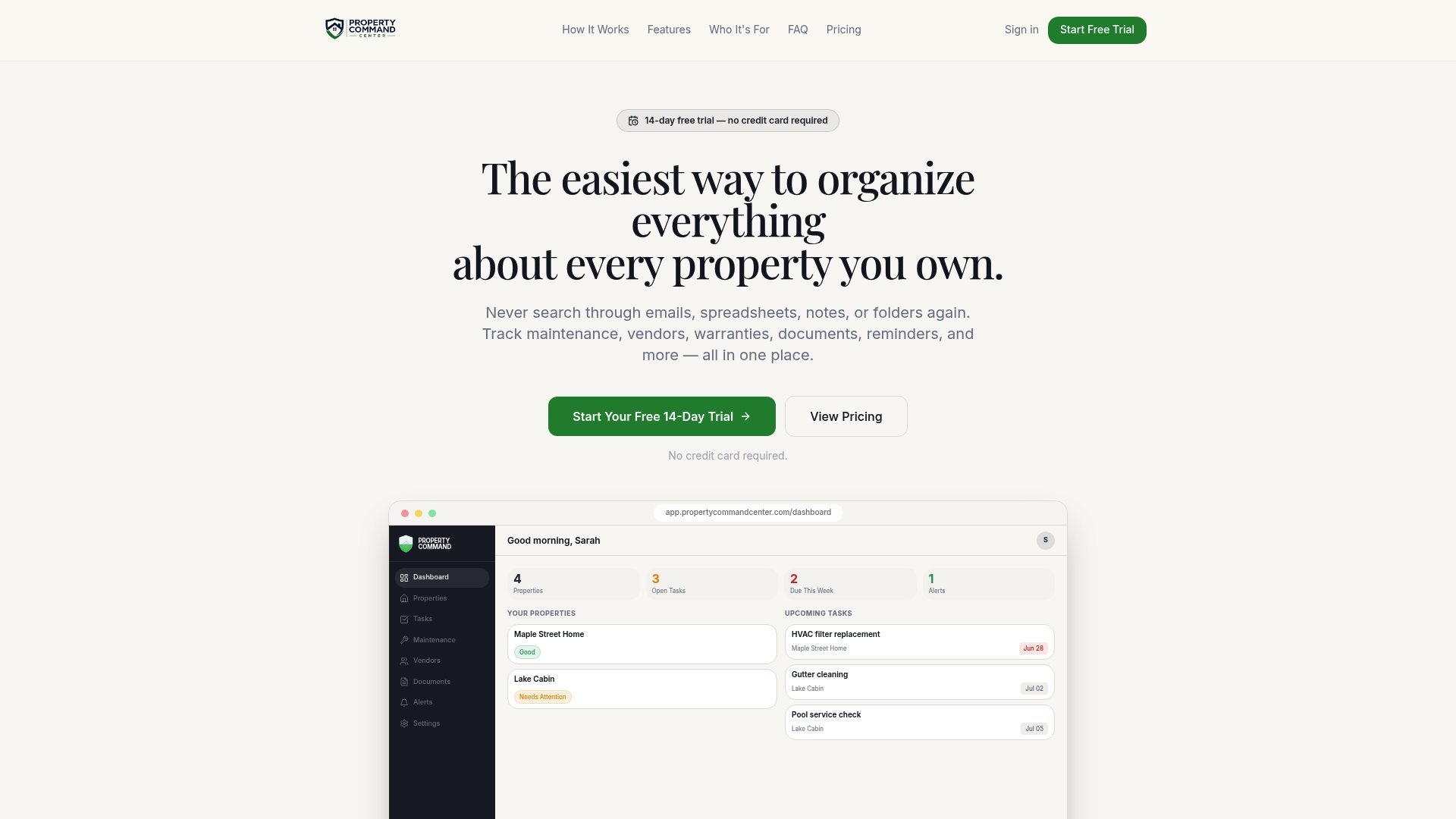
We offer tiered monthly pricing options without the complexity of enterprise property management software built for agencies rather than individual owners. If you manage more than one rental, a vacation home, or a short-term rental, check out our pricing page or browse our vendor directory to see how a centralized system fits your properties. Try it free and see whether a single dashboard changes how much time your rentals actually take.
FAQ
What is the 7% rule for rental property?
Some investors use a rough annual maintenance budget benchmark informally, but it's not an official guideline, so check your specific property's age, condition, and location before relying on any flat percentage.
How long does a landlord have to do maintenance?
Repair timelines are generally set by state and local landlord-tenant law rather than a single national standard, with most jurisdictions requiring prompt action on habitability issues like heat, water, or safety hazards. Emergency repairs typically need attention within 24 to 48 hours, while non-urgent repairs commonly allow a longer window, so check the specific statute in your property's location.
What is the 50% rental rule for maintenance costs?
The 50% rule is a rough investment guideline suggesting that about half of gross rental income may go toward operating expenses, including maintenance, taxes, and insurance, excluding mortgage payments. It's a simplified estimate for comparing properties, not a guaranteed figure, and actual costs vary by property age, location, and condition.
What can a landlord not do in Arizona?
Landlord-tenant rules vary by state, and specific restrictions depend on each state's statutes rather than a single federal standard. Every landlord, regardless of state, must follow HUD fair housing requirements prohibiting discrimination based on protected characteristics during screening, leasing, and maintenance decisions.
How do I find reliable vendors if I don't live near my rental?
Start with referrals from other local landlords, a professional network like NARPM, or local trade associations, then verify licensing and insurance before hiring. Testing a vendor on a small job before an emergency arises confirms reliability before you actually need them.
Sources
- Publication 527 (2025), Residential Rental Property | Internal Revenue Service
- Fair Housing | U.S. Department of Housing and Urban Development
- NARPM