
Use one permissioned cloud workspace plus a local backup, share only what each person needs, and schedule regular reviews. This single setup covers co-owners, caretakers, and vendors without scattering documents across e-mail threads or random folders. A regular review every few months of who has access and what has changed helps keep the whole system trustworthy.
TL;DR:
- Build a property file set covering maintenance, inventory, vendor contacts, and operating notes, then keep working, separate backup, and shared cloud copies.
- Organize files by property, system, and document type, name records with dates, and upload them before sending links instead of attachments.
- Use named invites instead of open links, default to view only, set vendor expiration dates, and limit each person to records their role requires.
- Require multifactor authentication, review active permissions every six months, and revoke a vendor’s access as soon as the job is complete.
Table of Contents
- What to include when you share home information
- How should you organize files so anyone can find them fast?
- Which permission settings actually protect your home data?
- A repeatable workflow for sharing and revoking access
- Why a single dashboard beats scattered folders and inboxes
- How Property Command Center brings this checklist to life
- FAQ
- Sources
What to include when you share home information
Before you invite anyone into a shared workspace, gather the material they will actually need. A scattered pile of PDFs and photos does not help a caretaker fix a leak at 9 p.m. or a co-owner approve an invoice.
Build these four categories first:
- Maintenance library: manuals, warranties, service history, and the next due date for each major system (HVAC, water heater, roof, septic), following the system-based library approach recommended by University of Minnesota Extension.
- Property inventory: item descriptions, model and serial numbers, purchase dates, and photos, matching the fields the University of Minnesota Extension household inventory guide recommends for insurance and identification purposes.
- Vendor and emergency contacts: name, company, phone number, service type, and last job date for every plumber, electrician, landscaper, and cleaner you use.
- Operational notes: alarm codes, lockbox locations, Wi-Fi credentials, and trash pickup days that a caretaker needs on day one without calling you first.
Once you have those four lists, stage them in three places: a working copy you edit day to day, an off-site copy stored separately in case the primary device fails, and a shared cloud copy that co-owners and vendors can view. The Extension guide notes that household records decay quickly when no one updates them, which is why the three-copy habit matters more than any single tool. A home maintenance checklist can help you assemble this material before you send your first invite.
How should you organize files so anyone can find them fast?
A folder structure that makes sense to you at 2 a.m. rarely makes sense to a vendor who has never seen your account. Structure by property first, then by system, then by document type, so a caretaker managing two homes never has to guess which folder applies.
- Create one top-level folder per property, named with the address or a short nickname ("Lakeview" or "Oak St").
- Inside each property folder, create subfolders by system: HVAC, plumbing, roofing, appliances, landscaping.
- Inside each system folder, separate documents by type: manuals, warranties, service history, and photos.
- Name files with the date and a plain description, such as "2026-03-HVAC-service-report," so the file list sorts chronologically without opening anything.
- Store documents as PDF for records and JPEG for photos, since both open on any device without special software.
The real risk is not messy folders. It is an attachment that lives only in someone's inbox. Set one rule: nothing gets shared by e-mail attachment, everything gets uploaded to the shared workspace first, then linked. This single habit eliminates the version confusion that happens when three people edit three copies of the same spreadsheet. For a deeper walkthrough of folder naming and the single capture point principle, see how to organize home documents for owners managing more than one property.
Which permission settings actually protect your home data?
Organizing files solves half the problem. The other half is controlling who can open, edit, or forward them, and this is where most home sharing setups quietly fail.
CISA's guidance on cloud storage recommends named-user access over open "anyone with the link" sharing, because a link can be forwarded indefinitely while a named invite can be tracked and revoked. Pair that with view-only defaults so a vendor can read a manual without accidentally editing your service log.
- Invite people by name and e-mail address rather than generating a shareable link.
- Set every new share to view-only by default, then grant edit access only where someone truly needs to update a record.
- Add an expiration date to vendor invites tied to the length of the job, not left open indefinitely.
- Revoke access the day a job finishes rather than waiting for a periodic cleanup.
- Require multifactor authentication on the shared account and keep a local backup of critical documents, both of which CISA lists as baseline protections for cloud-stored records.
Map roles to minimal permissions: a co-owner typically needs broad visibility across financials, maintenance, and documents, while a caretaker needs maintenance records and vendor contacts for one property only, and a vendor needs just the work order and relevant manual. This mirrors the attribute-based access control model NIST describes, where a decision weighs the subject, object, operation, and environment together, so a rule like "caretaker can view maintenance records for Property A only" becomes explicit rather than assumed. CISA's own SharePoint and OneDrive configuration baseline recommends defaulting external shares to specific people with expiration windows, a setting worth checking no matter which platform you use.
Pro Tip: Review every active share twice a year and ask one question for each: does this person still need this access right now?
CISA recommends pairing named-user access with multifactor authentication and encryption for any cloud workspace holding sensitive records, a baseline that applies just as well to a family sharing home documents as it does to a business.
A repeatable workflow for sharing and revoking access
A good permission structure only works if you follow the same steps every time someone new needs access. Treat it as a short checklist rather than a judgment call.
- Prepare: gather the relevant documents and tag the next due date on anything maintenance-related before you share it.
- Invite: add the person by name with the narrowest scope that covers the job, set an expiration date, and send a short message listing exactly what you need back (a quote, a signed invoice, a completion photo).
- Confirm: verify the recipient can actually open the files they need before the work starts, so a locked-out vendor is not discovering the problem on-site.
- Close out: download a local copy of anything new, revoke temporary access once the job is done, and note the change in your records.
Set a recurring reminder every six months to audit your full inventory and every active permission at once, rather than relying on memory. A maintenance calendar organized by month makes this easier to keep on schedule alongside your regular upkeep tasks.
Why a single dashboard beats scattered folders and inboxes

The owners who struggle most with home information are not disorganized. They are managing good information in too many places: one spreadsheet for inventory, a separate e-mail thread per vendor, and a drawer of paper warranties nobody has scanned. Every one of those extra locations is a place where a maintenance reminder gets missed or a caretaker loses an hour hunting for a manual.
Consolidating into one capture point removes that duplicate work entirely. When a co-owner, caretaker, and vendor all pull from the same source, nobody is reconciling three versions of the truth after the fact. That consolidation, more than any individual security setting, is what actually prevents the small failures that turn into bigger repair bills.
— Francisco
How Property Command Center brings this checklist to life
Building this system by hand with folders, spreadsheets, and e-mail reminders works, but it takes ongoing upkeep. Property Command Center gives multi-home owners a single dashboard that already follows the structure above.
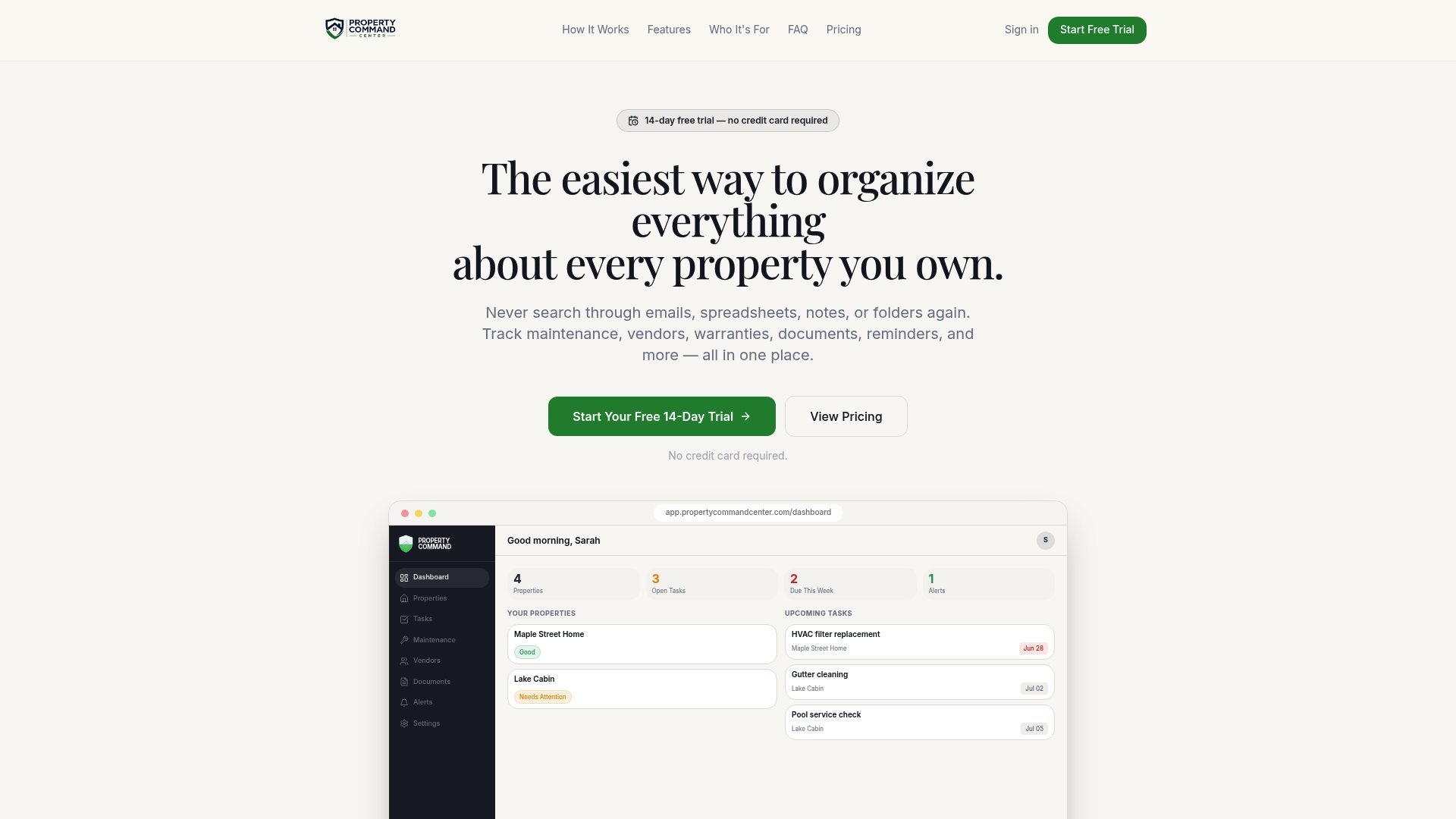
- One capture point for property status, documents, and photos instead of scattered folders per home.
- Maintenance reminders tied to next-due dates so service windows do not slip.
- A vendor directory that stores contact details and service history per property.
- A document vault for warranties, manuals, and insurance records, organized by property from the start.
Owners managing shared budgets with co-owners or family members can pair this with a tool like PoolCash to track pooled maintenance costs and vendor payments, and anyone planning a larger renovation may want Urban Planning Pros to review zoning or feasibility questions before work begins. Our Starter and Pro plans start with a free trial, no credit card required, and onboarding walks you through adding your first property, documents, and vendors in one sitting.
FAQ
How often should I review who has access to my home information?
A semi-annual review works for most multi-home owners, matching the cadence University of Minnesota Extension recommends for refreshing household inventories and records. Check every active share at the same time you update your maintenance library so neither task gets skipped.
What is the difference between caretaker and co-owner access?
A co-owner typically needs broad visibility across financials, maintenance history, and documents for a property they partly own, while a caretaker needs only the maintenance records and vendor contacts relevant to the home they manage day to day. Mapping each role to the minimum access it needs follows the attribute-based model NIST describes for access control.
Should I keep a local backup even if I use cloud sharing?
Yes. CISA recommends keeping a local copy of critical documents in addition to any cloud-stored version, so you are not locked out if an account or connection fails. A local backup also gives you something to hand a vendor directly if sharing access is not practical for a single quick job.
How do I safely revoke a vendor's access after a job is done?
Remove the vendor's named-user invite from the shared workspace as soon as the work is confirmed complete, rather than waiting for your next scheduled review. Setting an expiration date on the invite when you first grant access, a practice outlined in CISA's SharePoint and OneDrive baseline, makes this automatic even if you forget.
What does Property Command Center cost?
Property Command Center offers a Starter plan at $19 per month and a Pro plan at $49 per month, both available through a free trial with no credit card required.
Sources
- Get the Most out of Cloud Storage and Services while Minimizing the Risk | CISA
- Develop a household inventory | University of Minnesota Extension
- Home maintenance and safety | University of Minnesota Extension
- Guide to Attribute Based Access Control (ABAC) | NIST SP 800-162 (updated)