
Becoming a landlord is mostly a paperwork job with a few big decisions attached. You check the rules where the property sits, get it safe and insured, set a rent, screen applicants the same way every time, sign a lease that covers the basics, and then keep a record of everything that happens afterward. The first five steps happen once. The record keeping never stops, and it is where new landlords most often fall behind. Below is the full path, in order, with the places it tends to go wrong and how to keep every document, vendor and due date in one place from the first day.
TL;DR
- Start with the law where the property is: federal rules set the floor, and your state and city add licenses, deposit limits and notice rules.
- Treat the rental as a business: separate income and expenses, carry the right insurance, and report all rent received as income.
- Screen every applicant against the same written criteria, and write a lease that covers rent, deposit, notices and required disclosures.
- Keep a file for every property: complaints, repair requests, inspections, vendors, warranties and dates. Records protect you when something is disputed.
- Property Command Center gives you one organized place for those records, with a 14-day free trial and no credit card required.
Table of Contents
- Check the rules before you list anything
- Get the property ready and insured
- Set the rent and understand the money
- Advertise and screen applicants fairly
- What your lease should cover
- Keep a file on every property from day one
- Run maintenance on a schedule, not on reaction
- Handle complaints in writing
- Keeping it all in one place
- Our perspective
- FAQ
- Sources
Check the rules before you list anything
Landlord law in the United States has layers. Federal law covers areas like fair housing and lead-based paint disclosure. States and cities then decide things such as deposit limits, eviction procedures, licensing and rent increases. Two properties 30 miles apart can follow quite different rules.
Local requirements can start before you ever meet a tenant. In Philadelphia, a property must be zoned as a dwelling, and renting counts as a business. Depending on the number of units and whether you live there, you need an activity license or a commercial activity license, a business tax account, and a rental license. The rental license application asks for proof of ownership, lead-safe certification and no open violations.
Washington, DC goes further. Its guide for new landlords says you need a basic business license with a housing endorsement, and you must register the rental. If you rent without registering, the lease is still valid and you can collect rent, but you cannot raise the rent or evict until the license and registration are complete. The same guide warns that moving the property into a living trust or LLC can forfeit the small-landlord rent-control exemption.
You do not need to memorize any of that. You need to know which questions to ask for your own address:
- Does the city or county require a rental license, registration or inspection?
- Do state rules apply to my type of tenancy? Many states exempt certain tenancies, such as a resident property manager's, from their landlord-tenant statutes.
- What are the limits on deposits, application fees and late fees?
- What notice must I give before entering the unit, raising rent or ending a tenancy?
Write the answers down and save the official pages. You will need them again at renewal time.
Be aware of what you are taking on. Nolo's book for new landlords notes that landlords can face liability for health, safety, environmental and discrimination issues, including injuries to neighbors when a landlord knew about illegal activity and did nothing. The practical lesson is that documented follow-through matters. For eviction questions, which vary widely by state, talk to a local landlord-tenant attorney before acting.
Get the property ready and insured
A rental has to be habitable, which means safe, clean and in working order, before a tenant moves in. Walk through the unit as if you were the tenant. Test smoke and carbon monoxide detectors, check locks, look under sinks for leaks, and confirm heating, water heating and appliances work. Fix issues before listing, not after a complaint.
Your safety checks will repeat every year, so it helps to settle the routine now. Our landlord safety inspections checklist lays out what to look at.
Insurance is the other pre-rental job. Fannie Mae's guide for new landlords says to comply with applicable laws, keep careful records of income and expenses, and maintain various types of insurance. A standard homeowner policy is usually written for owner-occupied homes, so tell your insurer you are renting the property and ask what coverage fits. Keep the policy, the declarations page and the renewal date where you can find them in seconds.
The same guide suggests having the tenant complete a move-in condition checklist and taking photos of the unit. Do both. Dated photos and a signed checklist are your best evidence when a deposit is disputed.

Set the rent and understand the money
Price the rent by looking at comparable units nearby, then check that the number covers your real costs: mortgage, taxes, insurance, repairs, and months when the unit sits empty. A slightly lower rent with a reliable tenant often beats a higher rent with turnover, because every vacancy costs you a month or more of income plus cleaning and repairs.
On taxes, the IRS says rental income includes all amounts received for the use or occupation of the property, not only the regular monthly payment. That covers things like a fee to break the lease. Security deposits are treated differently. If you plan to return the deposit at the end of the lease, it is generally not income when you receive it, but any amount you keep because the tenant broke the lease terms becomes income in the year you keep it, as summarized from the IRS publication here. A tax professional can tell you which expenses and depreciation rules apply to your situation.
What this means in practice: open a separate account for the rental, and keep receipts and invoices for every expense by property. When all of that sits in one inbox or a shoebox of paper, tax season turns into a scavenger hunt.
Advertise and screen applicants fairly
Fair housing law is the part of screening you cannot get wrong. Fannie Mae notes that federal, state and sometimes local laws prohibit discrimination in advertising, interviewing and tenant selection. The safe approach is simple: decide your criteria in writing before the first inquiry, and apply them identically to every applicant.
The same guide says most landlords look for three things: willingness and ability to pay on time, willingness and ability to follow the lease, and a reasonable expectation the tenant will not engage in illegal activity on the property. Turn those into measurable criteria, such as an income-to-rent ratio, a credit report review and verified employment, and keep them on one page.
Fees and questions are regulated locally, so check yours:
- Application fees. In DC, the application fee is capped, must be returned within 14 days if not used for screening, and criminal history questions can only come after a conditional offer.
- Itemized costs. California's tenant guide says a screening fee cannot exceed your actual out-of-pocket costs plus the reasonable value of your time, must be itemized on a receipt, and any unused portion must be returned.
- Credit information. Fannie Mae recommends obtaining credit information in writing, possibly from more than one report, and verifying income sources.
Keep each applicant's paperwork, including the ones you decline, with the date and the criteria you used. If a decision is ever questioned, a consistent paper trail is your answer.
What your lease should cover
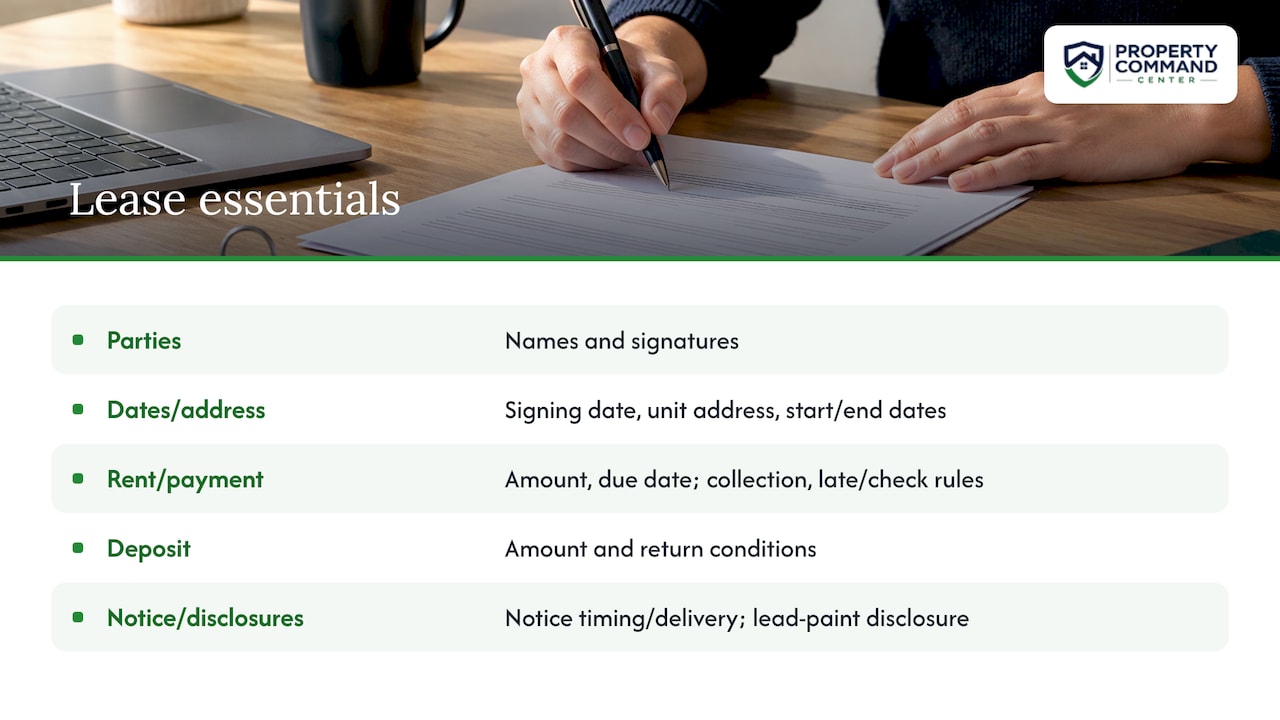
Use a lease that fits your state rather than a generic template pulled from anywhere. Fannie Mae lists the basics: names and signatures, signing date, unit address, start and end dates, rent amount, due date and collection procedures, late-fee and returned-check policies, the security deposit amount and return conditions, how much notice is needed to end the tenancy and how it is delivered, and required disclosures such as lead-based paint.
Late fees need care. Boston's landlord resources say a late fee can be charged only with a written agreement and when rent is at least 30 days late, and that a landlord cannot lock out a tenant without a court order or shut off utilities to force someone out. Rules differ elsewhere, which is why the local check in the first step matters.
Once the lease is signed, file the signed copy, the move-in checklist, the photos and any disclosures together under that property. Our rental document checklist walks through seven items to have on hand and a turnover workflow.
Keep a file on every property from day one
This is the step the ranking guides treat as a footnote and the one that saves the most trouble. Fannie Mae's advice is to keep a secure file for each tenant with the application, credit and employment information, the signed lease and rules, the inspection checklist, the date and amount of all transactions, repair requests and repairs made, complaints and all correspondence.
That is a lot of paper across a lot of places. A new landlord's information typically ends up scattered across:
- a spreadsheet with some of the dates
- Gmail threads with the plumber and the tenant
- PDFs of the lease, insurance policy and appliance manuals
- photos on a phone
- notes about who fixed what, and when
The problem shows up the first time you need an answer fast. When was the water heater replaced and is it under warranty? Who did the roof repair? When does the insurance renew? If the answer takes an hour of searching, you have a records problem, and it only gets worse with a second property.
Run maintenance on a schedule, not on reaction
Fannie Mae recommends written repair and maintenance policies, including a process for tenants to report problems, periodic maintenance inspections at least once a year with completed checklists kept in the file, and a written log of all complaints with follow-up noted. Put differently: decide in advance how tenants report a problem, how fast you respond, and where the record goes.
A simple routine for a first-timer:
- List recurring tasks. Furnace service, gutters, smoke detector batteries, pest control, lawn care, and so on.
- Assign a cadence and an owner to each. Quarterly, annual or seasonal, and who does it: you or a named vendor.
- Keep a vendor directory. Name, trade, phone, license and insurance details, and what you paid last time.
- Log every request and response. Date received, what was done, date closed.
- Store the proof. Invoices, warranties and photos attached to the property, not buried in email.
If you want fuller schedules, see our guides to rental property maintenance schedules and recordkeeping and a 90-day plan for landlord maintenance responsibilities. If the property is far from where you live, the long-distance landlord maintenance guide covers how to run it remotely. Lawn and exterior work is a common source of arguments, and the rental lawn care schedule shows three ways to assign it clearly.
Handle complaints in writing
Tenant complaints are normal. How you respond is what protects you. Log each one the day it arrives, note what you did, and follow up until it is resolved. That habit is exactly what Nolo's authors point to when they describe landlord liability: a landlord who knew about a problem and failed to act is in a much weaker position than one who documented and followed through.
Some complaints, such as repeated noise, involve neighbors or local authorities as well as the tenant. Understanding how a structured noise complaint response process works can help you see why timely, written communication reduces disputes. Whatever the issue, keep the message trail with the property record rather than in a personal inbox.
Keeping it all in one place
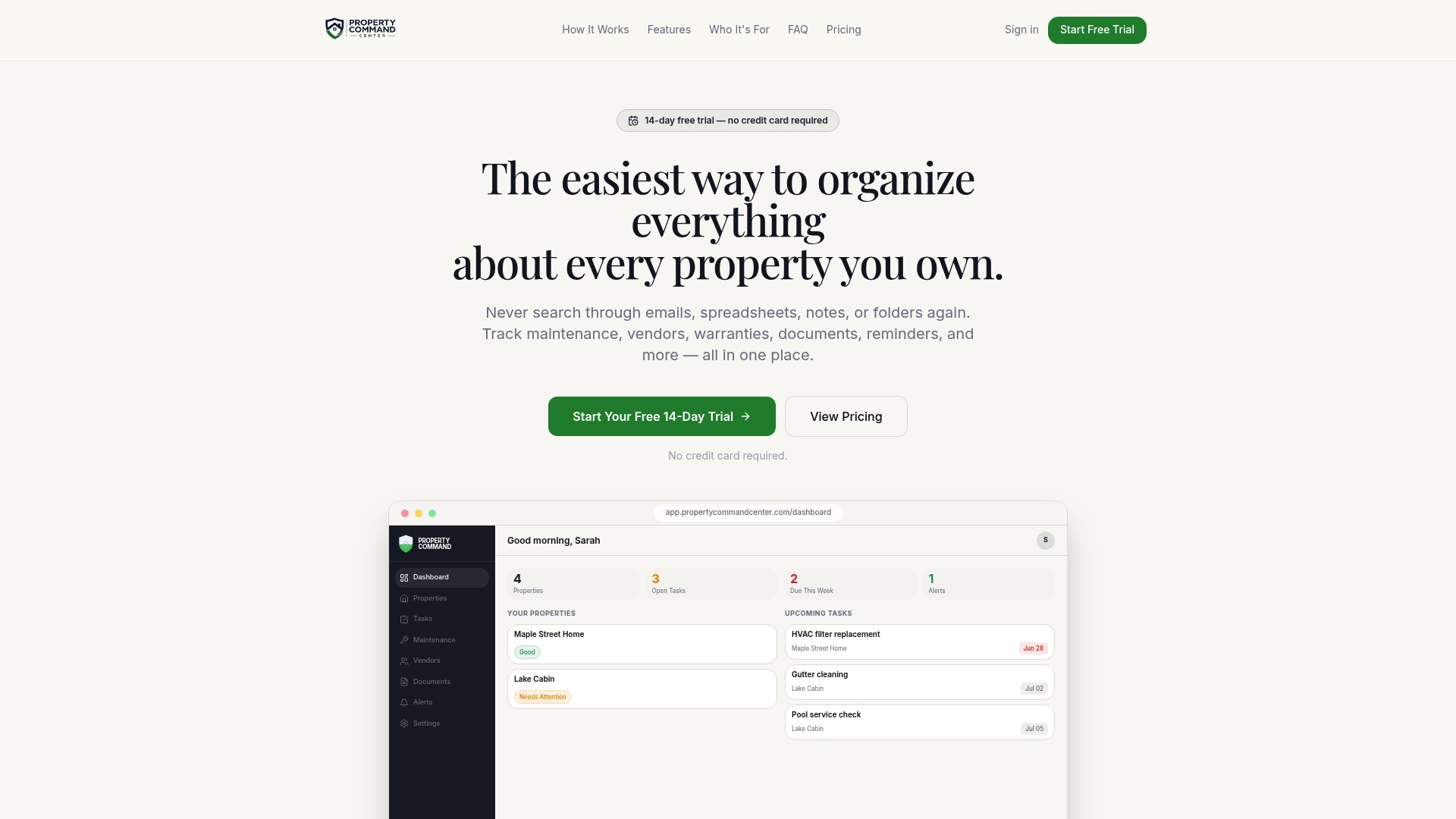
Paying attention to records is easy for the first month and hard by the first year. Property Command Center is built for owners who want one organized place instead of spreadsheets, folders, emails and notes. You bring in what you already have, and each property becomes a living record with maintenance history, documents, vendors, tasks and reminders.
Smart Setup is designed to help extract and organize information from your existing files, emails and spreadsheets, and portfolio import tools let you bring in several properties without entering them one at a time. The platform includes a dashboard for property status, task and repair tracking, maintenance schedules and reminders, a vendor contact directory, a document vault for warranties, manuals and insurance, and smart alerts.
It focuses on property knowledge: what happened at each property, who did the work, where the documents are and what is due next. It is not built around rent collection, tenant screening or accounting, so it works alongside whatever you use for those.
Plans are priced by the number of properties: Starter is $19 per month and Pro is $49 per month, and there is a 14-day free trial with no credit card required.
If you are setting up your first rental, start your free trial at Property Command Center and load the lease, insurance policy and inspection photos before the tenant moves in.
Our perspective
Most first-time landlord advice is about the decisions: price, screen, sign. Those matter, but they happen a handful of times. What decides whether owning rentals feels manageable is the hundreds of small facts that come after: which vendor fixed the dishwasher, when the warranty ends, when the last inspection happened, where the insurance policy lives.
We built Property Command Center around that idea. Owners already have the information, but it sits in spreadsheets, Google Drive, Gmail, PDFs and notes. Our view is that the owner should not have to retype all of it to get organized, which is why Smart Setup and portfolio import exist.
A property should have a living record that grows every time something happens to it. When that record is complete, you answer a tenant faster, hand a contractor the right history, and walk into tax season or a dispute with facts instead of guesses. We think that is the real foundation of self-managing well, and it is what we design for.
Francisco
FAQ
Do I need a license to rent out my property?
It depends on where the property is. Some cities require rental licenses, business licenses or registration, and some tie your right to raise rent or evict to completing them. Philadelphia and Washington, DC both do, as the guides above show. Check your city and county websites before you advertise.
Should I screen applicants the same way every time?
Yes. Federal, state and sometimes local laws prohibit discrimination in advertising and tenant selection. Write your criteria down before you list, apply them to everyone, and keep the paperwork for each applicant.
Is a security deposit taxable income?
Generally not when you receive it, if you plan to return it at the end of the lease. If you keep part of it because the tenant breached the lease, that amount is income in the year you keep it. A tax professional can confirm how this applies to you.
What records should a new landlord keep?
Keep the application, signed lease, inspection checklist and photos, records of every payment, repair requests and the work done, complaints and all correspondence. Keep insurance, warranties and vendor details with the same property so everything is findable.
Sources
- Becoming a Landlord, Fannie Mae
- Publication 527, Residential Rental Property, IRS
- Resources for Landlords, Boston.gov
- New landlords, City of Philadelphia
- Becoming a Landlord in DC, DC Rental Housing Commission
- California Tenants guide, 2024
- First-Time Landlord, Nolo
- Landlord-Tenant Statutes, State-by-State, Nolo
- Tips for new real estate investors