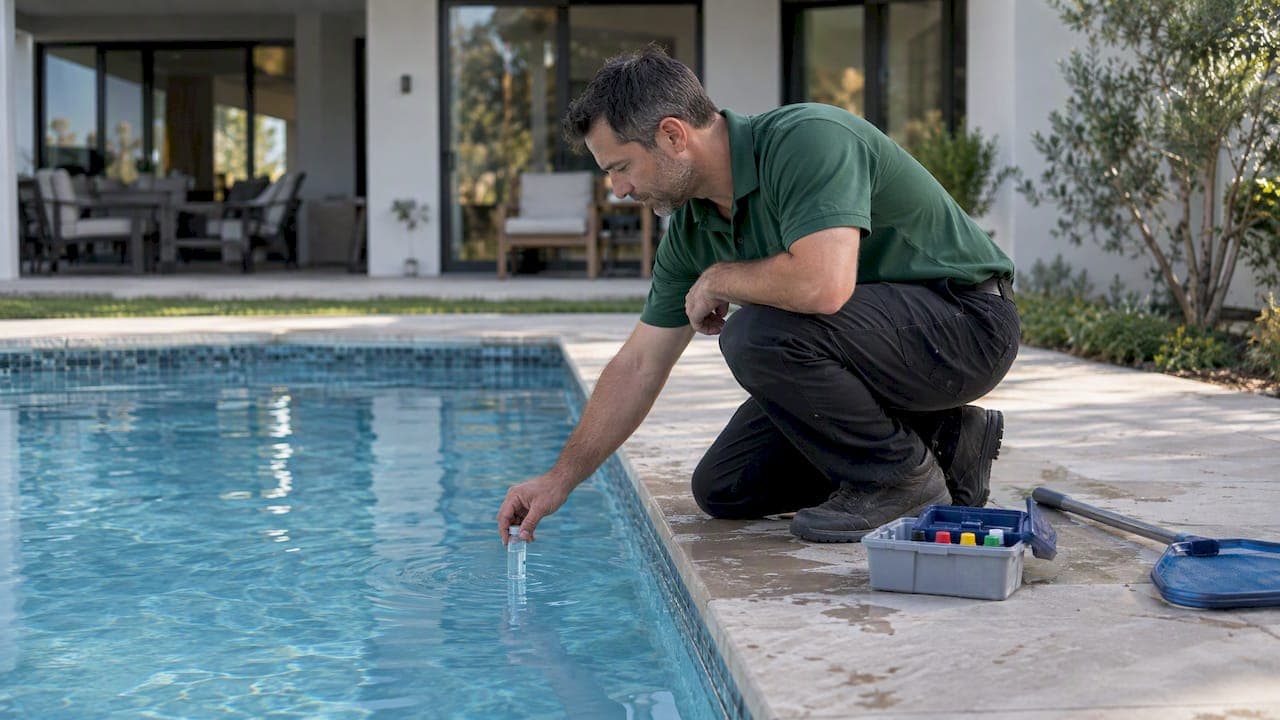
A rental pool needs water tests at least twice a day when it is in use, a weekly service visit for cleaning and equipment checks, a monthly look at the mechanical side, and a seasonal open or close. Just as important, you need a written record that shows each task happened and who did it. This guide gives you the schedule, a way to split the work between you, a tenant or guest, and a pool pro, and a simple log that protects you.
It is written for owners who run their own rentals: a vacation home, a short-term rental, or a long-term rental with a pool in the backyard. It is not for property managers running hundreds of doors.
TL;DR
- Test chlorine and pH at least twice a day, and more often when the pool is busy. CDC guidance puts chlorine at 1-4 ppm and pH at 7.0-7.8.
- Set the cadence by who is on site: daily checks by whoever is staying, weekly service by a pro, monthly equipment checks by you or your vendor, and seasonal open and close.
- Write down every test, chemical addition and visit. A pool log is your best evidence if there is a guest injury, a dispute or an insurance claim.
- Put pool responsibility in the lease or house rules in plain terms, and keep safety items such as fencing and gates as your own job.
- Track it all in one place, with recurring reminders, vendor contacts and warranties together, so nothing depends on memory.
Table of Contents
- Why a rental pool needs a written schedule
- The schedule at a glance
- Daily and twice-daily checks: the water
- Weekly service: what a visit should include
- Monthly checks: the mechanical side
- Seasonal tasks: opening, closing and winterizing
- Who is responsible: owner, tenant, guest, or pool pro
- Working with a pool service without being surprised
- The pool log: what to record
- Our perspective: treat the pool as a recurring system
- Keeping the schedule in one place
- A starter plan you can set up this week
- FAQ
- Sources
Why a rental pool needs a written schedule
A pool you own and live next to gets fixed when you notice a problem. A rental pool gets used by people who do not know the equipment, do not know the chemistry, and may not tell you when the water turns cloudy. Three things follow from that.
First, small problems become expensive ones. Green water, a clogged filter or a pump running dry are cheap to catch in week one and costly in week four.
Second, you carry the paper trail. Safety guidance for accommodation providers keeps coming back to documentation: an HSE guidance document from the UK, written about spa pools in holiday rentals and hotel rooms, advises treating a pool used for business as a managed facility. That is British guidance, not a U.S. rule, but the logic carries over. If something goes wrong, a dated log of tests and visits is far stronger than "we always kept it clean."
Third, responsibility gets blurry. Landlord forums are full of the same question: the lease says the tenant maintains the pool, so what is the owner still on the hook for? A schedule with named owners for each task answers that before it becomes an argument.
The schedule at a glance
Use this as a starting template. Pool size, climate, shade, bather load and local rules change the details.
| Frequency | Task | Usually done by |
|---|---|---|
| Twice daily (when in use) | Test chlorine and pH; adjust only as needed | Guest, tenant, or on-site caretaker with a simple test kit |
| Daily | Skim surface, empty skimmer basket, check water level and that the pump is running | Guest, tenant or caretaker |
| Weekly | Full service: test and balance, brush, vacuum, clean baskets and tile line, inspect equipment, photo report | Pool service or you |
| Weekly | Check gate latch, fence, cover and safety signage | You, vendor, or caretaker |
| Monthly | Read filter pressure gauge, check refill valve and pump seals, inspect pool light and ladder hardware | You or pool service |
| Quarterly | Deeper chemistry check (full water panel), filter cleaning if the gauge calls for it | Pool service |
| Seasonal | Opening, closing or winterizing, cover inspection | Pool service, with your sign-off |
| Yearly | Equipment review, warranty and insurance check, review of lease and house rules | You |
The following sections explain each layer.
Daily and twice-daily checks: the water
The CDC says residential pool owners should test chlorine and pH at least twice a day, and more often when many people are using the pool. The same page gives a free chlorine range of 1-4 ppm and a pH of 7.0-7.8, which is where chlorine works fastest against germs.
Twice a day sounds like a lot for a rental, and in practice it is the part that most often falls through. Here is how owners handle it realistically:
- Occupied vacation rental or STR: Put a simple test kit or strips by the equipment, with a one-page card showing the target ranges and what to do if a reading is off (usually: do not swim, call you). Do not ask guests to dose chemicals. Ask them to read and report.
- Long-term tenant: The lease can assign daily testing and skimming to the tenant, but you should still verify at inspections. A tenant who agrees to "maintain the pool" often has never owned one.
- Empty between stays: A pool does not stop needing care when nobody is in it. Sun, rain, debris and heat keep changing the water. Weekly service stays on the calendar even for vacancies.
When readings are outside range, write them down along with what was done and the retest. Do not rely on a text message thread that nobody will find in six months.
Weekly service: what a visit should include
A standard weekly visit from a pool service typically covers testing and balancing the water, brushing and vacuuming, skimming, emptying baskets, cleaning the tile line, and a look over the pump, filter and heater. Some companies also send a photo report after each visit, which is handy for remote owners. You can see how one provider lists its steps in its job description for technicians, which ends with documenting the visit.
What does it cost? Pricing varies by region, pool size and what is included. One pool service cost guide for 2026 puts standard weekly service at about $150 to $350 or more per month, and biweekly at $100 to $250 or more. Treat these as ballpark figures and get two or three local quotes, because a Phoenix quote and a Minneapolis quote will not look alike.
If your rental is short-term, weekly is the floor, not the ceiling. High guest turnover, kids, sunscreen and hot tubs put more load on the water. Ask whether your service will add a mid-week check around busy weekends, and what that costs.
Weekly checks that are not in the water
While the water is the star, add three non-chemical items to every week:
- Gate and latch. Does it self-close and self-latch? Is anything propped against the fence?
- Fence, cover and barriers. Look for gaps, loose panels, and a cover that does not seat properly.
- Signage and rescue gear. Rules posted, life ring or reaching pole in place, emergency number visible.
These are the items that matter most in a bad day, and they are easy to skip because the pool "looks fine."
Monthly checks: the mechanical side
Most owners focus on the water and ignore the machinery. Guidance on home water efficiency from the EPA's WaterSense program points out that pool upkeep is partly a hardware question, including using a pool cover when the pool is idle and keeping an eye on equipment such as refill valves. A monthly pass through the equipment pad catches leaks and failing parts before they cost you a pump.
A practical monthly list:
- Read the filter pressure gauge and note the number in your log. A rise above the clean baseline is the cue to clean or backwash the filter, per the manufacturer's manual.
- Look at the automatic refill valve and water level. A pool that keeps losing water is a leak or evaporation question you want answered early.
- Check pump lid, seals and unions for drips, and listen for unusual noise.
- Test the pool light, inspect ladder and handrail hardware, and check drain covers for cracks.
- Confirm the chemical storage area is dry, ventilated and locked.
Keep the manuals and warranties for the pump, filter, heater and cover in one place. When a pump fails in July, you want the model number and purchase date in thirty seconds, not after a search through old email.
Seasonal tasks: opening, closing and winterizing
If your climate has a freeze, the closing step is where the real money is saved or lost. The EPA's home maintenance guidance mentions winterizing equipment by draining pumps and piping to prevent freeze damage. A rental makes this harder because nobody is there to notice a cold snap, so schedule the close with a pro and confirm in writing that lines, pump and filter were drained and the cover was secured.

The same applies in reverse in spring. Book the opening before the first booking weekend, not after, and plan a re-test and a photo before the first guest arrives. In warm states there may be no closing at all, but there is still a seasonal rhythm: leaf drop, storm cleanup, algae risk in summer heat. Our four-season host maintenance calendar shows how to place these tasks alongside the rest of a multi-property year.
Who is responsible: owner, tenant, guest, or pool pro
Responsibility depends on your state, your lease and your insurance, so this is a framework to bring to your lease or an attorney, not legal advice. One common way to think about it is the split between ownership responsibility and use responsibility, as described in a landlord and tenant overview of rental pools:
- Ownership side (usually you): the pool shell and deck, pump, filter and heater, installed lighting, and fixed fencing and gates.
- Use side (usually the occupant): day-to-day conduct, guest behavior, closing gates, and reporting problems promptly.
Chemistry sits between the two, and that is exactly where leases go wrong. Here are three arrangements that work:
| Arrangement | Best for | Watch out for |
|---|---|---|
| Owner hires and pays a pool service; tenant handles daily skimming and reports issues | Most long-term rentals and nearly all STRs | Cost is yours, build it into rent or nightly rates |
| Tenant handles all maintenance, including chemistry | Experienced tenants in longer leases | Tenants without pool experience, inconsistent results, your equipment risk |
| Owner or caretaker does everything | Owners living nearby | Time. It is a weekly job, every week |
For most owners the first option is the safest. A tenant-run pool might look cheaper on paper, but the ownership-side assets are still yours, and so is much of the risk. Whatever you choose, write it down: who tests, how often, what the tenant must do if the water looks wrong, and who pays for repairs caused by neglect versus normal wear.
Safety items are the area where you should not delegate away. Barriers, gates and latches are your property and your exposure. Check local code and your insurer's requirements, since pool barrier rules differ by city and state.
Working with a pool service without being surprised
Pool pros are a good answer, but it helps to know how their world works so you can ask better questions.
Route density drives reliability. A full-time technician typically services 12 to 20 pools a day, or about 60 to 100 a week, and drive time between stops caps that number more than time at the pool does. Dense subdivisions allow 20 or more, while spread-out rural routes may top out at 10 to 12. The practical meaning for you: if your rental is far from the rest of a company's stops, your service day may shift, and your visit may be the first to slip when the tech is stretched.
Ask about capacity. Experienced operators start hiring when they hit around 80% of their weekly maximum, according to a capacity planning resource, so that training a new hire does not hurt service. You can ask a vendor, politely, how full their routes are and what happens when a technician is sick.
Be an easy stop. A PoolPro feature on what drives success in the pool business describes the owner relationship as a partnership: clear gate access, an organized equipment area and written instructions help a technician finish faster and more consistently. For a rental, that means a lockbox or gate code in your vendor notes, a dog-free service window for the pool area, and no guest towels blocking the skimmer.
Questions to ask before you sign:
- What does a standard visit include, and what is extra (filter cleaning, green-pool recovery, repairs)?
- Do you send a photo or written report each visit?
- What is your plan for a missed visit or a pool that turns green between visits?
- Are you licensed and insured, and can I see the certificate? (Requirements vary by state.)
- Can you reach my property on the same day every week?
Save the answers with the vendor's contact details so a backup person can find them.
The pool log: what to record
The single habit that most improves your position is the log. Write the date, who did it and what they found. A good entry is short:
- Date and time, name of the person
- Free chlorine and pH readings (and any other test you run, such as alkalinity)
- Chemicals added and amounts
- Filter pressure reading
- Visible condition: clear, cloudy, debris level
- Gate, fence and safety gear check: pass or fail
- Photos of the pool and equipment pad
- Issues found and who is handling them
A physical clipboard at the equipment pad works if your guests or tenants are doing daily readings. A digital version is better for your own records because it is searchable and cannot be lost in a shed. For deeper recordkeeping habits for rentals in general, see our guide to rental property maintenance schedules and recordkeeping.
Our perspective: treat the pool as a recurring system
We built Property Command Center for owners who handle their own properties, often more than one, without a back office. When we look at pool care for rentals, the failures we see described are rarely about not knowing how to balance water. They are about coordination: the service day changed and nobody noted it, the warranty was in an old email, the gate repair was "on the list" for months, the tenant thought the owner was testing and the owner thought the tenant was.

So our view is simple. A pool is a bundle of recurring tasks with different owners and different intervals, and the job is to make those visible. Put the twice-daily readings, the weekly visit, the monthly equipment check and the seasonal close in one calendar. Put the pool vendor's contact next to the property they serve. Put the pump manual and the insurance policy in the same place as the task that refers to them. If you have a vacation home plus a rental, the same structure repeats, and that is where scattered spreadsheets and notes start to hurt.
If you run short-term rentals, our piece on four cadences for short-term rental maintenance lays out how pool tasks fit with turnovers and seasonal work. And if you are far from the property, the vacation home checklist for remote owners covers what to ask local help to verify.
— Francisco
Keeping the schedule in one place
If you want the schedule above to run itself, Property Command Center is a subscription dashboard for owners with one or more homes or rentals. You can keep each property's status, maintenance schedules and reminders, tasks and repairs, vendor contacts, and documents such as warranties, manuals and insurance in a single place, with alerts so recurring tasks do not slip. It is built for owners, not property managers, and it does not try to be tenant or rent software.
Plans are Starter at $19 per month and Pro at $49 per month, and there is a 14-day free trial with no credit card required. You can see both on the pricing page, and the vendors page shows how the contact directory works for people like your pool tech.
A starter plan you can set up this week
If you do nothing else, do these in order:
- Write the responsibility split into your lease or house rules: daily testing and skimming, who pays, who to call.
- Hire a weekly service or commit to a specific person who will do it. Ask for a photo or written report.
- Post a one-page card at the pool with target ranges (chlorine 1-4 ppm, pH 7.0-7.8), safety rules and your emergency contact.
- Create recurring reminders for the weekly visit, the monthly equipment check and the seasonal open and close.
- Store the documents: pump, filter, heater and cover manuals, warranties, the service agreement, and your insurance policy.
- Start the log today, even if it is a shared note.
- Check safety hardware this weekend: latch, gate, fence, signage, rescue gear.
If you are earlier in the process and still setting up how you manage the rest of the property, our self-managing rentals checklist is a good companion, and the landlord maintenance responsibilities 90-day plan covers the wider duties that sit alongside pool care.
FAQ
What does weekly pool maintenance include?
A typical weekly visit covers testing and balancing the water, skimming, brushing, vacuuming, emptying skimmer and pump baskets, cleaning the tile line, and checking the pump, filter and heater. Many companies also send a photo report. Ask any provider for their exact list, since extras like filter cleaning are often billed separately.
Do I put chlorine in my pool every day?
Not necessarily, but you should test every day. The CDC advises testing chlorine and pH at least twice a day, with free chlorine at 1-4 ppm and pH at 7.0-7.8. How much chlorine you add depends on the readings, sunlight, bather load and the type of chlorine you use, so follow your product label and your pool pro's advice.
Who is responsible for pool maintenance in a rental, the landlord or the tenant?
It depends on the lease and your state. In general, owners handle equipment, structure and safety barriers, while tenants handle day-to-day use and reporting problems, and chemistry is assigned by agreement. Put the split in writing, and ask a local landlord-tenant attorney if you are unsure about your state's rules.
How much does a pool service cost for a rental?
One 2026 cost guide puts standard weekly service at roughly $150 to $350 or more per month, with biweekly service lower. Your price will depend on location, pool size, what is included and how much use the pool gets. Short-term rentals often need extra visits, so ask for a quote that reflects your booking pattern.
How many pools can a pool technician service in a week?
A full-time residential technician typically handles about 60 to 100 pools a week, depending on how close together the stops are. That is why your service day can shift, and why it helps to ask a vendor how full their routes are before you sign.
Sources
- CDC: Home Pool and Hot Tub Water Treatment and Testing
- HSE (UK): HSG282, control of legionella in spa pool systems
- On-Time Pool Service: technician duties
- Pool service cost in 2026
- US EPA WaterSense: Home Maintenance
- Landlord and tenant responsibilities for swimming pools
- PoolBoss: how many pools a tech can service daily
- PoolDial: pool service capacity planner
- PoolPro: Drivers of Success