Remote home management is a single dashboard that centralizes maintenance schedules, vendor contacts, and document records for each property you own. It replaces scattered emails, spreadsheets, and sticky notes with one searchable view, cutting down on missed repairs and last-minute scrambles. If you own more than one home, the fastest way to start is simple: create one property record today and set one recurring maintenance task.
TL;DR:
- A dashboard should support creating and consistently updating one property record per home, including documentation of repairs and vendor interactions, to build a complete history.
- Its key features must include a portfolio view, recurring task scheduling, document indexing with metadata, vendor management, and mobile access for quick task approval and status checks.
- Proper document indexing requires attaching searchable PDFs like warranties and receipts directly to each asset with clear naming conventions for rapid retrieval during emergencies.
- Security measures should involve multi-factor authentication, role-based access, data encryption, and regular offline backups to protect sensitive property information.
- Starting with a simple workflow—logging assets, scheduling recurring maintenance, and sticking to a consistent pattern—ensures stable management across multiple homes over time.
Table of Contents
- A repeatable workflow for keeping multiple homes organized
- What to require from a dashboard built for owners, not landlords
- How to index documents so warranties and repairs move fast
- Security and backup checks before you trust a dashboard with your records
- A 90-day maintenance calendar you can copy today
- How to test a dashboard before committing to one
- Integration with smart home devices and IoT for automated monitoring
- Mobile app features and remote notifications worth having
- Data privacy considerations specific to remote home management
- Examples of remote home management done well
- Why simplicity beats feature depth for owners managing a few homes
- Try Property Command Center for your own properties
- Sources
- FAQ
A repeatable workflow for keeping multiple homes organized
The point of a dashboard is useless if you dump information into it once and never touch it again. Owners who stay organized follow a consistent pattern for every property they add, so the system produces real history instead of a pile of files.
- Create one property record per home, including address, access notes, and emergency contacts.
- Add recurring maintenance tasks and inspection checklists tied to each property, not to a general to-do list.
- Log every service visit against the property record so completed work builds a timeline instead of disappearing into an inbox.
- Link vendor records to specific jobs and invoices so you can see who did what, when, and for how much.
- Index documents like warranties, manuals, and receipts as you go, rather than saving them for later.
That last step matters more than it seems. National Association of Realtors guidance on preventive maintenance points to fragmented records, not a missing feature, as the real failure mode: history scattered across email and spreadsheets takes far longer to reconstruct than it does to attach the right document the first time. A 90-day onboarding push, walking each property, photographing assets, and logging the basics, gets every home current at once instead of trickling in over a year. See our guide on tracking service history in 90 days for the six fields worth capturing per asset.
What to require from a dashboard built for owners, not landlords
Not every property management tool is built for someone who owns a few homes and wants to check on them without a second job. Before you commit to one, confirm it covers the basics an owner actually needs.
- Portfolio view: one screen showing the status of every property, not a separate login for each.
- Recurring scheduling: tasks that repeat automatically (monthly, quarterly, seasonal) without manual re-entry.
- Document vault with asset metadata: warranties and manuals attached to the specific appliance or system they cover.
- Vendor directory: contact details, job history, and notes tied to each service provider.
- Task tracking: a clear record of what is open, overdue, or completed across properties.
- Mobile access: the ability to check status or approve a repair from wherever you are.
Each of these prevents a small problem from becoming an expensive one. A missed quarterly HVAC filter change is a $30 fix; a neglected one can mean a failed unit. Skip anything built around leasing, rent collection, or tenant screening. Those features add complexity for owners who are not managing renters, and they usually come with a steeper learning curve than the job requires. See how a portfolio system for owners differs from tools built for landlords.
Pro Tip: Test a product's portfolio view before anything else. If switching between properties takes more than two clicks, the workflow will not survive daily use.
How to index documents so warranties and repairs move fast
A document vault only earns its place if the files inside it are usable under pressure, not just stored. When a water heater fails at 9 p.m., you want the model number and warranty terms in seconds, not to be buried in a folder of scanned receipts.
- Property: which home the asset belongs to.
- Asset name: a plain description (furnace, water heater, roof).
- Model and serial number: required by most manufacturers for warranty claims.
- Purchase or install date: determines whether a warranty is still active.
- Warranty terms: coverage length and what it includes.
Store receipts, service manuals, inspection notes, and photos as searchable PDFs whenever possible, and attach each one directly to the asset record rather than a generic property folder. Consistent file naming (property, asset, date) makes search fast even when a vault grows to dozens of documents across several homes. Export your full document set periodically and confirm the export actually opens and reads correctly. A vault you cannot get data out of is a liability, not a convenience. For a template you can copy directly, the vacation home checklist for remote owners covers inspection notes alongside document indexing.
Security and backup checks before you trust a dashboard with your records
Centralizing property records in one place is convenient, but convenience without security guidance turns a helpful tool into a single point of failure. The FTC's small-business security guidance recommends regular backups that are not always network-connected, encryption of sensitive data at rest and in transit, controlled access, and multi-factor authentication for any system holding sensitive records.
- Multi-factor authentication: required for any login that touches your property records.
- Role-based access: vendors and family members see only what they need, not your entire portfolio.
- Encryption: data protected both while stored and while moving between your device and the dashboard.
- Backup and export policies: a documented way to pull your full data set out if you ever switch tools.
Regular, offline-capable backups and encryption at rest and in transit are core recommendations in the FTC's security guidance for any business handling sensitive records remotely, and the same standard applies to a household managing property data online.
Limit vendor access with time-bound sharing links instead of permanent logins, and check that any service contract includes a basic security clause. On the home side, use WPA2 or WPA3 on your router, keep your device operating system and antivirus current, and avoid accessing property records over public Wi-Fi without a VPN.
A 90-day maintenance calendar you can copy today
A dashboard is only as useful as the schedule behind it. This pattern works whether you own two homes or ten, because each property gets its own copy of the same simple calendar.
- Days 1 to 30: walk each property, photograph major systems and appliances, and book seasonal vendors (HVAC, gutter cleaning, chimney) before their busy windows fill up.
- Days 31 to 60: run monthly quick checks such as filter changes, smoke detector tests, and exterior walk-arounds, logging each one against the property record.
- Days 61 to 90: complete a deeper quarterly inspection covering roofing, plumbing, and electrical systems, and confirm every vendor visit from the quarter is logged with notes and cost.
- Ongoing: set the same three-tier pattern (monthly, quarterly, seasonal) to repeat automatically for each new property you add.
The pattern scales without extra effort because each property carries its own calendar. Adding a third or fourth home means duplicating the same recurring tasks, not building a new system. Our 90-day calendar template walks through the same structure with sample task names you can adapt directly.
How to test a dashboard before committing to one
Most trials let you poke around for a few minutes and give up. A better approach is running a short, deliberate test that mirrors how you will actually use the tool.
- Feature fit: can you index a document with asset metadata and set a recurring task in under five minutes?
- Vendor sharing: can you share a job or invoice with a vendor without giving them access to your whole portfolio?
- Security fit: does the product support multi-factor authentication, encryption, and a clear export policy?
- Commercial fit: is pricing based on the number of properties, and does the trial require a credit card upfront?
During the trial itself, create one property record, add a single asset with its model and serial number, and schedule one recurring task. If those three actions feel awkward on day one, they will not get easier at property number three.
Pro Tip: Prefer a trial that does not require a credit card. It tells you whether the product respects your time before it asks for your money.
Integration with smart home devices and IoT for automated monitoring
A remote home management dashboard is not a smart-home control system, and that distinction matters. Its job is to track maintenance schedules, vendor history, and documents, not to operate thermostats, locks, or cameras. Where the two intersect is narrower than most people expect: a smart water sensor or leak detector can flag an issue, and that alert becomes a task logged against the property record rather than something you chase down separately.
Think of it as a division of labor. Smart devices monitor conditions in real time, cameras, sensors, thermostats. A management dashboard tracks what happened as a result: a technician visit, a repaired valve, a warranty claim filed. Trying to make one tool do both jobs usually means a worse version of each. A dashboard stretched to control devices adds complexity without improving monitoring, and a device hub stretched to manage maintenance records rarely handles document storage or vendor history well.

If you already use smart sensors for leak detection or temperature monitoring, look for a dashboard that lets you log an alert as a maintenance event, not one that promises to control the sensors themselves. That keeps the tool focused on what it does well: turning an issue into a tracked task with a vendor assigned and a resolution logged, rather than adding another app to manage devices you likely already control through the manufacturer's own system.
Mobile app features and remote notifications worth having
Most property problems do not wait for you to be at a desk. A pipe leaks on a Tuesday morning while you are at work three states away from the vacation home in question, and the dashboard needs to work from your phone as well as it does on a laptop.
The features worth prioritizing are narrower than a long feature list suggests. You want push notifications for overdue tasks and vendor updates, the ability to approve or decline a repair estimate from your phone, and quick photo upload so you can attach evidence to a task without emailing yourself first. A vendor confirming a job is complete should update the record instantly, not require you to log in later and check.
What you do not need is a mobile app that tries to replicate every desktop feature at full complexity. A cluttered mobile interface trying to cram in leasing tools or tenant messaging (features an owner-only user never touches) makes the app slower for the tasks you actually do on your phone: checking status, approving a bid, or confirming a task is done. Test the mobile experience during any trial period, since a dashboard that looks complete on a laptop can fall apart on a small screen if notifications are buried three menus deep.
Data privacy considerations specific to remote home management
Property records carry more personal information than people usually realize: addresses, alarm codes, financial details from invoices, and sometimes photos of the interior of a home. That combination is worth protecting the same way you would protect financial or health records, even though it does not always get treated that way.
The starting point is controlling who sees what. A vendor who needs access to log a completed repair does not need visibility into your entire portfolio or your other properties' documents. Role-based access, mentioned earlier for security, does double duty for privacy: it limits exposure by default rather than relying on every user to be careful.
Data location and retention matter too. Ask how long a provider keeps records after you cancel, and whether you can request full deletion, not just account closure. The FTC's guidance on business data security recommends secure disposal of sensitive data once it is no longer needed, a principle that applies just as much to a household managing a handful of properties as it does to a company managing thousands of customer records.
Finally, treat photos carefully. Interior photos taken for inspection or insurance purposes are useful, but they are also a detailed map of a home's contents and layout. Store them inside the same access controls as everything else, rather than in a separate, less protected folder just because they started as phone photos.
Examples of remote home management done well
The owners who get the most out of a dashboard tend to share a few habits, regardless of how many properties they manage. A family with a primary residence and one vacation home might set up recurring seasonal tasks for both properties on day one: gutter cleaning before fall, HVAC service before summer, and a pipe-freeze check before winter for the colder property. Every vendor visit gets logged with cost and notes, so by the second year they can compare a heating bill or repair cost against the prior year without digging through old invoices.
A host running two short-term rental properties in different states might lean harder on the document vault, since remote guests and cleaning crews create more turnover events that need tracking. Appliance model and serial numbers get logged the week each property is acquired, not months later when something breaks, following the same indexing habit Everyday Old House recommends for warranty tracking. When a dishwasher fails at property two, the serial number and purchase date are already attached to the asset record, and a warranty claim takes minutes instead of an afternoon of searching.
The common thread across both examples is not a specific feature. It is consistency: every property gets the same recurring schedule, every vendor visit gets logged, and every document gets indexed the same way. Owners who treat the 90-day onboarding process as a one-time chore rather than an ongoing habit tend to drift back to scattered notes within a year. The ones who stick with the pattern rarely look back.

Why simplicity beats feature depth for owners managing a few homes
Most property management software is still built for people managing dozens of units with tenants, leases, and rent rolls. That is the wrong shape of tool for someone managing two or three homes they own outright. The features that matter most for an owner, recurring tasks, a document vault, vendor history, are a small fraction of what enterprise platforms offer, buried under menus built for a different job entirely.
The stronger case for a simpler dashboard is not that owners cannot handle complexity. It is that complexity nobody uses does not stay neutral. A feature you never touch is still a menu you have to navigate around, a setting you might get wrong, a reason the tool feels heavier than the job it needs to do. Multi-home guides on tracking service history and building 90-day onboarding plans work precisely because they strip the process down to what an owner actually repeats: log it, schedule it, attach it, done. Pilot the workflow with one property before rolling it out to your whole portfolio. If it holds up there, it will hold up everywhere else.
— Francisco
Try Property Command Center for your own properties
This type of property management solution is built around the exact checklist covered above: a portfolio dashboard, recurring maintenance schedules, a vendor directory, and a document vault for warranties, manuals, and insurance records, all in one place instead of scattered across email and spreadsheets.
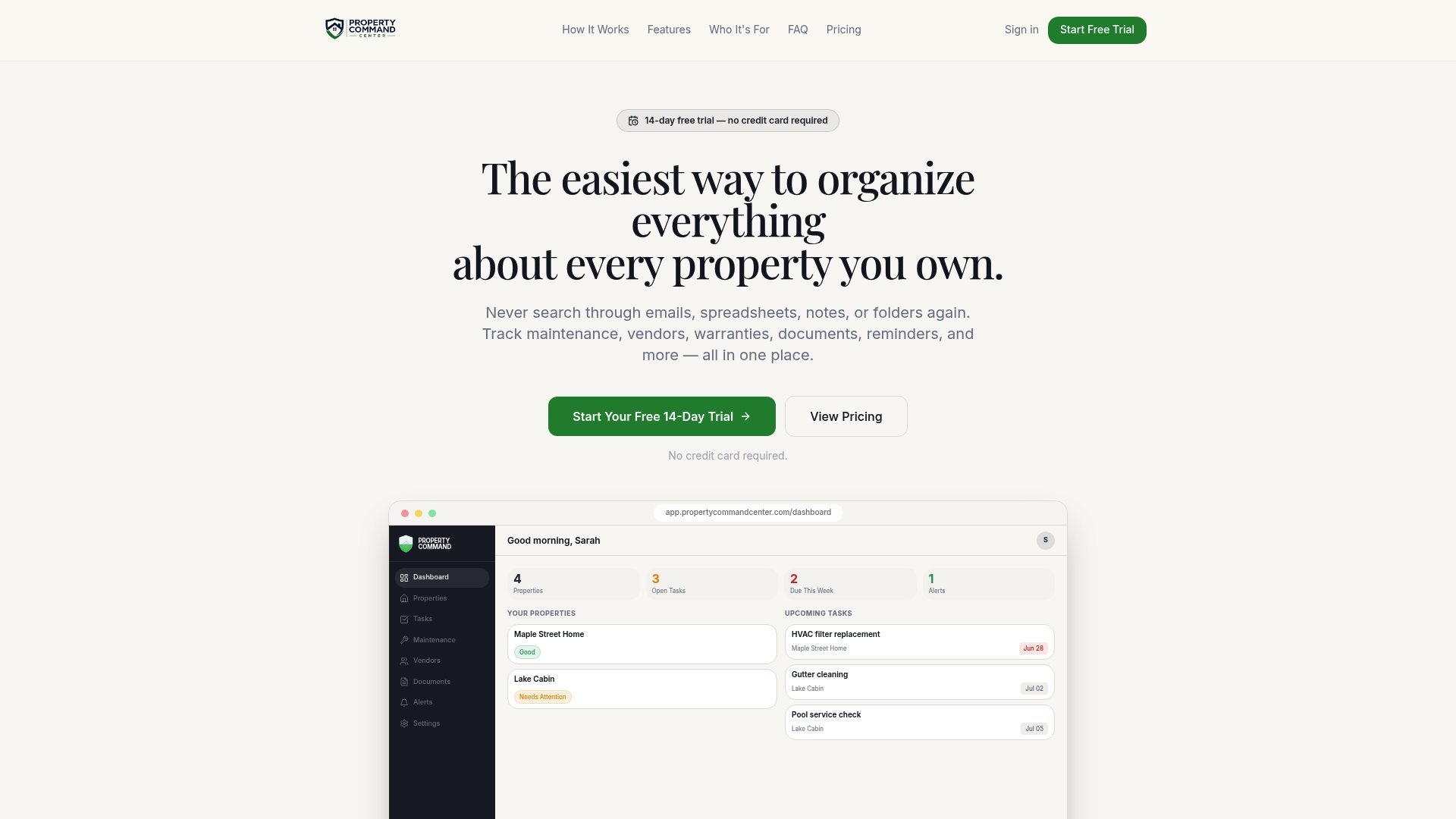
- A single dashboard showing the status of every property you own.
- Recurring task scheduling so maintenance does not depend on memory.
- A vendor directory that keeps contact details and job history attached to each property.
- A document vault for indexing warranties, receipts, and asset records by property.
It skips the leasing and tenant-management features that add complexity without adding value for an owner managing their own homes. You can start with a 14-day free trial with no credit card required, then choose a plan that fits your portfolio after the trial. Check pricing and plan details to see which one matches the number of properties you manage.
Sources
This guide draws on the FTC's small-business security guidance for backup and access-control practices, National Association of Realtors preventive maintenance recommendations, Everyday Old House guidance on indexing appliance records, and Fannie Mae's property preservation reference for structured maintenance workflows at scale.
- National Association of Realtors — Property management
- FTC — Start with Security: A Guide for Business
- Everyday Old House — Track appliance maintenance
FAQ
What is remote home management?
Remote home management is a dashboard that centralizes maintenance schedules, vendor contacts, and documents for properties you own, so you can track them from anywhere. It replaces scattered emails and spreadsheets with one searchable record per property.
How do I set up remote management for multiple properties?
Start by creating one property record, then add recurring maintenance tasks and index key documents like warranties and manuals for that property before repeating the process for each additional home. A 90-day onboarding push, walking each property and logging assets as you go, gets every home current quickly rather than trickling in over months.
What security features should a home management dashboard have?
Look for multi-factor authentication, encryption of data at rest and in transit, role-based access for vendors, and a clear backup and export policy, all recommendations found in the FTC's small-business security guidance. Test the export feature during any trial to confirm your data is actually portable.
How much does Property Command Center cost?
Property Command Center offers a Starter plan at $19 per month and a Pro plan at $49 per month, with a 14-day free trial that does not require a credit card. Pricing is based on the number of properties you manage.
Do I need smart home devices to use a remote management dashboard?
No. A remote home management dashboard tracks maintenance, vendors, and documents, and works independently of smart home devices or IoT sensors. Some owners log alerts from a leak sensor or smart thermostat as a maintenance event, but the dashboard itself does not control those devices.