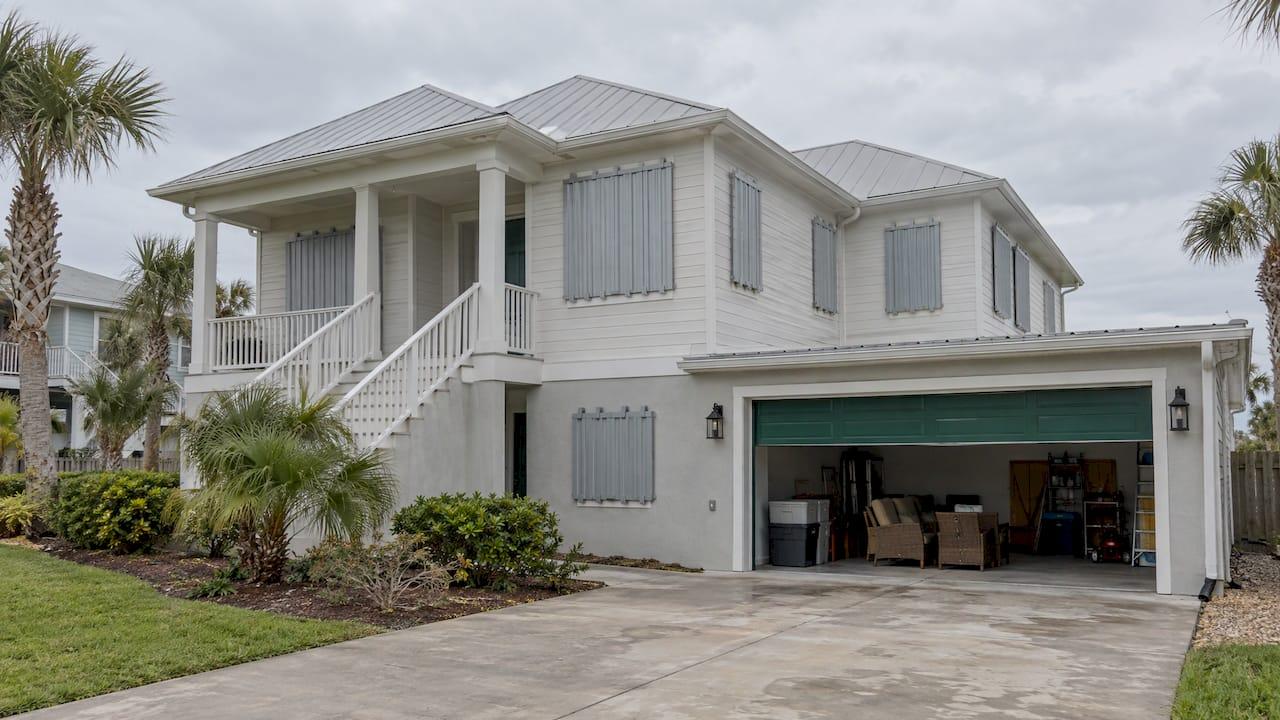
A storm prep checklist for your home covers five things: a supply kit, a protected house and yard, secured documents, an evacuation plan and a safe way to check for damage afterward. If you own a vacation home, a rental or several properties, the hard part is not knowing what to do. It is doing it at every address, with the right documents, vendor phone numbers and maintenance history at hand when a storm is two days out. This guide gives you the checklist, drawn from FEMA, NOAA, CDC and the Red Cross, and shows how to organize it so it works for each property you own.
TL;DR
- Build a basic kit first: Ready.gov lists water at one gallon per person per day, several days of food, a weather radio, flashlights, a first aid kit, batteries, cash and copies of key documents.
- Protect each house: trim trees, clear gutters and yard debris, secure loose outdoor items, and reinforce the garage door. In cold climates, insulate pipes and seal drafts.
- Keep insurance policies, deeds, leases and a photo inventory in digital and paper form, so a claim does not depend on one box in one house.
- Know your valves, your vendors and your plan for each property before the storm is in the forecast.
- A single record per property, with documents, vendors, tasks and reminders together, turns this checklist into a repeatable routine.
Table of Contents
- Why storm prep is different when you own more than one property
- The supply kit: what to stock
- Protect each house before the storm
- Secure your documents before you need them
- Line up your vendors and your plan
- Evacuation and pets
- After the storm: check, document, clean up
- Our view: the checklist is the easy part
- Put the records in one place
- FAQ
- Sources
Why storm prep is different when you own more than one property
Most storm checklists assume one household, one house and one set of papers. You may have a primary home, a lake house, two rentals and a short-term rental that has guests arriving Friday. Each has its own roof age, shutoff valves, insurance policy, landscaper and plumber. The storm does not wait for you to dig through email for the policy number.
Timing matters too. NOAA says to prepare before hurricane season, which runs June 1 to November 30 in the Atlantic and central Pacific and May 15 to November 30 in the eastern Pacific. It advises buying supplies while shelves are stocked and notes that flood insurance carries a 30-day waiting period. A policy checkup the week a storm forms is too late.
The practical answer is to build the checklist once, in two layers. The first layer is the same everywhere: supplies, documents, communications. The second is specific to each address: what to secure, who to call, which valve to close. The sections below follow that structure.
The supply kit: what to stock
Start with the basics from Ready.gov's kit guide:
- Water: one gallon per person per day for several days, for drinking and sanitation
- Food: a several-day supply of non-perishable items, plus a manual can opener
- A battery-powered or hand-crank radio and a NOAA Weather Radio with tone alert
- Flashlights, extra batteries, a whistle and a dust mask
- First aid kit, moist towelettes, garbage bags
- Wrench or pliers to turn off utilities
- Plastic sheeting, scissors and duct tape
- Local maps, plus a phone with chargers and a backup battery
The same page suggests additions: prescription medications, infant supplies, pet food, cash, important documents in a waterproof container, sleeping bags, a change of clothing, a fire extinguisher and waterproof matches. It also says to replace expired items and update your needs every year.
How much is enough
The numbers vary by source, so size the kit to your location. FEMA's Are You Ready guide gives water at one gallon per person per day for 3, 7 or 14 days depending on where you live, and adds cash for food, fuel or a hotel and N95 respirator masks. NOAA recommends a minimum three-day supply of food, water and medicine per person, along with extra cash and a portable crank or solar USB charger.
The American Red Cross splits the kit in two. A Go-Kit holds at least three days of supplies you can carry, including backup batteries and chargers for phones and medical devices. A Stay-at-Home Kit holds at least two weeks of supplies. It also recommends a one-month supply of medication in a child-proof container.

FEMA adds that you may need to survive on your own for several days after a hurricane, so size everything to the whole household, including hygiene products, infant formula, pet supplies and comfort items for kids. If you or a family member lives alone and will ride out a storm at home, the planning around food, water, medications and pet needs gets more personal, and hurricane prep for seniors living alone walks through it.
A kit for the second home
FEMA's guide says to store emergency supplies in several places: home, office and vehicle. For a vacation home, that means a small stocked kit on site that you check each season rather than packing from scratch. Note the kit's expiry dates in the same place you track every other recurring task at that property.
Protect each house before the storm
Storm type changes the job. Here is how the official guidance breaks down.
| Threat | What to do | Source |
|---|---|---|
| High wind and hurricanes | Trim trees, install shutters or impact glass, seal outside wall openings, reinforce the garage door | NOAA |
| Flooding rain | Clean gutters so rain drains, anchor fuel tanks, move documents upstairs or to a high shelf | FEMA |
| Winter storms | Insulate water lines on exterior walls, caulk and weather-strip, repair roof leaks, cut back branches | CDC |
| Power outage | Charge devices, set fridge and freezer to coldest settings, keep a way to charge medical devices | Mass.gov |
Wind and rain
NOAA identifies the garage door as the most vulnerable part of the home in hurricane-force winds, so reinforcing it belongs near the top. FEMA also says to pick up yard waste, trim or remove trees that could fall on the house and clean gutters.
When the forecast is close, CDC's hurricane guidance says to clear the yard of bikes, lawn furniture, grills, propane tanks and building material, and to cover windows with storm shutters or plywood nailed to the outside frames. Do not tape your windows. FEMA warns that tape will not stop glass from shattering and can make the shards larger and more dangerous.
If you leave, FEMA says to bring loose items inside, secure what is unsafe to bring in (grills, gas canisters), unplug small appliances, leave the refrigerator and freezer plugged in, lock doors and windows, and shut off water, gas or electricity only if officials tell you to.
If the property has a homeowners association, debris on the roof or in the yard can also trigger rule letters. A clear process helps, and roof debris HOA letters shows how those notices are handled between owners, renters and managers.
Cold, ice and power loss
CDC's winter storm page says to insulate water lines along exterior walls, caulk and weather-strip doors and windows, insulate walls and the attic, and repair roof leaks. It also recommends smoke alarms and battery-operated carbon monoxide detectors near heating appliances, tested monthly with batteries replaced twice a year, and an annual furnace and vent check by a qualified technician.
If you use a generator, Ready.gov says to run it only outdoors, at least 20 feet from windows, doors and attached garages, and never to heat a home with a gas stovetop or oven. For a rental or vacation home, put this in your guest or tenant instructions, since the person running the generator may not be you.
Know your shutoffs
Mass.gov calls knowing where your electricity, gas and water switches and valves are, and how to shut them off, a baseline home-safety step. Across several properties, nobody remembers where each one is. Write it down per property, with a photo of each valve, and keep it with the rest of that property's record.
For a coastal property, our beach house maintenance guide covers the seasonal work that makes storm week easier. For the routine tasks that keep any house storm-ready, see our home maintenance checklist.
Secure your documents before you need them
After a storm, the owner who can produce a policy number, a deed and a dated photo inventory in an hour has a different week than the one who cannot. FEMA's guide says to gather financial, legal and contact information and to list household belongings and valuables for insurance records. Keep paper copies in a fire- and waterproof box or safe, a bank safe deposit box, or with a trusted person. Keep electronic copies in password-protected, encrypted form on a removable drive or through a secure cloud service.
FEMA's hurricane checklist adds the items for a go bag: photo ID, cash and credit cards, birth and marriage certificates, medical records, bank account information and property records such as insurance policies and your deed or lease. It also calls for medications for at least one week with copies of prescriptions, and extra eyeglasses or contacts. The FEMA hurricane blog says to save digital backups of policies and deeds, seal originals in plastic bags stored upstairs or on a high shelf, and take them if you evacuate.
The five P's, applied to a portfolio
The Arizona Emergency Information Network describes the five P's of preparedness: people and pets, prescriptions, papers, personal needs and priceless items. For an owner, add one more layer to "papers":
- Insurance: the policy, the agent's number and the claim line for each property
- Ownership: deed or lease, mortgage details, HOA contacts
- Condition records: dated photos of the roof, appliances and contents before the storm
- Warranties and manuals: for the water heater, HVAC, roof and appliances, which matter when something fails after a storm
- Maintenance history: who serviced what, and when
Our guides on what to keep for every property and a claim-ready insurance document organizer go through each category in detail. If you rent properties out, landlord insurance documents covers which ones to keep and why.
Line up your vendors and your plan
After a major storm, roofers, tree services, restoration crews and plumbers are in demand. Owners with a ready contact list for each property start the week ahead of those who are searching. For each property, record:
- The roofer, tree service, plumber, electrician and HVAC technician you trust
- The person who can board up, tarp or inspect if you are away
- The local contact who can walk the property after the storm, for vacation homes and short-term rentals
- Utility emergency numbers
NOAA says to write emergency contacts on paper, including utilities and critical services, because the internet may not be accessible during or after a storm. Keep a printed copy for each property.
For remote owners, our vacation home checklist covers closing up a property you cannot get to quickly. The 60 minute emergency maintenance plan is a good model for what to line up before trouble starts. If you rent to tenants, landlord safety inspections covers the detectors and safety checks that storm season puts to the test.
Evacuation and pets
NOAA advises building an evacuation plan before the season starts. Your destination need not be hundreds of miles away: a friend or relative in a well-built home outside flood-prone areas can work. Plan several routes and account for pets.
When an order is issued, go. CDC says staying to protect property is not worth risking your health and safety, and that hurricanes can cause damage hundreds of miles from the coast. It also warns never to drive through flooded areas: cars can be swept away or stall in just 6 inches of moving water.
The Louisiana emergency guide suggests fueling up, checking your car, bringing cash, leaving early to avoid heavy traffic and calling 2-1-1 to ask whether your destination accepts pets. For pets, pack three or more days of food and water, a carrier large enough for the animal to stand and turn around, leashes, medications and records in a waterproof container, and current photos. The National Weather Service hurricane guide adds current vaccination proof and a proper ID collar, and says not to assume a shelter or hotel will take a pet.
If your rental allows pets, add a line to your guest or tenant instructions about evacuation and pet carriers.
After the storm: check, document, clean up
Return only after authorities say it is safe. FEMA's guide says to inspect with a flashlight, walk the outside for downed power lines, gas leaks and structural damage, and never enter if you smell gas. Open a window, leave immediately and let only professionals turn the gas back on. Do not check the electrical system while wet or standing in water.
FEMA's post-hurricane guidance says not to enter damaged buildings until qualified professionals inspect them, never to walk or drive through floodwater, to wear gloves, safety glasses, rubber boots and masks, to throw out food exposed to floodwater, and not to drink tap water until authorities say it is safe. Its five cleanup steps are to air out, move out saturated porous materials, tear out saturated flooring, drywall and insulation, clean and disinfect, and dry out.

For your insurance claim, the same FEMA guide says to photograph all damaged property, separate damaged from undamaged items, list lost items with purchase dates and values, and keep receipts for extra expenses. This is where the photo inventory and the maintenance history you built beforehand pay off: you can show what the property looked like, what was serviced and when.
Our view: the checklist is the easy part
Every owner we talk to can recite what belongs in a storm kit. What they cannot do quickly is find the roof invoice, the policy number or the plumber's cell phone for the third property.
That is why we built Property Command Center around property knowledge rather than rent collection. A storm checklist is only as good as the information behind it, and for most multi-property owners that information is scattered across spreadsheets, Google Drive, Gmail, PDFs and notes. Each property should be a living record: maintenance history, documents, vendors, tasks and reminders in one place.
Our Smart Setup is designed to extract and organize what you already have from files, emails and spreadsheets, so you are not retyping years of records. Do that once, and storm prep stops being a scramble. It becomes a review of records you trust.
Francisco
Put the records in one place
Property Command Center brings your spreadsheets, emails, documents, maintenance history, vendors, warranties, tasks and reminders into one record for every property. It has a document vault for warranties, manuals and insurance papers, a vendor directory, maintenance schedules with reminders, and a dashboard that shows what needs attention across your homes and rentals.
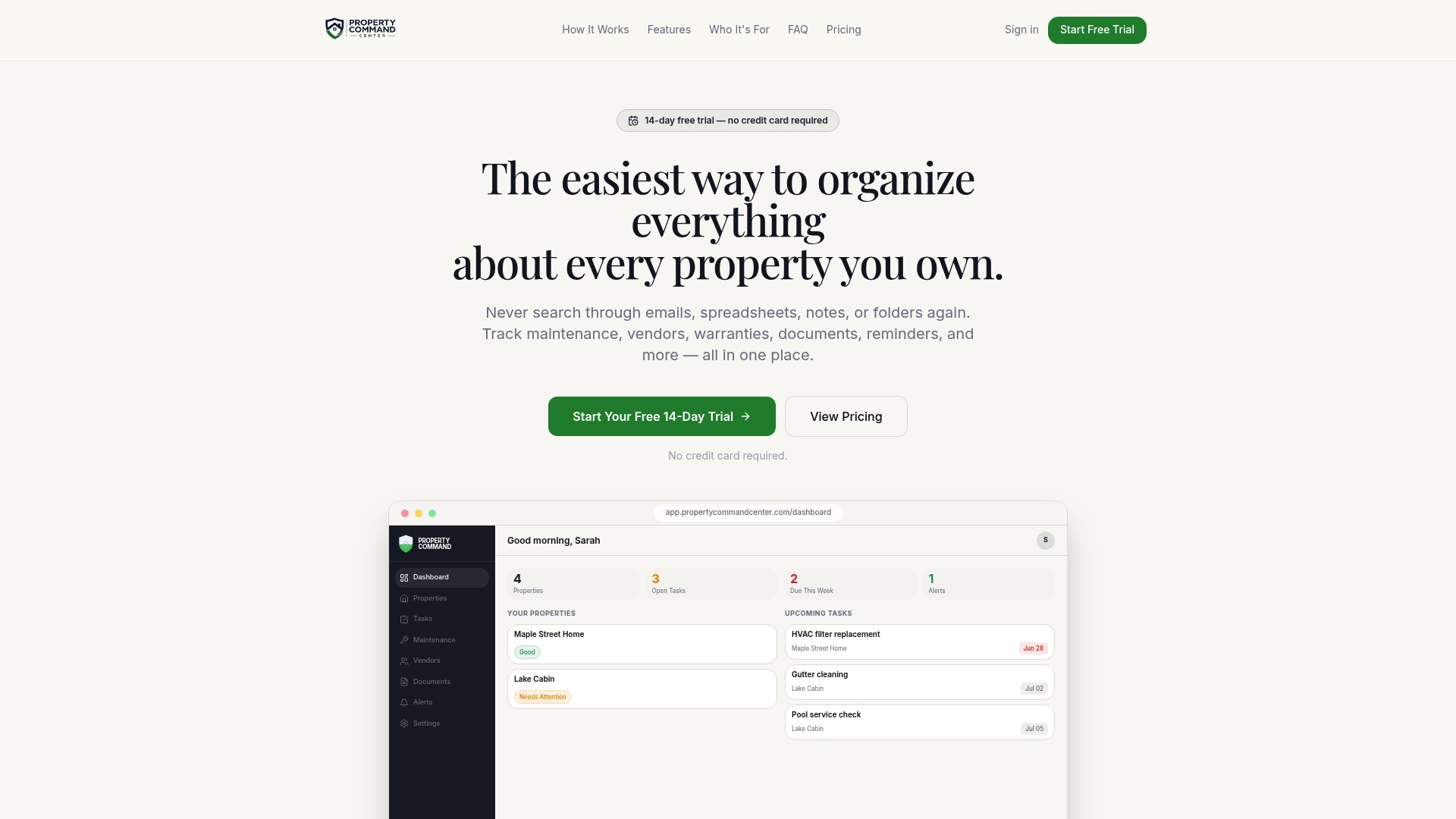
Plans are priced by the number of properties: Starter is $19 per month and Pro is $49 per month, and both start with a 14-day free trial that needs no credit card. See the pricing page to match a plan to your portfolio.
FAQ
What should I include in a storm prep checklist?
Cover supplies, home protection, documents, evacuation and recovery. For supplies, Ready.gov's basics are water, non-perishable food, a weather radio, flashlights, a first aid kit, batteries, cash and copies of important documents. Then add the house-specific work: trimming trees, clearing gutters, securing outdoor items and knowing your shutoffs.
What are the five P's of preparedness?
They are people and pets, prescriptions, papers, personal needs and priceless items, as described by the Arizona Emergency Information Network. Together they make a simple way to pack a go kit. Owners should treat "papers" broadly: policies, deeds, leases, warranties and a photo inventory for every property.
How much water and food do I need?
Official sources give a range. Ready.gov and FEMA say one gallon of water per person per day, for several days; FEMA's guide specifies 3, 7 or 14 days depending on where you live. NOAA recommends a minimum three-day supply of food, water and medicine per person, and the Red Cross suggests two weeks for staying at home.
When should I start preparing for hurricane season?
Before it begins. NOAA says the Atlantic and central Pacific season runs June 1 to November 30 and the eastern Pacific season runs May 15 to November 30. It advises buying supplies while shelves are stocked and reviewing insurance early, since flood insurance has a 30-day waiting period.
Should I shut off utilities before a storm?
Only if officials tell you to, according to FEMA. Know where your electricity, gas and water shutoffs are in advance, and never turn natural gas back on yourself after it has been shut off. Only professionals should do that.
Sources
- Build A Kit, Ready.gov
- Are You Ready? An In-Depth Guide to Citizen Preparedness, FEMA
- Prepare Before Hurricane Season, NOAA
- Preparedness Essentials, American Red Cross
- Six Ways to Prepare Your Home for a Hurricane, FEMA
- Preparing for a Winter Storm, CDC
- Preparing for Hurricanes or Other Tropical Storms, CDC
- Winter Weather, Ready.gov
- Prepare Your Home for Emergencies, Mass.gov
- How to Prepare for a Hurricane, FEMA
- Ready, Set, Go!, Arizona Emergency Information Network
- Louisiana Emergency Guide, GOHSEP
- Hurricane Guide 2025, National Weather Service
- Hurricane Prep for Seniors Who Live Alone
- Roof Debris HOA Letter