
A multi-home maintenance calendar works when every task lives with a specific property, repeats on a rule, has a named owner and leaves a record when it is done. Copy a generic checklist into one document and it fails by the second property, because each home has its own climate, systems, age and use. We built Property Command Center around that problem: one place where each property keeps its own tasks, vendors, documents and history, so the calendar is a view of what you already know.
This guide covers what belongs on the calendar, how to adjust it for each property, a sample year across three different homes, and how to keep it accurate after the first month.
TL;DR
- Build the calendar per property, not per task type. Each home gets its own recurring tasks, then you view them together by month.
- Start from a baseline: inspect each area at least every six months, check filters quarterly, and book heating and cooling service before each season.
- Adjust for climate, age, occupancy and rental use. A vacant mountain cabin and a year-round rental should not share a schedule.
- Give every task an owner, a reminder two weeks ahead and a place to log the result. A calendar without history cannot tell you what was missed.
- Review it once a year and cut what you ignored twice.
Table of Contents
- Why one calendar for all homes fails
- The baseline every property gets
- What the recurring jobs cost
- Adjust the calendar for each property
- A sample year across three different homes
- Tasks that get missed when you own more than one home
- Build the calendar in six steps
- Keep it current: reminders, sharing and history
- Our view
- Put your calendar in one place
- FAQ
- Sources
Why one calendar for all homes fails
A single home maintenance checklist assumes one roof, one furnace and one person walking through the door. With two or more properties, three things break.
First, timing collides. Spring AC service, gutter cleaning and roof checks all land in the same few weeks at every property, and the same local contractors get booked at once.
Second, context gets lost. You remember when the water heater was flushed at your primary home, but not at the lake house or the rental. The invoice is in an email, the warranty is in a drawer, and the vendor's number is in someone's phone.
Third, use differs. Experts quoted by AP News point out that homes are stressed differently at different times of year, so seasonal timing makes a big difference, though doing any preventive maintenance matters more than doing it perfectly. For an owner with several homes, that means the aim is a calendar you will actually follow, not a perfect one.

The baseline every property gets
Start each property with the same short baseline, then add to it. These intervals come from extension and industry guidance.
- Whole-property inspection. NC State Extension recommends inspecting the house and yard thoroughly at least once every 6 months, with every 3 months better. It suggests a system of one area per month, so each area gets regular attention without one giant weekend.
- Air filters. The National Association of Home Builders says to change air conditioning filters at least once every three months. Many owners check monthly and replace as needed.
- Smoke and CO detectors. The same NAHB guide says to check batteries twice a year and replace detectors every 10 years. Put the 10-year replacement on the property record with the install date.
- Heating and cooling service. NC State advises having these systems checked by a qualified service person at least once a year, before the heating or cooling season. It also notes that skipping manufacturer-recommended servicing may void warranties, which is a good reason to keep service records with the warranty.
- Roof and chimney. NAHB recommends a qualified roofer inspect the roof every three years, with skylights checked at the same time, and a CSIA-certified chimney sweep inspect the chimney annually, especially after heavy winter fire use.
- Plumbing and water. An insurer's checklist from Gallagher Personal Insurance lists monthly checks of HVAC filters, detectors and the fire extinguisher gauge, quarterly checks for leaks under sinks and around toilets, and an annual test of water pressure in the 40 to 60 PSI range.
For a full task-by-task list, our home maintenance checklist and month-by-month maintenance calendar cover what goes where.
What the recurring jobs cost
A calendar is also a budget. Opendoor's 2026 cost table gives typical US prices for the professional jobs most homes share:
| Job | Typical cost | How often |
|---|---|---|
| Full HVAC service | $150 to $300 | Annually (spring for AC, fall for heat) |
| Dryer vent deep cleaning | $100 to $170 | Annually |
| Water heater flush | $0 to $150 | Annually |
| CSIA-certified chimney inspection and sweep | $150 to $300 | Annually |
| Professional roof inspection | $150 to $400 | Every 3 years |
| Gutter cleaning | $100 to $250 per visit | Twice a year |
| Septic tank pumping | $300 to $500 | Every 3 to 5 years |
Multiply by the number of homes and the totals add up quickly. Redfin recommends budgeting 1% to 4% of a home's value per year for maintenance, adjusted for age, size and location. A 30-year-old house may need a roof or HVAC replacement sooner than one built in the last decade, and homes in extreme-weather areas wear faster. Put the expected cost on each recurring task so the calendar doubles as a yearly forecast per property.
Adjust the calendar for each property
The baseline is where you start. Four factors change it.
Climate
A home in a freeze zone needs fall winterizing and spring thaw checks. A coastal or hot-climate home needs more attention to AC, humidity and exterior wear. The same task moves by months depending on where the house sits. Your calendar should hold a date per property, not one date for the portfolio.
Age and systems
Older roofs, furnaces and water heaters deserve more frequent checks and an earlier replacement budget. Record the install year of each major system, and let the calendar flag it when a system reaches the age where you want a closer look.
Occupancy
A home that sits empty for weeks needs a different routine from one lived in daily. Pacaso's vacation home checklist suggests, before a long absence, turning off the main water supply or setting pipes to low flow, unplugging small appliances, adjusting the thermostat, arranging lawn, pool or periodic property checks, and using smart leak sensors and camera alerts while you are away.
Seasonal properties add costs that are easy to forget. A White Mountains second-home guide lists heating all winter even when nobody is there, a plowing contract signed in early fall, semi-annual property taxes, and house checks weekly or after storms, which some insurers expect for empty homes. Each of those is a calendar item.
Rental use
Rentals add turnover, guest-facing items and local rules. For short-term rentals, the cadence is tighter: quick checks between stays, a monthly pass, and deeper seasonal work. We lay this out in our guide to four cadences for short-term rental maintenance and the host maintenance calendar. Condo owners should also separate what they own from what the association handles, which our condo maintenance checklist walks through.
A sample year across three different homes
Imagine three properties: a primary home in a four-season climate, a lake cabin used mostly in summer, and a short-term rental condo. The same months carry very different work.
| Season | Primary home | Lake cabin | Rental condo |
|---|---|---|---|
| Spring | Book AC service, inspect roofline, gutters and foundation, clean drains | Thaw recovery: roof and exterior check, restart water, check for leaks, pest check | AC service before guest season, test detectors, deep clean and restock |
| Summer | Book heating service while contractors have openings, plan bigger projects | Peak use: quick check on arrival and departure, lawn and dock upkeep | Monthly walkthrough, filter check, appliance check between bookings |
| Fall | Furnace tune-up, replace filters, chimney check, clear vents | Winterize: drain or protect water lines, furnace service, chimney sweep, set plow contract | Heating service, gutters, detector batteries, review the next year's vendor list |
| Winter | Monthly filter checks, watch energy bills, respond to new sounds | Heat held at a safe minimum, scheduled house checks after storms | Quarterly leak and caulking check, pre-arrival checks for each stay |
The summer heating-service item comes from the 2026 year-round calendar by Laura Rosen, who notes that contractors have openings and prices are lower in summer, and that a system inspected in July leaves months of margin before cold weather. Use that logic to spread the pro visits across the year so you are not booking three properties in the same fall week.
For timing and how long each visit takes, see our guide to seasonal home maintenance.
Tasks that get missed when you own more than one home
Most missed items are not the big systems. They are the ones nobody sees.
- Empty-house routines. Water shutoff, thermostat minimums and periodic checks on homes that sit vacant.
- Seasonal contracts. Plowing, lawn, pool and snow removal agreements that need signing before the season, not during it.
- Insurance and tax dates. Seasonal or secondary classification can come with monitoring and heat requirements, and property taxes may be due twice a year.
- Warranty windows. Service intervals tied to warranties, such as the HVAC servicing noted above.
- Local rental rules. Short-term rental permits and licensing vary by city and county, so put renewal dates on the calendar and verify the rules with your local authority.
- Detector replacement. A 10-year replacement date is easy to lose if you never recorded the install date.
Build the calendar in six steps
- List each property and its systems. For each home, note HVAC type, water heater, roof material and age, appliances, pool or septic, and anything that sets it apart. This is the inventory the schedule hangs from.
- Write recurring rules, not one-off tasks. Instead of "service the furnace in October," write "furnace service, every fall, before heating season." The rule recreates the task every year.
- Set the interval for each property. Start with the baseline, then adjust for climate, age, occupancy and rental use as above.
- Name an owner for every task. That may be you, a spouse, a caretaker, a cleaner or a contractor. Laura Rosen's guidance is to name an owner for each task and set reminders two weeks early so there is time to book.
- Attach the vendor and the documents. The plumber's number, the warranty PDF and the last invoice should sit with the task, not in three different inboxes.
- Log the result. Record the date, who did the work, what they found and what it cost. Without the log you have a to-do list, not a maintenance history.
Our maintenance calendar setup guide starts with two checks to get this running quickly.
Keep it current: reminders, sharing and history
Most calendars die at the update stage. A few habits keep yours alive.
Mark work done where you can see it. When a vendor finishes, close the task and attach the invoice the same day. Our guide to tracking service history across multiple homes shows how six fields cover most of what you will want later: property, task, date, vendor, cost and notes or documents.
Share it with whoever helps. If a spouse, adult child or caretaker handles some properties, everyone needs the same view. Tools for coordinating recurring tasks across calendars help families keep schedules visible to each other, and our guide to a shared maintenance calendar for your family covers how to divide the work.
Review once a year. Laura Rosen suggests cutting anything you ignored twice, since the only realistic calendar is one that gets followed. Use that review to also adjust intervals after a property changes use, for example when a second home becomes a rental.

Track small portfolios without heavy software. If you own a handful of properties, you need tasks, history and reminders in one place, not rent roll and accounting features. See maintenance task tracking for small portfolios.
Our view
We built Property Command Center for owners who have the information but not the place to keep it. The warranty is in one folder, the vendor's number in an old email, the service history in a spreadsheet that was last updated two summers ago.
A multi-home calendar is only as good as the records behind it. When each property is a living record with its maintenance history, documents, vendors, tasks and reminders, the calendar stops being something you rebuild every January. It is a view of what you already know.
That is why we focus on property knowledge and organization, not on rent collection or tenant screening. Our Smart Setup is designed to help pull information out of the files, emails and spreadsheets you already have, and portfolio import lets you bring in several properties without typing each one by hand. Start with the records, and the calendar follows.
Francisco
Put your calendar in one place
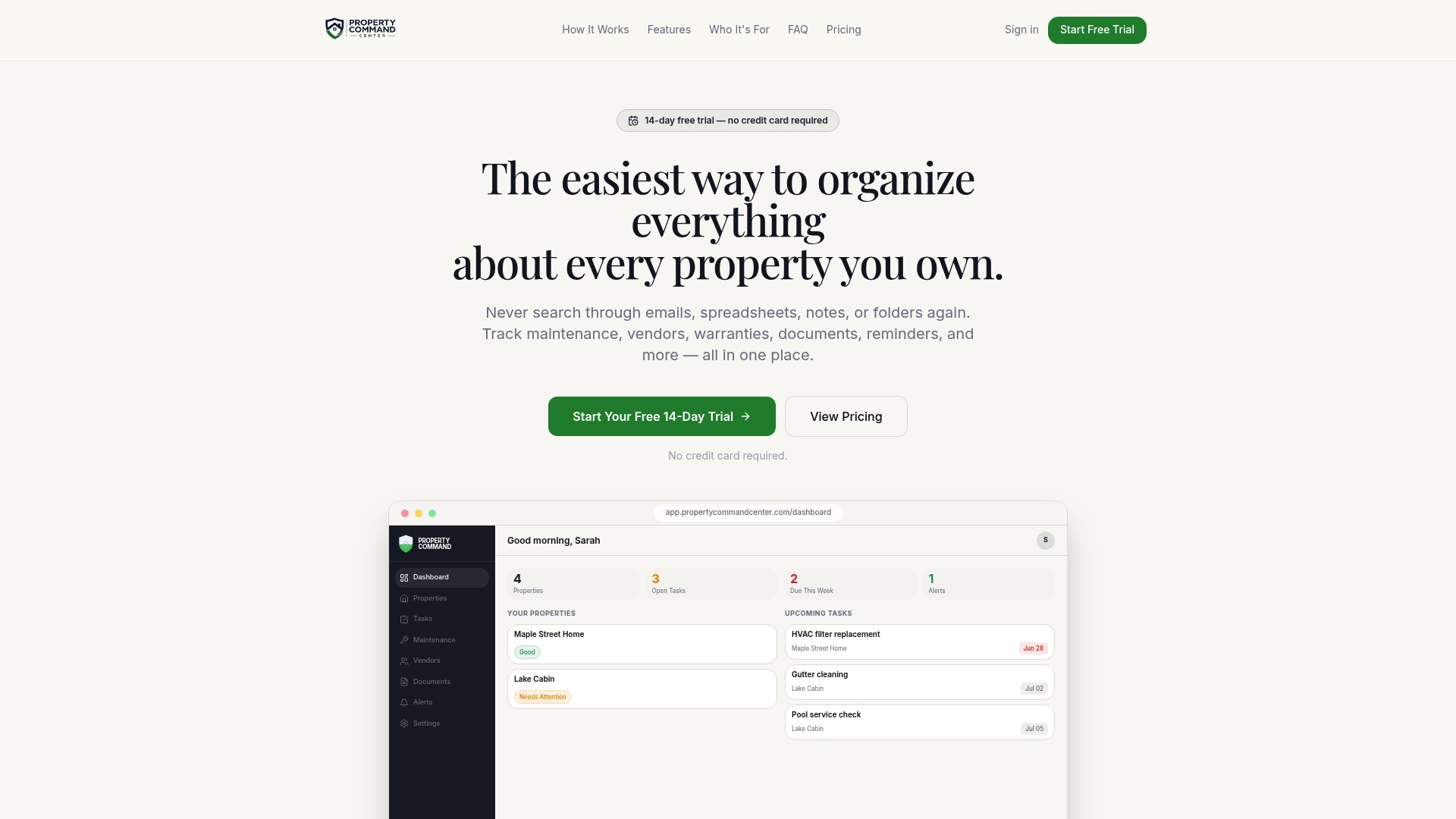
Property Command Center gives each property its own record for maintenance history, documents, vendors, tasks and reminders, with a dashboard across the portfolio. Plans are tiered by the number of properties: Starter is $19 per month and Pro is $49 per month, and you can start with a 14-day free trial without a credit card. When you are ready to bring in your first homes, the onboarding page is the place to begin.
FAQ
How often should I inspect each home?
NC State Extension recommends a thorough inspection of the house and yard at least every six months, and every three months is better. Splitting it so you inspect one area per month keeps the work small. Vacant or seasonal homes should also get periodic checks between visits.
Can one calendar cover a primary home, a vacation home and a rental?
Yes, as long as each property carries its own tasks and intervals and you view them together. The baseline is shared, but climate, occupancy and rental use change the timing. A single list for everything usually leaves the unusual homes underserved.
What should I record after each job?
Record the date, who did the work, what they found, any follow-up needed, the cost and the invoice or warranty document. That history lets you spot repeat problems, plan replacements and show what was done if you sell or file a claim.
How much should I budget for maintenance across several homes?
Redfin suggests 1% to 4% of each home's value per year, adjusted for age, size and location. Older homes and extreme climates sit toward the higher end. Add the recurring professional jobs from your calendar to see where your own number lands.
Sources
- Preventative Home Maintenance, NC State Extension
- Routine Home Maintenance, NAHB
- Start the new year right with expert home care tips, AP News
- Home Maintenance Checklist, Gallagher Personal Insurance
- Home Maintenance Checklist, Opendoor
- How to Budget for Home Maintenance, Redfin
- Building a Year-Round Maintenance Calendar That Actually Gets Followed, Fine Homes and Living
- Home maintenance checklist: The complete guide, Pacaso
- White Mountains Second Home: Costs, Insurance, Owl's Nest Real Estate