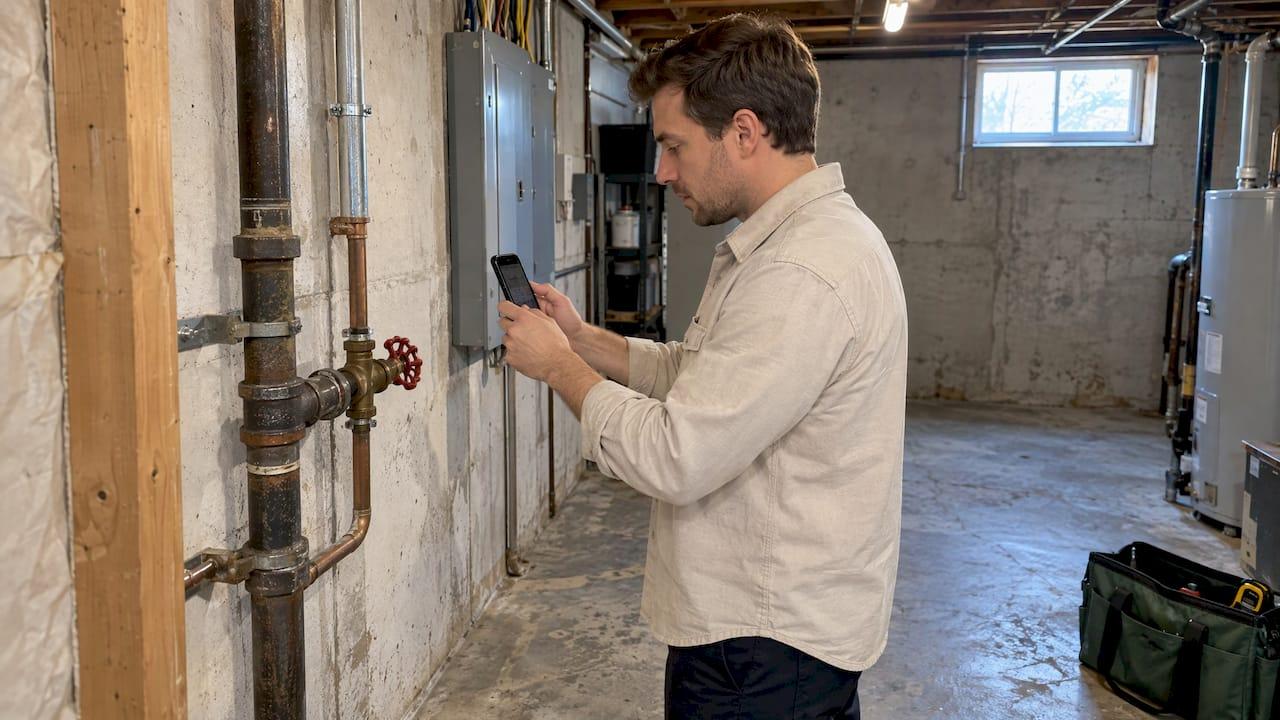
Property management is the work of keeping a property safe, maintained, documented and legally in order, whether you rent it for a year at a time, host guests by the night or visit it twice a summer. For an owner who manages their own homes, the basics come down to one skill: knowing what happened at each property, who did the work, where the paperwork is and what comes due next. Spreadsheets, email threads and a folder of PDFs can carry that for one property. Across several, it breaks, and that is where a single organized record for every property, like the one we build at Property Command Center, starts to pay for itself.
- ✓Maintenance history
- ✓Property documents
- ✓Vendor contacts
- ✓Tasks and reminders
TL;DR
- Property management has four recurring jobs: maintenance, vendors, records and compliance. Rent collection and leasing sit on top for long-term rentals, and guest operations sit on top for short-term rentals.
- Schedule maintenance at the start of each year, inspect at least annually, and log every request and its outcome.
- Keep one file per property holding documents, warranties, insurance, invoices and vendor contacts, so nothing depends on one person's memory or inbox.
- Rules differ by state and city, especially for short-term rentals. Check local requirements before you list or lease.
- Once you pass two or three properties, a single system beats scattered files. Our plans start at $19 per month, with a 14-day free trial and no credit card.
Table of Contents
- What property management means when you own the property
- The five basics of property management for self-managers
- What changes for vacation homes and short-term rentals
- Legal basics: know the layer you are in
- Where owners get stuck, and why
- A simple setup you can start this week
- Property Command Center: one record for every property
- Our perspective
- FAQ
- Sources
What property management means when you own the property
Most top search results describe property management as something a company does for an owner: a third party overseeing a building for a fee. That is one version. If you are a self-managing landlord, a second-home owner or an Airbnb host, you are the manager, and the job is the same list of duties without the staff.
The duties fall into a few groups:
- Physical upkeep: routine inspections, preventive maintenance and repairs.
- Vendors: the plumber, electrician, HVAC technician, cleaner and landscaper you call, and the way you schedule and pay them.
- Records: leases, insurance, warranties, manuals, invoices, permits and a history of what was done and when.
- Compliance and money: local rules, insurance, taxes and deposits, plus the budget for all of it.
- People: tenants or guests, and how fast and how clearly you respond to them.
The type of property changes the mix. Long-term rentals lean on leases, rent and renewals. Vacation and short-term rentals add frequent turnovers, cleaning schedules, guest messaging and local lodging rules. A vacation home you use yourself is mostly upkeep, vendors and being able to act from a distance. Same foundation, different emphasis.
The five basics of property management for self-managers
You will see lists of "P's" and "pillars" online. Rather than memorize one, build your routine around these five habits.
1. Know what you own, property by property
For each property, write down the fundamentals: address, parcel number, insurance policy and renewal date, mortgage servicer, any permit or license numbers, utility accounts and where the shutoffs are. Photograph the water shutoff, the electrical panel and the gas valve with labels. This takes an afternoon per property and saves hours during the first emergency.
2. Put maintenance on a calendar, not in your head
Fannie Mae's landlord guide advises marking the calendar at the start of each year to schedule maintenance and improvements, and inspecting every rental unit at least once a year, keeping copies of the completed checklists (Fannie Mae, Becoming a Landlord). Build on that with a recurring-task list where every item has an owner and a frequency. A reasonable starting set:
| Task | Typical frequency |
|---|---|
| HVAC filter change | Quarterly |
| Smoke and CO detector test | Twice a year |
| Gutter and roof check | Annually, plus after major storms |
| Water heater flush | Annually |
| Insurance and warranty review | Annually |
| Walk-through or inspection | At least once a year, twice for many single-family homes |
The frequencies are a sensible baseline, not a code. Adjust for climate, age of the home and what your insurer or local ordinance expects. Our guides on rental property maintenance schedules and recordkeeping and landlord safety inspections go deeper on what each visit should cover.
3. Log every request and every repair
A repair that is not written down did not happen, as far as a dispute is concerned. Fannie Mae recommends written repair and maintenance policies, a complaint log, and a file for each unit that holds the complaints, repair requests and responses. The American Association of Landlords adds that you should track requests and their resolution dates, keep invoices and before-and-after photos, and give proper notice before entering a unit, since unauthorized entry is a quick way to create liability (AAOL, Becoming a Landlord for the First Time).
The log needs only a few fields: date, property, what was reported, who was called, what it cost, the date it was closed, and where the photos and invoice live. Review it monthly and chase anything that has sat open too long.

4. Build a vendor bench before you need it
The worst time to find an electrician is when the power is out. AAOL recommends having preferred vendors ready for plumbing, electrical, HVAC and pest control. For each one, record the name, phone number, trade, service area, after-hours availability, how they invoice and who is allowed to call them. If you own a second home or a rental in another town, a local backup per trade matters even more.
Set a spend threshold in writing: the amount below which a cleaner, co-host or handyman can act without asking you, and the amount above which they must. A number in writing avoids the most common argument between owners and the people helping them. Our guides on vendor coverage plans and emergency home contacts lay out how to organize that bench, including a backup for each trade.
5. Keep the paperwork where you can find it
What to keep depends on the property: leases and addenda, insurance policies and certificates, warranties and manuals, appliance serial numbers, permits, inspection reports, vendor invoices, tax documents and photos. The rule that matters is that every document is filed under the property it belongs to, within days of arriving, in a place that is not just your inbox. Retention periods vary by document type and by state, so ask your accountant or attorney how long to hold tax, lease and deposit records in your state. Our rental document checklist lists the items to collect at each turnover.
What changes for vacation homes and short-term rentals
If you host guests or leave a house empty for weeks, the basics stay the same but the timing tightens.
- Turnovers are maintenance events. Every checkout is a chance to spot a failing lock, a stained mattress or a leaking fixture. A repeatable turnover inspection catches problems before the next guest does. Our vacation rental inspection checklist uses a two-layer check for exactly this.
- Service schedules multiply. Cleaners, linen, landscaping, pool service, snow removal, lock batteries: more vendors, more dates, more handoffs.
- Local rules decide whether you can operate at all. Nolo's First-Time Landlord guide notes that many municipalities, including New York City, San Francisco and New Orleans, restrict short-term home rentals, and that registration, licensing and tax rules vary widely from place to place (Nolo). If your city is not obviously covered by your listing platform's guidance, call the local zoning board or housing authority before you accept a booking.
- Distance raises the stakes. A second home several hours away needs a documented plan for who checks it after a storm and who can authorize a repair. See our long-distance landlord maintenance SOPs and 60-minute emergency maintenance plan.
If you also need to promote a property, a look at real estate marketing agencies compared will help you weigh the options for getting listings in front of renters or buyers.
Legal basics: know the layer you are in
Property rules stack: federal law, then state landlord-tenant law, then county or city ordinances. Federal fair housing rules apply to renters nationwide. State law typically governs deposits, notice periods and entry. Cities often add rental registration, lodging taxes and short-term rental permits.
Three habits keep you on safe ground:
- Keep the house habitable. Landlords are responsible for maintaining a property to applicable safety and health standards, as the Fannie Mae guide puts it. Prompt repairs and a written record of them are your protection.
- Give notice before you enter. Follow your state's notice rules every time, even for a quick check.
- Look up your own city and state. Do not rely on a national summary. Your state attorney general, housing agency or city licensing office publishes the current rules, and a local real estate attorney can confirm how they apply to you, especially if you hold properties in an LLC or plan to evict.
This article gives general information, not legal advice. For deposit disputes, evictions and permit questions, a landlord-tenant attorney in your state is the right person to ask.
Where owners get stuck, and why
Most self-managers do not fail at fixing things. They fail at remembering them. The roof was replaced in which year? Which company installed the water heater, and is it still under warranty? Which cleaner has the lock code for the lake house? The answers exist, but in a spreadsheet tab, a three-year-old email, a photo on a phone and a PDF in a downloads folder.
The usual fixes are a master spreadsheet and a shared drive. They work until the second or third property, when the folder structures drift, tabs go stale and nobody can say which version is current. Reminders live in a different app from the records they refer to. The cost shows up as a missed filter change, a lapsed warranty claim or a frantic search during an emergency.
The fix is not more discipline. It is a system where the record, the reminder and the document live together, per property.
A simple setup you can start this week
- List every property with its fundamentals (see habit 1 above).
- Gather what already exists: policies, warranties, manuals, invoices, vendor emails, inspection reports.
- Create one record per property with sections for maintenance history, documents, vendors and tasks.
- Load the recurring tasks with owners and frequencies, and put a first-of-the-year review on the calendar.
- Write down your spend threshold and an emergency contact order for each property.
- Set a monthly 20-minute review: open items, upcoming tasks, expiring documents.
Our self-managing rentals checklist and 90-day plan for landlord maintenance responsibilities turn this into a week-by-week sequence.
The hard part is step 2 and 3: pulling years of scattered material into one structure. This is where Property Command Center does the heavy lifting. Our Smart Setup uses AI to help extract and organize information from your existing files, emails and spreadsheets, and portfolio import tools let you bring in several properties without typing each one separately.
Property Command Center: one record for every property

Property Command Center is built for owners who manage their own homes, vacation properties and rentals, not for property management companies. Each property becomes a living record holding its maintenance history, documents, vendors, tasks and reminders, with a dashboard showing property status across your portfolio, a vendor directory, and a document vault for warranties, manuals and insurance. We focus on property knowledge and organization rather than rent collection, tenant screening or accounting.
Plans are priced by the number of properties you manage: Starter is $19 per month and Pro is $49 per month, and every account begins with a 14-day free trial that needs no credit card. See the pricing page for what each plan covers, or start from the Property Command Center home page.
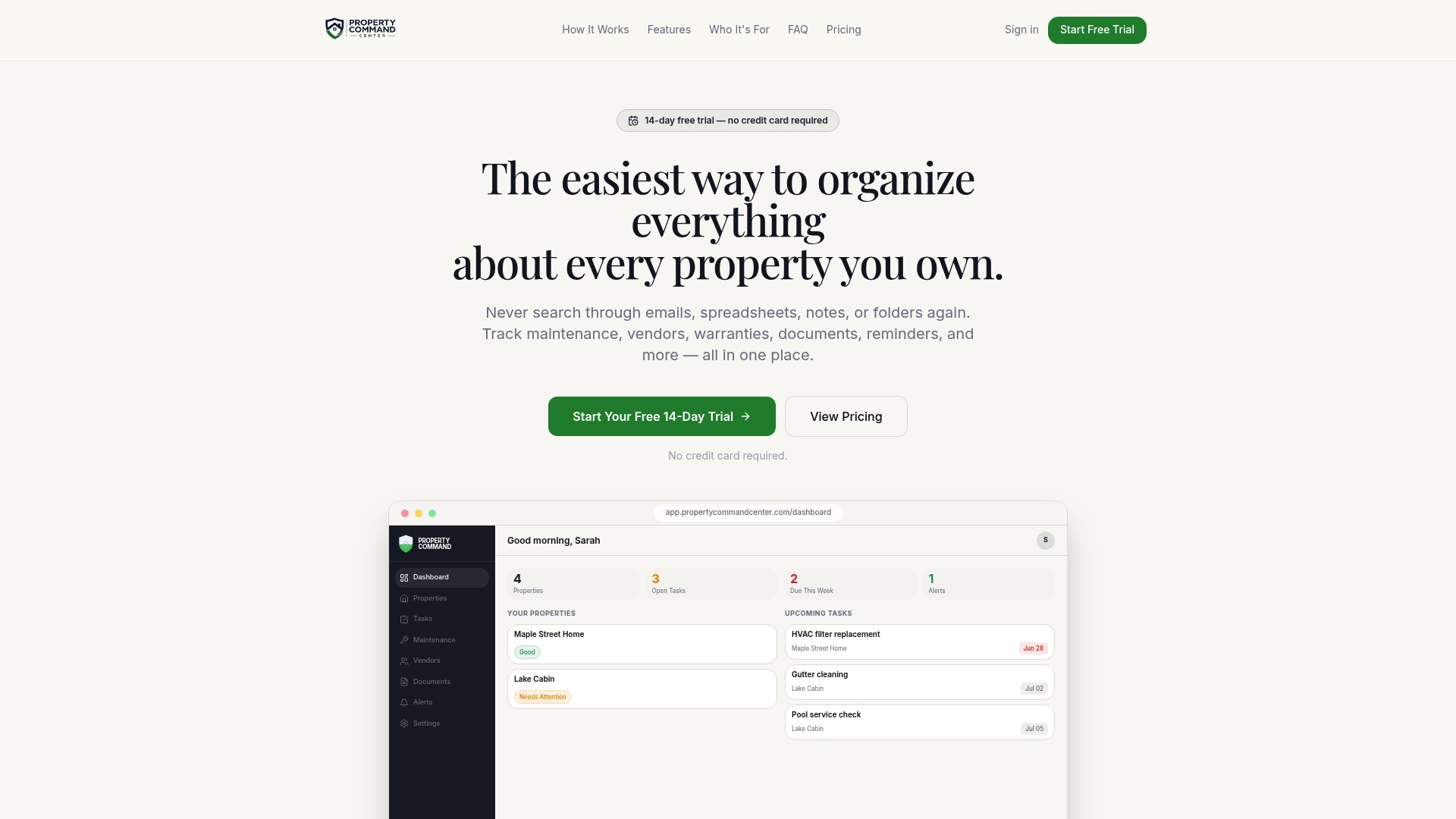
If your vendors are the part that lives in your phone contacts, the vendor directory shows how we keep them attached to each property.
Our perspective
Owners tell us the same thing in different words: "I know I have the answer somewhere." The warranty is in an email. The painter's name is in a text. The last inspection is a PDF from two laptops ago.
We built Property Command Center on one idea: the information is not missing, it is scattered. You do not need to start over or retype years of records. You need a place that gathers what you already have and keeps it attached to the right property.
That is why our Smart Setup starts from your existing spreadsheets, files and emails, and why each property becomes a living record rather than a form you fill out once. Maintenance history, vendors, documents and reminders sit together, so when something breaks at 9 p.m. you see who fixed it last time and what is under warranty, not a folder of guesses.
Property management basics are not complicated. They are repetitive. A system that remembers for you makes the repetition manageable, whether you own two properties or twelve.
Francisco
FAQ
What are the basics of property management?
The basics are maintenance, vendor coordination, record keeping and legal compliance, with leasing and rent collection added for long-term rentals and guest operations added for short-term rentals. Build a yearly maintenance calendar, log every request and repair, keep a vetted vendor list, and file documents by property. Check state and local rules for your property type.
Do I need a license to manage my own property?
Owners generally manage their own property without a property manager license, but licensing rules for managing property for others, and permit rules for short-term rentals, are set by state and city. Confirm with your state real estate regulator and your local licensing office. A landlord-tenant attorney can advise on your situation, especially if the property is held in an LLC.
How often should I inspect a rental or vacation home?
Fannie Mae advises inspecting rental units at least once a year, and many owners of single-family homes walk the property in spring and fall. Vacation rentals benefit from a quick inspection at every turnover. Always follow your state's notice requirements before entering an occupied rental.
What documents should I keep for each property?
Keep leases, insurance policies, warranties and manuals, permits, inspection reports, maintenance invoices, photos and vendor details in one file per property. Ask your accountant or attorney how long to retain tax, lease and deposit records in your state.
When should I move from spreadsheets to dedicated software?
Usually when you add a second or third property, or when you catch yourself searching email for a warranty or vendor. A tool such as Property Command Center, which starts at $19 per month after a 14-day free trial, keeps records, reminders and vendors together so the information scales with your portfolio.
Sources
- Fannie Mae, Becoming a Landlord
- American Association of Landlords, Becoming a Landlord for the First Time
- Nolo, First-Time Landlord